
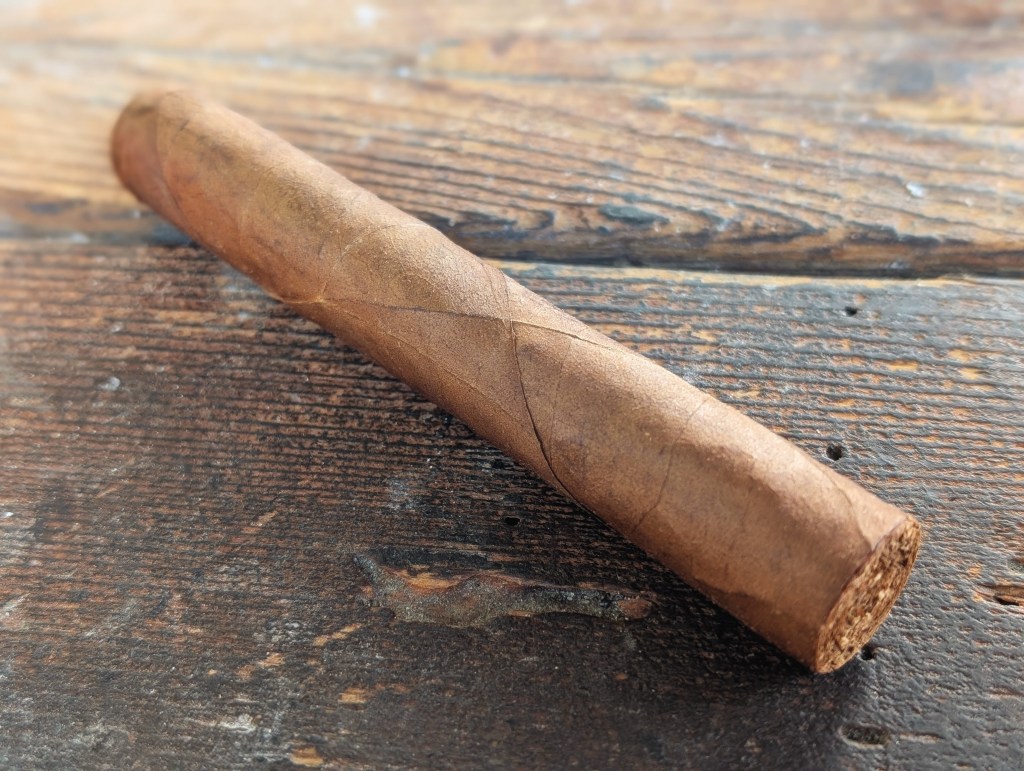
This review is a little different because you can’t buy this cigar at retail. I got it at a Puros Mantis rolling event. My ultimate purpose in reviewing this cigar was to give a real-life account of the difference between smoking the blend fresh and smoking it after two months of age to prove out what marrying does to a cigar.
Attending a cigar-rolling event is like that old joke: What’s the difference between a hooker and a Rolls-Royce? Not everyone’s been in a Rolls-Royce. That’s especially true where I live in the San Francisco Bay Area. Though a few companies provide live cigar rolling, in all my time living here, I’ve attended only one event with a live roller. That was at the Dunamis launch this past July at Morgan Hill Cigar and Wine.
Luis Barragan brought in Andrew Wong of Puros Mantis, a San Jose event service specializing in live cigar rolling. I met Andrew earlier this year, but I hadn’t tried his cigars before the launch. I didn’t get a chance to sample his wares there because attendees were snatching them up before I could get one.
Fortunately, Andrew holds occasional pairing events to showcase his blends and promote his rolling service. I attended his Italian wine pairing a couple of months ago. My intent was simply to hang out with friends and drink Italian wine. The modest fee covered two cigars and a tasting of four different wines. Before I left, Andrew gave me a couple of extra sticks because he wanted to know what I thought of them.
Andrew also told me that if I didn’t smoke them within the next couple of days, I’d have to wait several weeks before they’d be ready because they needed to marry. That was really interesting to me and got me thinking about the cigar-aging process, which led me to research and eventually write Cigars Need Time to Marry.
It has been a couple of months since the event, so it’s time to write a review. Andrew gave me two sticks: a Corona and a Toro. I’m reviewing the Corona here.
The leaf stats are as follows:
Wrapper: Ecuador Habano
Binder: Ecuador Habano
Filler: seco: Nicaragua (Condega/Jalapa); viso: Nicaragua (Estelí) and Dominican Republic (Piloto Cubano); ligero: Nicaragua (Jalapa)
Blender: Andrew Wong/Puros Mantis
It’s a complex filler mix, and I thank Andrew for giving me the specifics on the blend. While we usually see country and region in blend stats, rarely do we get to see the primings used, so this is a treat.
And speaking of treats, I smoked two of these at the event and they were fantastic. I’m excited to smoke it now with two months of age.
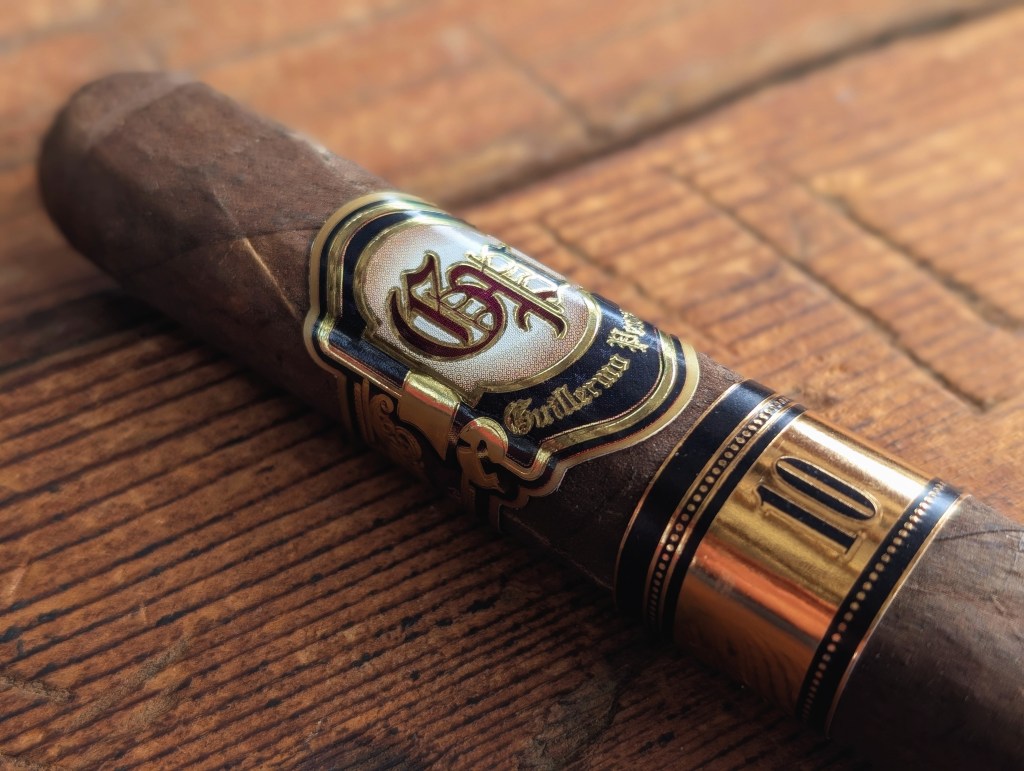
Inspecting the cigar, the wrapper looks rustic, with veins running across its surface, but it also has a gorgeous sheen of oil. The cigar is packed, and the bunch at the foot looks even and consistent. The wrapper carries a hint of barnyard beneath a subtle floral and perfumy sweetness, while the foot gives off shortbread, dried fruit, and rich tobacco. The cold draw is perfect, with just the right amount of resistance.
From the first puff, this cigar is far better and much more powerful than I remember the fresh cigars being. I don’t remember their exact flavor profile, but this start is declarative: black coffee, black pepper, and burnt cedar. A couple of puffs later, cream arrives and underscores the coffee, pepper, and cedar, accompanied by a subtle background sweetness. Teak wood appears on the retrohale, giving the profile an exotic feel.
By the first half-inch, a little nicotine sneaks in. It’s enough to add some energy without making me euphoric. The core is now confirmed as coffee, black pepper, cedar, and cream. At ignition, the coffee, pepper, and cedar were dark and pronounced. They’ve lightened up and become much more balanced.
As the cigar progresses through the first half, I’m reminded of something that struck me when I smoked the fresh sticks: a sense of internal energy. I mentioned it to my companions at the time, and that energy has been preserved in this aged stick. It feels so alive. The aromas coming off the foot are intoxicating, filled with cedar, dried sweetgrass, and baking spices.
Those baking spices enter the flavor profile as clove, nutmeg, cardamom, and allspice. The profile is complex, but it’s difficult to pin down everything because the flavors are cycling too quickly for me to process. Despite all that’s happening, the cigar remains incredibly balanced and composed.
There’s not much spice, which normally acts as a counterpoint and helps me pick things out. It’s so light here that I don’t have that familiar anchor point. To be clear, that’s not a negative mark. Beyond the core, I can pick out baking spices, nougat, malt, caramel, vanilla, cashew, hazelnut, oak, leather, and sweet corn. That last one is new for me, but it’s unmistakable.
Yeah, this is a flavor bomb.
I don’t know the exact proportions of the filler, but I’m loving what Andrew did. There’s enough ligero to give the cigar some oomph and energy. The Nicaraguan seco and viso seem to be providing the rich aromatics, structure, and Nicaraguan boldness. The interesting component is the Piloto Cubano, which seems to round out and mitigate the Nicaraguan leaves. I may be talking out of my ass, but whether I’m right or not, what this blend produces is nothing short of amazing in flavor.
At the halfway mark, the body becomes thick and rich. The smoke is luxurious, luscious, and velvety smooth. Spice finally steps up, but it’s a light touch that simply sits on my tongue. The profile compresses, and I can feel the strength edging up past medium.
That compression brings everything closer together, but it also makes the flavors pop. The intensity is amazing. If this was a flavor bomb during the first half, it has now gone ballistic. Amazing energy!
Moving into the second half, there’s no respite. The profile continues to intensify and begins taking a darker turn. The coffee becomes espresso, the black pepper grows stronger, the cedar chars, and the cream thickens. Baking spices dominate the secondary layer, now tasting as if they’ve been pan-roasted. They’re intense and aromatic. Despite all of this, the strength is medium-plus at best, so I’m not getting bowled over.
With a couple of inches remaining, the spice finally begins asserting itself. It’s pronounced as I inhale but quickly settles to a comfortable level on the finish. A pleasant mineral astringency joins it there.
All the sweet elements have abandoned ship. That doesn’t mean the profile has become savory. The sweetness is simply no longer present. Strength is now pushing toward full as the profile becomes more compressed and focused. The retrohale fills with gorgeous bread-like elements. Sourdough leads the way before resolving into a broader yeasty bread note. It’s a welcome contrast to the overall darkness of the profile.
As I near the last inch, the profile is all core. It hasn’t compressed any further, though the spice continues to grow in intensity and now coats my entire mouth. I’m content to ride it out to the end.
While the fresh smokes were delicious, what this cigar has become after a couple of months of aging is simply amazing. It’s far more structured, composed, and coherent. A fresh roll gives you a reference for how well the leaves play together, but aging brings everything together. How this blend developed over time makes me think Andrew should have his own commercial brand.
Rating: 95
I know, I know. You can’t get any of these unless you’re in the Bay Area and attend one of Andrew’s events. I can’t even give you a price for this stick because Andrew charges an hourly rate, so the price per stick depends heavily on the contract.
But that said, this review was less about presenting you with something you can buy and more about proving out the effects of marrying. If you make it to one of Andrew’s events, smoke one fresh and take another home. Then wait. The second cigar will tell you why.
If you’re in the Bay Area, Andrew is available for future bookings. He also holds tasting and pairing events to showcase his work. Check out Puros Mantis for his event schedule and for a consultation.




Leave a comment