
Wrapper: Sun-grown Corojo
Binder: Undisclosed
Filler: Undisclosed
Size: Double Figurado (6 x 58)
Strength: Just shy of Medium → Medium (last inch)
Body: Full (last couple of inches)
Price: $6.00 per cigar ($149.95 per 25-count bundle, Atlantic Cigar)
Factory: La Aurora, Dominican Republic
Blender: Manuel Inoa
Release: Available by October 2026
Smoking Time: 1 hour 35 minutes
Experience Rating: 98
When I wrote my first impressions of the Special Batch Maduro a week after it arrived, I wrote that it wasn’t ready to smoke. On the other hand, I got the Corojo at the same time, and I could’ve easily written a review of it.
Everything seemed integrated and harmonious with no elbows out nor sharp edges. There was movement and energy in the profile. But I still waited because I wanted to see where it would go.
I have to come clean. I smoked one of each every week since then to check if they were ready. The Maduro is now ready. This one has improved even more with a month of rest.
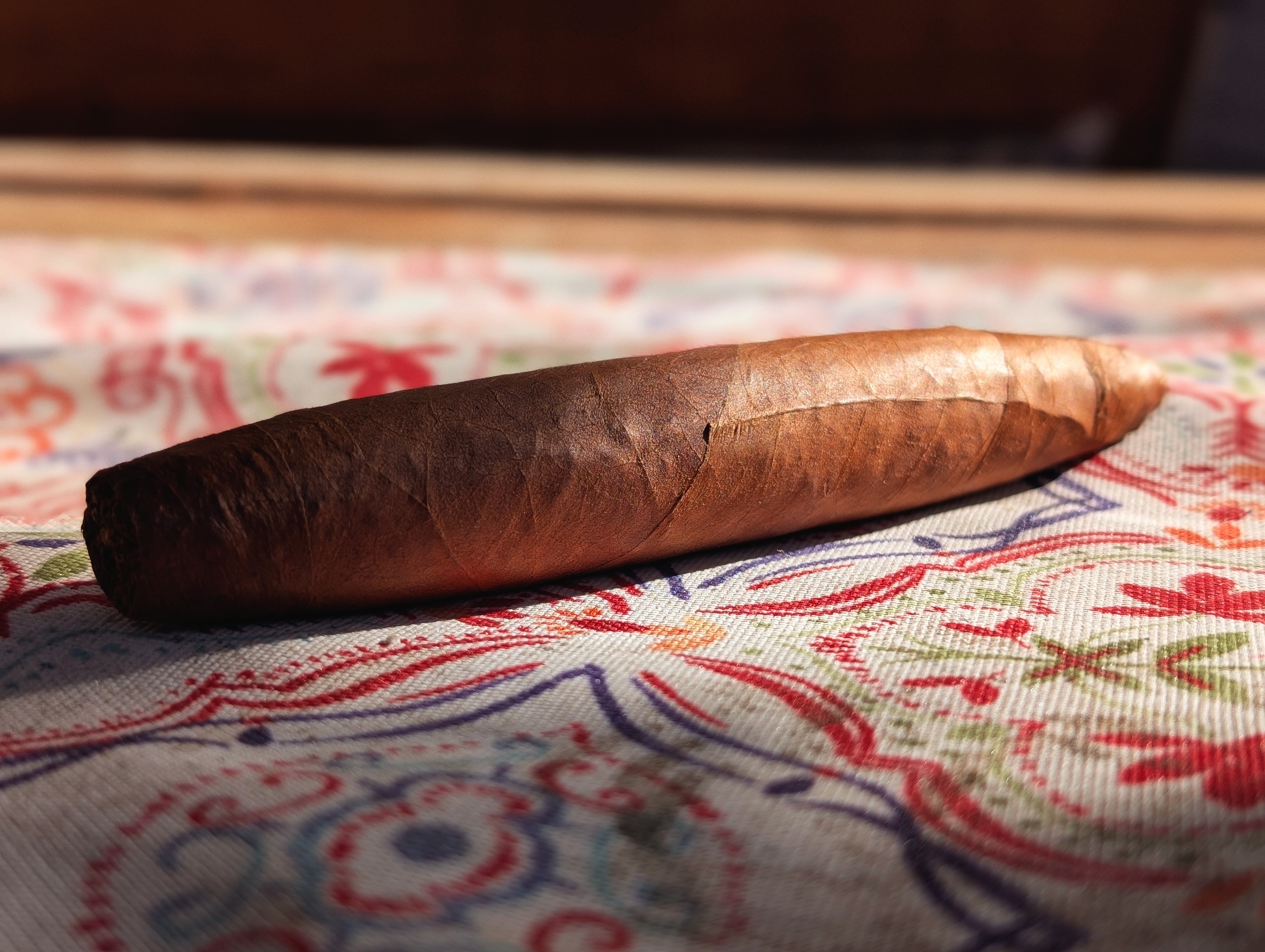
Man, I just love the Perfecto vitola. Done right, it provides an ever-changing experience over the course of the smoke. The cigar feels light in weight, but the roll is solid with just a little give. The veins are visible, and the rolling job is a little rough, but it’s even. Rolling it between my fingers in the sunlight shows minuscule dots of crystallization. The skin feels like felt.
The wrapper smells of barnyard with a touch of sourdough bread and a hint of sweetness, while the foot, however small the opening, reminds me of my wife’s peach cobbler.
The draw is open with a slight resistance. When I first smoked it almost a month ago, the draw was much tighter. Over the last few weeks, it has opened up. It needed time to equalize and get rid of the excess moisture. With the draw opening up, I felt the flavors come alive, even though the younger cigar was already quite tasty.
I always challenge myself to light as little of the foot as possible when smoking Perfectos. This way I can get the full experience. The opening is lovely with baking spices, shortbread, and gorgeous sweetness that punctuates the finish.
A couple of puffs in, light coffee with cream appears alongside a subtle spice that gently lies on my tongue. A slight retrohale brings out the baking spices of nutmeg and cinnamon. Fresh-baked, yeasty bread adorns the profile, and the spice intensifies slightly. This is classic Corojo spice that simply glows.
The complexity at the start is remarkable.
As I get about half an inch in, strength is a tad shy of medium, and the cigar, even at this early stage, produces thick white clouds of smoke with every puff. I don’t feel a core forming, but the cigar isn’t misbehaving either. Everything feels orderly as the cigar seems to be in accumulation mode right now. As I hit the one-inch mark, cashew and almond arrive with a little charred cedar.
As I get into the first half proper, the spice and cream have an interesting interplay, pulling against each other. The cream wants to ground the profile, while the spice gives it a forward pull as it settles on the front top of my mouth.
I don’t know why I think this, but the profile has a sensual, romantic quality, and it reminds me of this chill, sexy, mellow song called Frente al Mar by Brisa Flamenca. I temporarily get lost in the song and forget about the cigar. It’s a great pairing, as I remember to keep the cigar lit.
As I near the end of the first third, a core of light coffee, roasted cashew, baking spices, and cream finally forms as the cigar approaches its full diameter and all the tobaccos can express themselves. There’s incredible structure in the profile, but it doesn’t feel rigid. It’s just nicely composed and well-mannered.
Floral notes appear with a light citrus character on the finish. This is followed by shortbread cookies and sweet bread. The complexity of the profile is remarkable, but it’s presented as a light touch rather than overt. It’s hard to describe. It’s not as if it’s subtle because taking a close look reveals how complex it is, but it’s not at all forceful.
I think a lot of that has to do with the strength of the cigar. Despite having a nice, thick body, the strength is amazingly moderate. I don’t feel any pressure at all. It really flows like Frente al Mar.
One thing I have loved about this smoke is that there’s no heavy aftertaste on the finish. It’s like Manuel Inoa purposely didn’t want anything in the profile to stick out. It’s amazing to me because the cigar’s taper ensures the smoke is concentrated when it hits the mouth.
I hit the midpoint, and gorgeous but subtle tropical fruits of pineapple and mango appear on the finish. The coffee asserts itself a little by stepping forward and becoming slightly darker. The spice still has an amazingly light touch, and continues to pull the profile forward.
As I enter into the second half, the whole core seems to step forward as the coffee, baking spices, cashew, and cedar become a little more pronounced, and the cream thickens. And with that, subtle savory elements suddenly appear in the form of umami, grilled and heavily marbled skirt steak. The steak feels covered in a gorgeous au poivre sauce, with fresh cracked black pepper and salty capers.
Deeper into the second third, the burn rate slows way down. It took me less than 45 minutes to reach the midpoint, but as the cigar loads, it slows combustion. And as with the three other cigars I smoked, including the one I smoked yesterday, this is the point where everything seems to come together. The cigar was always composed, but it now feels complete. If it offers nothing else beyond that, I’d be content and satisfied.
I’m loving the savory aspects of the profile as shiitake mushroom enters. But the cool thing about the profile is that the flavors seem compartmentalized as it begins shifting between combinations of flavors. But they’re complementary to each other. For instance, tropical fruit with sweet bread and cream, grilled steak with mushrooms in au poivre, and baking spices with shortbread cookies.
I can really liken this movement to Frente al Mar. The song employs a repeating chord progression, with different melody lines and themes played on top of it. The core is like that repeating chord progression, and the flavor combinations cycle like the various themes played on top of it. They’re all in the same musical key, but they’re expressed completely differently.
The funny thing about Brisa Flamenca is that I think it’s AI-generated. I don’t want to take away from the beauty of the music. It’s just that the musician in me recognized an interesting pattern in the composition.
As I reach the final third, the transitions have slowed, and the body is full. Strength is barely medium, still allowing me to immerse myself in the experience without being overwhelmed. The profile begins to darken and then, out of nowhere, dark, ripe stone fruit appears on the finish with all its juicy goodness. Wow!
In the last inch, strength is now a solid medium. The spice has moved to my lips, and it sits there pulsing like a lighthouse in the distance.
I’m really getting a nautical theme with the profile now, and it reminds me of the Cayman Mariner. Combined with the beautiful flamenco music playing quietly in the background, I envision myself on a sailboat in the Caribbean with the breeze flowing through my hair, sipping a glass of Champagne.
I didn’t expect this kind of response, given the darker turn of the profile, but there’s so much lift. It’s putting me in my happy place, and I’m just enjoying the ride to the end.
In a recent interview, Daniel Lance spoke about long-aged tobacco as being depleted. I have to admit that it bugged me because it made me ask the question. Why would makers use it if it’s depleted?
Padrón ages the tobacco for its Family Reserve ten years before blending. The La Aurora Small Batch No. 008 uses fourteen-year-old tobacco. La Aurora aged the No. 006 for about fourteen years after rolling, and Cigar Aficionado reported that some of the tobacco in it was nineteen years old at release.
Maybe from a commercial trade perspective, where someone just wanted to purchase a bale of aged tobacco, it would make sense to call that tobacco depleted. Lance called 18 to 36 months prime and said buyers tend to offer less once tobacco gets past about five years. But there are plenty of makers out there that are aging tobacco much longer than what he mentions as the optimal age.
With respect to this Special Batch Corojo, it’s using ten-year-old tobacco. We don’t know if all the leaves are ten years old, but Manuel Inoa certainly found something in that long-aged leaf that had appealing characteristics. And those characteristics deliver what I can call a sublime, totally satisfying experience.
And if I were to give the Special Batch 10-Year Corojo a word, it would be triumphant.
You can buy this at Atlantic Cigar. It’s a steal at $149.95, but it’s an even better deal at $139.95 if you have a VIP membership. I don’t get paid to endorse the VIP program, but I have gotten more than my money’s worth since joining the program. This particular deal may not be a lot better than the normal price, but I’ve realized hundreds of dollars in savings.





Leave a Reply