
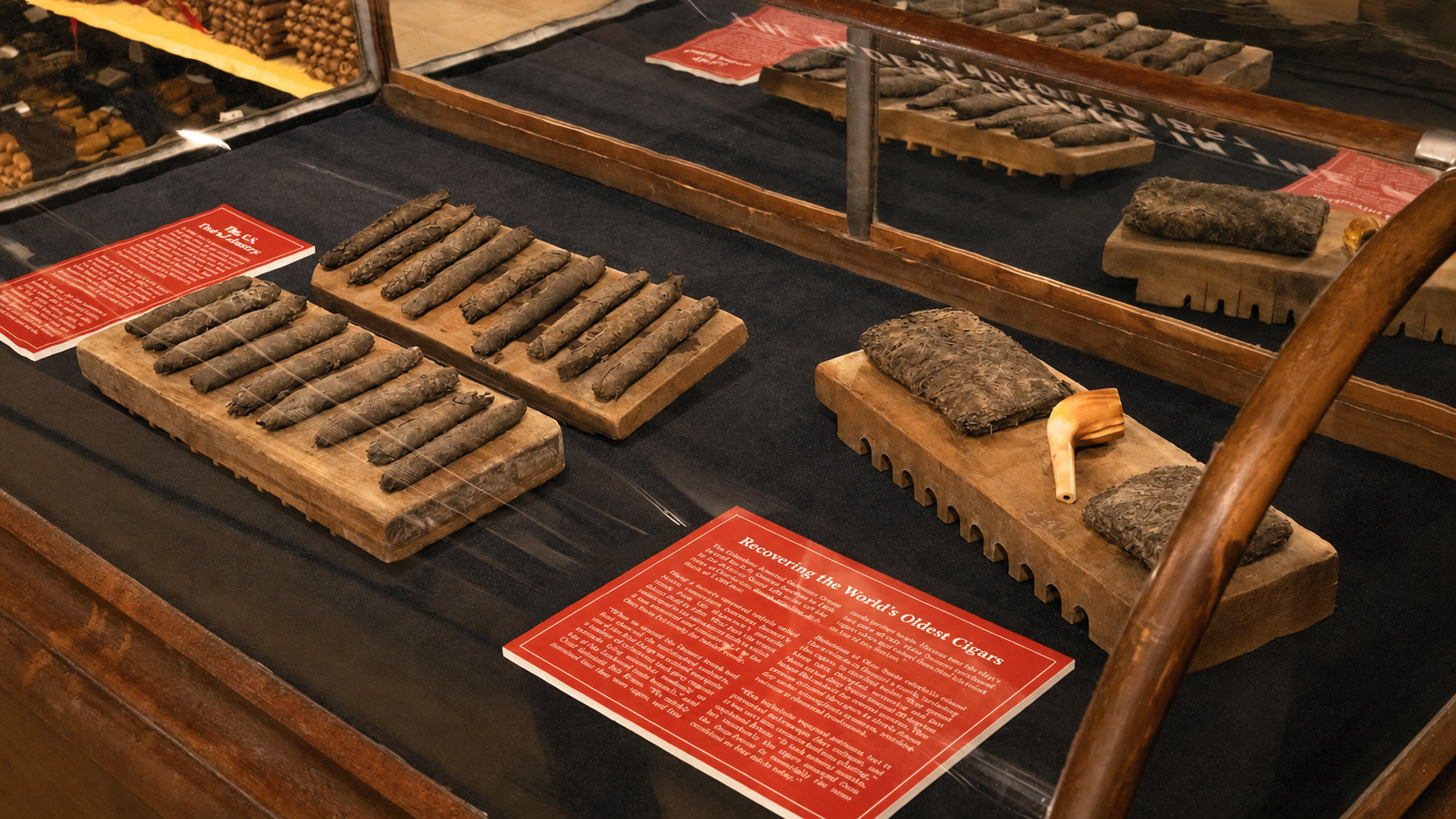
When I went to Bay Briar Shoppe to peruse their selection of vintage cigars, I saw some from the 1890s and early 1900s that looked pretty rough. They were all about the same length, but looked like fatter Backwoods Smokes.
To call them rustic would be a compliment.
Seeing those cigars left me with a lingering question: Were cigars back then typically that rough? That got me curious about the process itself. How were cigars rolled back then, and what did it take to make them consistently?
Although cigar molds were in use by the mid-1850s, their adoption in the United States took place over decades. They began entering American production around 1870, but the older method continued alongside them. In Tampa’s Ybor City, the transition to widespread mold use came around 1910.
Before molds, a single roller constructed the entire cigar. They selected and arranged the filler, formed the bunch in their hand, rolled it into the binder, then applied the wrapper and finished the head. The shape came from their hands, with a board and a curved knife as their principal tools.
Consistency was in the hands of that single roller.
Getting the amount of tobacco right, distributing it evenly, and reproducing the same shape and diameter cigar after cigar depended on their skill and experience. A mold would eventually provide a repeatable form for the bunch. Without one, the roller had to create that form themselves, every time.
Look at the title image. These cigars are on display at J.C. Newman’s El Reloj cigar factory and museum in Tampa. They were recovered from a passenger’s trunk aboard the S.S. Central America, which sank in 1857. The passenger had bought them during a stop in Havana.
Though most are degraded, you can still see that many share the same basic shape. The finish varies from cigar to cigar. Even so, imagine the skill it took to achieve that level of consistency entirely by hand.
Looking at those cigars, a thought comes to mind: We like to think of our beautiful cigars as artisan, but before molds and other devices like the Lieberman helped with rolling consistency, cigars were truly an artisan product.
From what I could gather, one person was both bonchero and rolero. Making the cigar required proficiency in both jobs, with each step depending on the work they’d just completed. Reading through some historical material, I became fascinated with the techniques these artisans employed.
One technique used in Tampa involved a triangular piece of brown paper, similar to the paper used for grocery bags. Along with their daily allotment of tobacco, workers received paper for this purpose. After gathering the filler in their palm and enclosing it in the binder, the roller wound the paper tightly around the bunch. The paper held it together while it rested for up to an hour. Then the roller removed the paper and applied the wrapper.
There was also a more immediate method. An 1878 American patent describes rolling the filler inside a moist binder on the table until the bunch had the desired shape and tightness. The roller then applied a dampened wrapper straight away, while the bunch was still moist. Shaping and wrapping followed directly after one another.
Applying that wrapper was another precise sequence. The roller laid the cut wrapper flat on the board, positioned the bunch on it, and rolled from the foot toward the head. As they approached the head, they trimmed the remaining wrapper, secured its end with a paste made from water and gum tragacanth, and smoothed the head between thumb and forefinger. Finally, they trimmed the foot to bring the cigar to its finished length.
Imagine doing that over and over again, and the skill it took to do it consistently. Before molds, rollers had to apprentice for 3 to 5 years! That’s similar to traditional crafts such as blacksmithing and even furniture building. Cigar rolling was truly an artisan trade.
An apprentice was learning more than a sequence of steps. They were developing the judgment to recognize when the amount of filler was right, when the bunch had the proper shape, and how to apply the wrapper smoothly. Knowing what to do was only the beginning. Being able to reproduce it, cigar after cigar, was the craft.
That’s not to say that modern cigar rolling involves less skill. But the bonchero and rolero roles are now distinct. Each requires its own expertise, and the finished cigar depends on how well their work comes together. The mold provides a repeatable shape between those stages.
What fascinates me about the older method is the range of skills one person had to master. From the first handful of filler to the final smoothing of the head, they were responsible for the whole construction.
When it’s all said and done, none of this changes the cigars we hold in our hands today. But learning about the artistry that went into making them, and how the process has evolved over time, deepens my appreciation for this wonderful hobby of ours.





Leave a Reply