
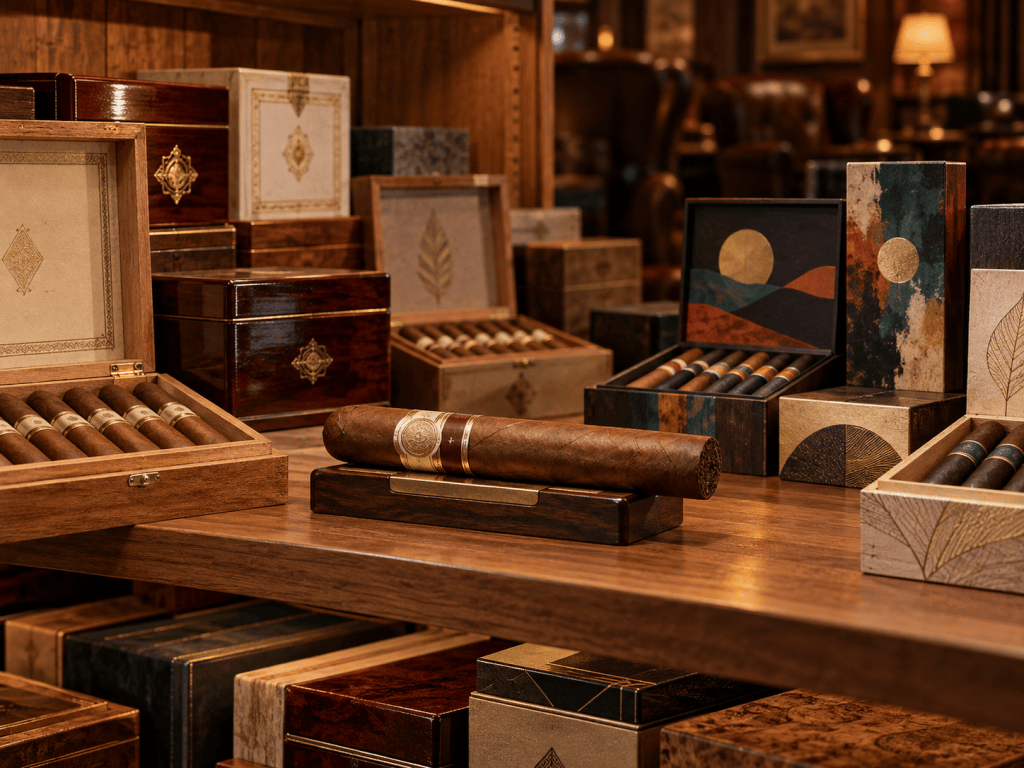
When you think of the word boutique, what does it mean to you?
I’ve wrestled with this term since before I started writing about cigars. When I wrote my amazingly still-popular guitar gear blog, GuitarGear.org, the term “boutique” was bandied about to describe any gear that didn’t come from Gibson or Fender. But throw in PRS, Ibanez, and Gretsch, and the waters got muddy pretty quickly.
With cigars, the waters are even murkier.
If you ask U.S. cigar smokers today what boutique means, I imagine you’d get a similar answer: anything that isn’t Padrón, Fuente, or Oliva. And that’s before we get to all the brands owned by giants like STG. But what about Cuban cigars? What about other major brands such as Perdomo, Drew Estate, and My Father?
Cuban cigars occupy their own category, but that still leaves all those other brands. Most cigar smokers wouldn’t call them boutique. So where, exactly, does boutique begin?
You see? It’s murky.
And it doesn’t stop there.
Look at the Macanudo Emissary, a line from one of the industry’s largest companies that could easily be perceived as boutique. The first time I had one, I saw the gorgeous box and stylish, nuanced banding and immediately thought it was a new boutique brand. When I finally noticed the Macanudo logo, I had a WTF? moment.
Unfortunately, as I found with guitar gear, there’s no way to draw an objective line between boutique and mainstream. Why? Because every smoker draws it in a different place.
But that doesn’t mean I’m not going to try.
The place to start is the mainstream. To understand what might be boutique, we’ve got to establish a point of reference.
The problem is that the mainstream isn’t a single, neatly defined group either. Some brands are practically synonymous with premium cigars. Others are broadly recognized but don’t carry quite the same weight. Then there are established brands that experienced smokers know well, but newer smokers may have never heard of.
That doesn’t necessarily make those lesser-known brands boutique. It means the mainstream has its own hierarchy. Some brands define the market, some occupy the middle, and others sit near the boundary where mainstream begins to blur into boutique.
That leaves us with three basic tiers, along with a separate category for corporate portfolio brands that don’t fit neatly into the same hierarchy:
| Category | Place in the market | Examples |
|---|---|---|
| Defining brands | The names nearly every premium cigar smoker recognizes | Padrón, Fuente, Oliva, Davidoff |
| Major national brands | Broadly distributed brands with strong recognition | My Father, AJ Fernandez, Rocky Patel, Perdomo, Drew Estate |
| Established mainstream | Familiar, widely available brands that don’t dominate the market in the same way | Joya de Nicaragua, La Aurora, Alec Bradley, Kristoff, Tatuaje, Foundation |
| Corporate portfolio brands | Historic names whose visibility is reinforced by conglomerate ownership and distribution | Macanudo, CAO, Partagas, Punch, Montecristo, Romeo y Julieta |
So mainstream isn’t a single bucket into which all these brands can be tossed. It has a hierarchy, and the farther down that hierarchy we go, the more the distinction depends on the experience and perception of the individual smoker.
I put Tatuaje and Foundation in that third tier on purpose. Plenty of smokers will look at those names and say, “Wait a minute. Those are boutique brands.” And they would have a point.
Both built their reputations as boutique brands and still carry that identity. At the same time, both have national distribution, extensive portfolios, and enough recognition that most experienced cigar smokers know their names.
So what happens when a boutique brand reaches that level? Does it graduate into the mainstream, or does the boutique designation remain part of its identity no matter how successful it becomes?
That’s the tension Tatuaje and Foundation expose. By reach and recognition, they belong in the established mainstream. By culture and consumer perception, they’re still boutique. A brand can be both.
That brings me to why I wrote this article in the first place.
The other day, Daniel Lance of Domain Cigars said in an Instagram story that a big house can produce a boutique cigar. My immediate reaction was: What really is a boutique cigar, then?
In the end, I came up with this: a brand is boutique when it sits outside the mainstream as cigar smokers perceive it, though that definition leaves a huge gray area around brands like Tatuaje and Foundation.
Then there are brands like Warped, Viaje, and Black Label Trading. They’re well known and broadly distributed, yet cigar smokers still regard them as boutique. Their success hasn’t pushed them across the cultural line into the mainstream.
Boutique is ultimately a cultural classification, not an industrial one.
That also means there is no checklist. Small batches, independent ownership, limited production, and the size of the factory can all shape how a brand is perceived, but none of them settles the question.
That’s how Tatuaje and Foundation can be mainstream and boutique at the same time, and how the Macanudo Emissary can feel boutique despite coming from one of the largest companies in the industry. The label follows the cigar or the brand, not necessarily the company or factory behind it.
So what really is boutique? It’s whatever cigar smokers collectively perceive as sitting outside the mainstream. The boundary moves. Some brands straddle it, and others eventually cross it.
The waters are still muddy. But that’s what happens when something is left to perception.




Leave a comment