
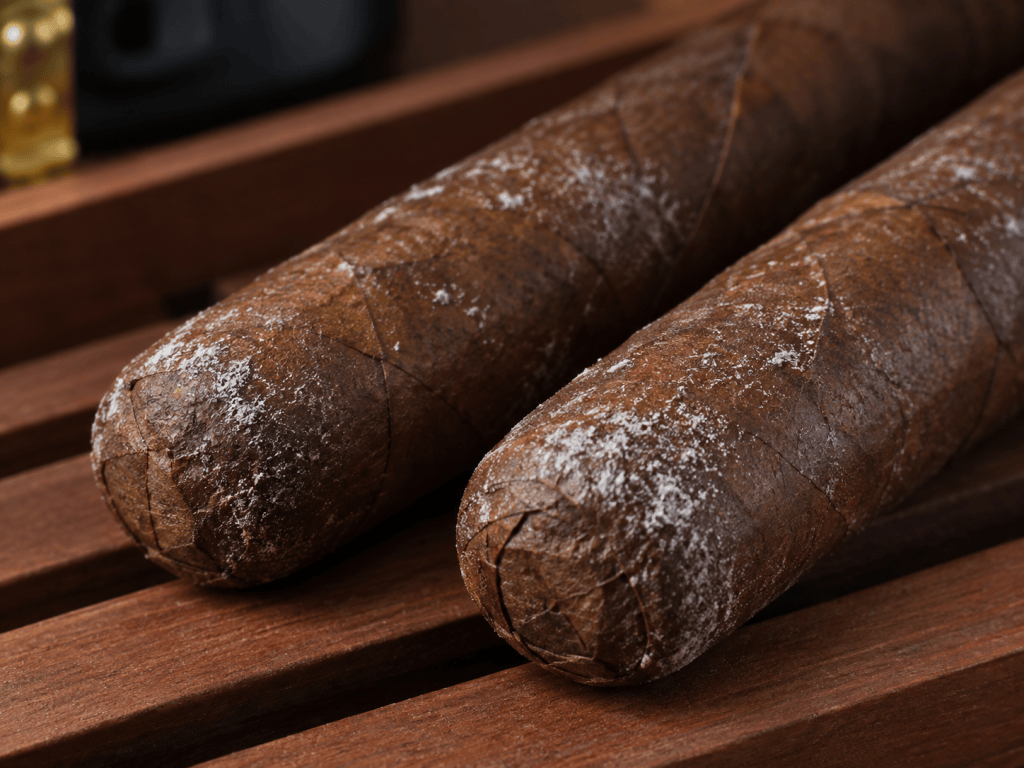
The other day, I watched a reel from Brian Desind of Privada where he showed off a cigar and marveled at how oily the wrapper was. Near the end, he showed a close-up of the cigar while rolling it between his fingers and said, “I don’t know if you can see, but there’s like glitter. See the little glitter? Can you see that on the iPhone? Those are flavor crystals. That’s where plume comes from. If it dries out, it’ll become plume. This is the sign of a very flavorful cigar…”
Before the plume police start beating their chests, chanting, “Plume is mold. Plume is mold,” don’t get your panties all up in a knot. I’m aware of the laboratory tests that proved every sample tested was mold. Yes, that light dusting on cigars that is commonly called plume is mold.
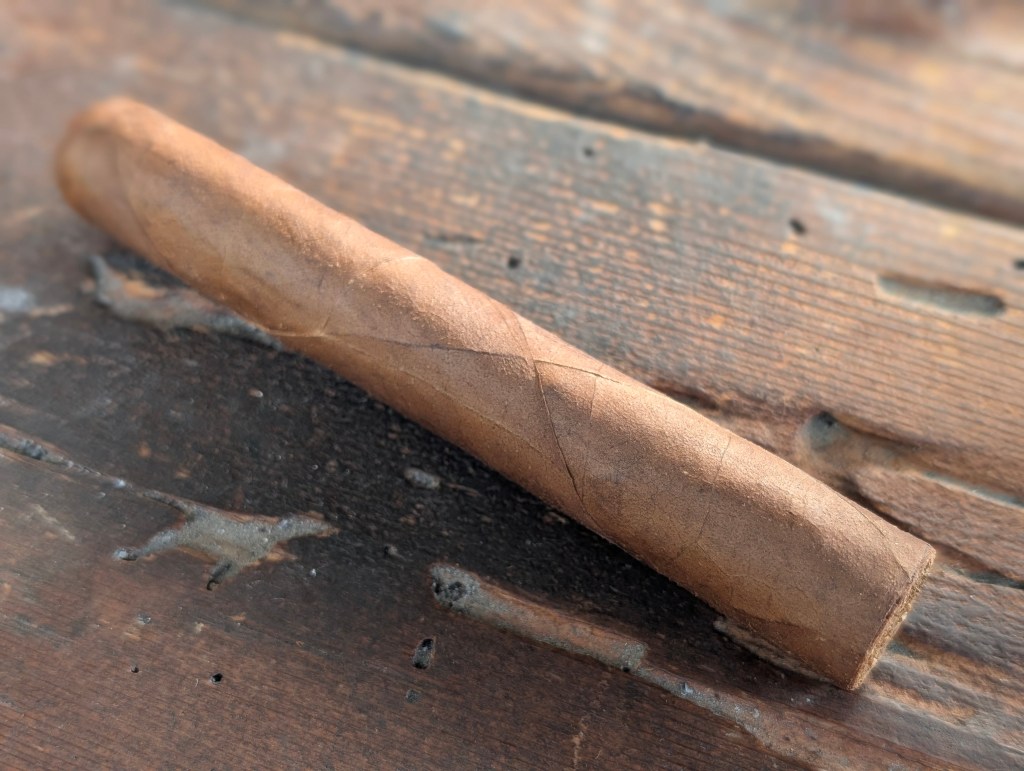
The glitter Brian mentioned is what intrigued me. I’ve seen it several times, especially on well-aged cigars, and it has usually been a sign of a very flavorful cigar.
As for it drying out and becoming plume, I don’t buy that. In all my years of smoking, I’ve never seen those tiny flecks develop into a dusting. I’ve seen the glitter, and I’ve seen the dusting commonly called plume. Once a cigar develops that dusting, it’s mold, not crystals. The laboratory tests have already established that.
The glitter is real. But it’s not crystallized oil, as many people believe. Until recently, I believed that as well.
So what the hell is it?
The tobacco plant itself produces crystals. Researchers have found calcium oxalate crystals inside tobacco leaves. In another study, they found mineral deposits sitting on the tiny hairs that cover the leaf. That study involved plants exposed to high levels of zinc, and the deposits included calcium carbonate and calcium oxalate.
Tobacco produces crystals both inside the leaf and on its surface. Those crystals survive processing because they barely dissolve in water and fermentation doesn’t generate enough heat to break them down.
I don’t want to get too scientific here and discuss the exact chemical structure of the glitter. Besides, I can’t. No studies have analyzed the glitter on finished cigars to identify its exact makeup. The tobacco plant produces mineral crystals, those crystals survive processing, and that’s what we’re seeing catch the light on the wrapper.
That brings me back to Brian calling them flavor crystals. Based on my research, I wouldn’t call them that, but the name isn’t completely off base. In my experience, those flecks are a reliable sign that the cigar is going to have lots of flavor. I doubt they add much flavor on their own, but when they’re present, I usually know I’m in for some goodness.
So what about plume?
C’mon. Plume is mold.
I realize you were probably expecting a serious ending to a Foundations piece, but the plume-and-bloom debate has gotten ridiculous. What amazes me is that organizations such as Tobacconist University still present plume as an actual phenomenon.
Its glossary defines plume as a natural by-product of cigar aging. It says oils pass through the wrapper, crystallize on the surface, and form a white powder that can be wiped away. That is the exact story the laboratory tests disproved.
This is how the myth survives. A respected educational source repeats the traditional explanation, retailers pass it along, and smokers treat it as settled fact. Meanwhile, the shiny flecks that actually appear on tobacco get lumped together with the powdery growth that tests as mold.
Dust is mold. Glitter is crystals.
The only thing they have in common is that cigar smokers have spent years calling both of them plume.
That said, I look at plume like I do UFOs. I’d like to believe it exist, but until I see definitive proof, it’ll remain a theory and not a law.






Leave a comment