
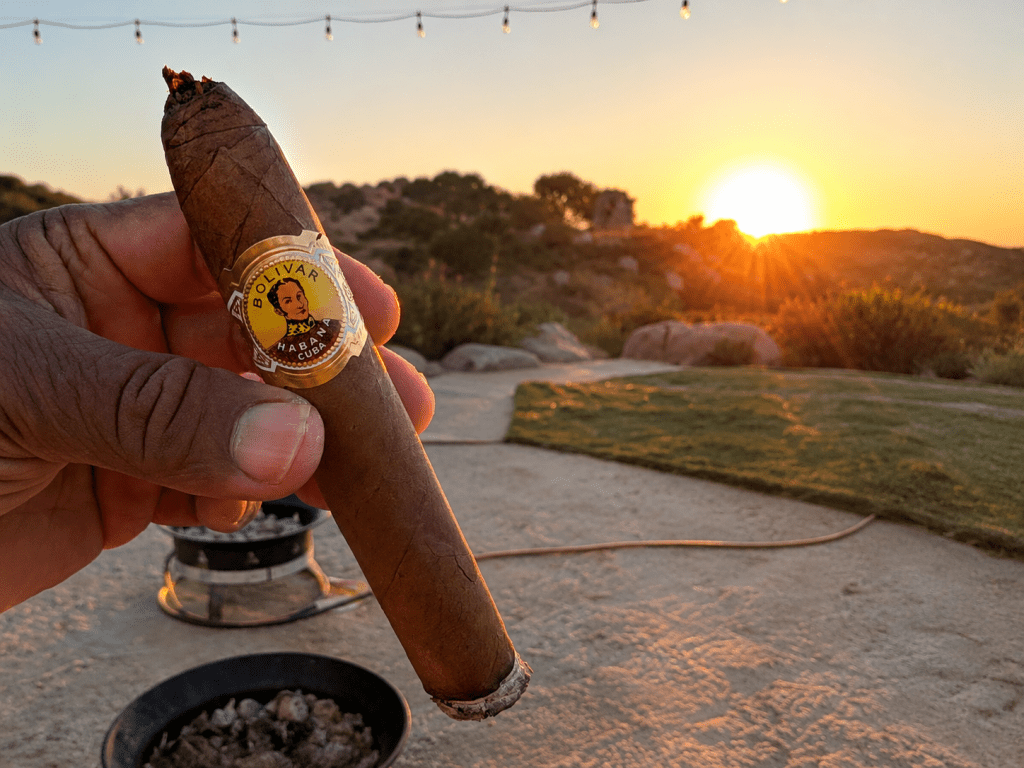
The other day, I read an article in Cigar Inspector by Nick Hammond, called The Decline of Cuban Cigars and the Rise of the New World in which he discussed how the New World has surpassed Cuba in investment, production, agronomy, and technology. He also mentioned how Nicaragua is now the largest exporter of handmade cigars in the world.
He knew the facts, and openly discussed their implications.
But the emotional center of his article remained on Cuba.
To be clear, he didn’t do what many of the I-only-smoke-Cubans-because-they’re-the-best crowd do by denigrating New World cigars as inferior and treating anyone who smokes them like an uneducated cretin. But it was clear from his prose that in his heart, Cuban cigars reigned supreme and New World cigars paled in comparison.
And this wasn’t coming from ignorance of the New World, as I’ve found to be the case with many Cuban cigar snobs. He has a deep respect for New World cigars and has traveled to many of the cigar-producing countries.
Here’s the thing: I share his passion for Cuban cigars.
It’s no secret that the Montecristo No. 2 is my all-time favorite cigar. I’ve mentioned it many times in this publication. While I’ve smoked and reviewed lots of cigars and have rated several 100 points, there are 100-pointers and then there’s the Monte No. 2.
And I’ve had plenty of others, like the Partagas Serie D No. 4, the Partagas Lusitanias, the Cohiba Behike, and the Siglo VI, to name just a few.
For me, there’s just something inherently magical about Cuban tobacco, and Mr. Hammond said as much with this phrase from his article: “when Cuban cigars are good, they are very, very good.”
It was that phrase that cleared the skies for me in understanding why I love Cuban cigars as I do.
Unless you’ve personally smoked Cuban cigars, the reverence for Cuban tobacco is almost impossible to explain, because that reverence doesn’t come from all the bullshit you often hear about tradition, terroir, and technique.
You can dissect the tobacco all you want. The magic isn’t in the calculus or even what many refer to as that distinctive Cuban twang.
It’s much more subtle and nuanced than that. And the hell of it is that it has nothing to do with anything you can isolate, measure, or describe on a tasting sheet.
You have to feel it.
And that’s where things get problematic, because not everyone does.
If you feel it, trying to explain it to someone who doesn’t is almost impossible. Eventually, you find yourself saying some version of, “You can’t understand unless you can feel it.” Which sounds exactly like the kind of elitist bullshit a Cuban cigar snob would say.
And so it pisses people off.
Considering the scarcity and expense of Cuban cigars here in the US, not to mention the legality, most American cigar smokers will never get the opportunity to experience that Cuban cigar magic for themselves.
But here’s where we come to a fork in the road.
One path is easy. You hear someone tell you that you can’t understand unless you can feel it, decide he’s a pretentious asshole, and move on. I wouldn’t blame you. From the outside, it sounds like someone claiming access to some higher plane of cigar consciousness that you’re simply incapable of reaching.
But there’s another path.
What if you’ve already felt it?
I’m not talking about Cuban tobacco. I’m talking about that cigar you’ve smoked where everything you could say about it somehow failed to explain the experience. You could describe the cigar down to the last inch and give it a score. And somehow, none of that would explain why you still think about that cigar.
That’s the feeling.
Maybe yours came from Nicaragua. Maybe the Dominican Republic. Maybe Honduras. It doesn’t matter. Its country of origin isn’t the point here. The point is that you’ve experienced something that couldn’t be reduced to the sum of its parts.
So when someone says, “You can’t understand unless you can feel it,” maybe that isn’t necessarily a claim of superior taste.
Maybe language just sucks at explaining some experiences.
Lately, I’ve been getting that feeling from the Cayman Mariner Toro. I smoke that cigar and the whole world stops. Every. Single. Time. And here’s the thing: I gave it a score of 97. Not 100. 97. From a purely analytical perspective, I scored it lower than 100 because of its slow start.
But about an inch in, I start feeling it.
It may not be the same feeling I get from Cuban cigars, especially the Monte No. 2, but it’s damn close.
So the next time you hear someone raving about a Cuban cigar, just nod your head.
You get it.





Leave a comment