
If you’ve read this publication regularly, you’ve occasionally heard me talk about the Seven Pillars. I discuss them on my Scoring page, but I wanted to finally bring them to the surface. Plus, I wanted to remove any ambiguity about how I review cigars.
I developed the Seven Pillars framework out of frustration with traditional reviews. Too often, they felt punitive. They seemed to start with a maximum score, then deduct points for too few flavors, an imperfect burn, construction problems, or whether the reviewer had enough coffee that morning. Deducting points works great for figure skating and gymnastics, but it tells me very little about the experience.
“I can taste coffee, dark chocolate, and Cherry Coke, overlaid with vanilla bean, roasted nuts, all floating in a thick and creamy texture. It’s complex and delicious. But the burn line was slightly wavy throughout the smoke. I’m giving it an 80.”
WTF?
That kind of review felt disjointed from what I was experiencing. Frankly, it also felt intellectually lazy.
I wrote about wine for years, and wine reviews worked the same way: all flavor-note accounting. I could see the problem then, but I didn’t have the balls to challenge it. Now that I’m older, I’m a Honey Badger.
Katman, of course, broke that mold years ago. Phil lets what he tastes trigger memories from his illustrious, and occasionally incriminating, past. You may forget the flavor note, but you won’t forget the story it pulled out of him. While I didn’t want to copy his style, and no one can, I, too, wanted to take a different perspective on cigar reviews.
In late 2025, I decided to change my approach. Until then, I had reviewed cigars in the traditional way. Boring. My new approach would revolve around the experience: observing what a cigar was doing, judging whether its parts worked together, then rating how I felt about it.
A big motivation for developing the Seven Pillars came from something Michael Herklots said about blenders in a Cigar Press interview: “Very few of them describe their cigars the way they are ultimately reviewed.”
That comment struck a chord in me because it captured the disconnect I was feeling. A blender works with tobaccos as an interacting system. Each choice affects the shape, movement, and character of the finished cigar. Yet traditional reviews often pull that system apart into individual flavors and technical deductions. I wanted to look at how those choices revealed themselves through the cigar’s behavior and whether they worked together as a whole.
That’s where the Seven Pillars came from.
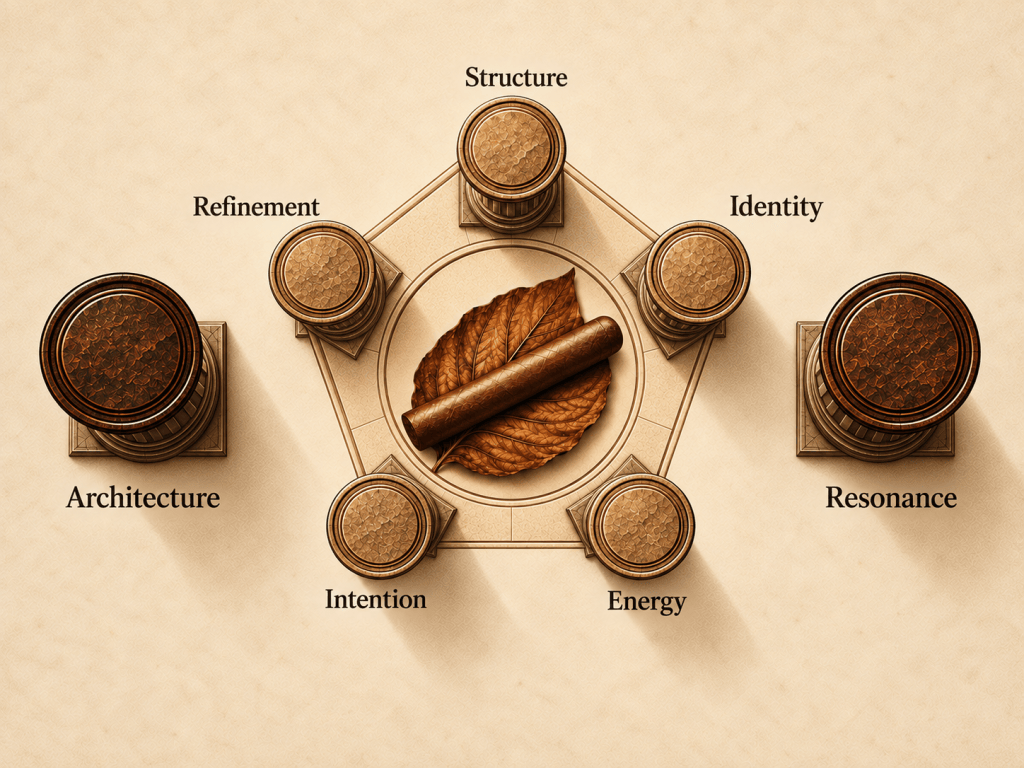
The Seven Pillars are Structure, Identity, Energy, Intention, Refinement, Architecture, and Resonance. The first five pillars are purely observational. Architecture is where I judge how those observations work together, while Resonance is where I judge the experience I had with the cigar.
The Seven Pillars
1. Structure
With this pillar, I’m asking whether the cigar reveals the shape of its profile to me. This isn’t a judgment but an observation. In my reviews, I’ll often speak of a core. In my experience, most cigars are built around a combination of central flavors, often something like coffee, cedar, and black pepper. More complex cigars layer other flavors around that core, while other elements lift or compress the profile. Together, they form a shape. Structure is whether I can detect that shape at all.
That said, some cigars are deliberately constructed not to present a clear structure. The Definition GEN 413 was “designed to prompt smokers to question the root of their identity, their beliefs, and how they define what they encounter.” Its flavor profile didn’t present a shape I could recognize. I had to give it one through how I engaged with its movement.
This is why Structure is an observation. Architecture determines how well the structure, or lack thereof, works.
2. Identity
This pillar is closely connected to Structure, and I could just as easily call it confidence. Whether or not a cigar reveals a fixed structure, how confidently does it communicate what it is? Identity doesn’t require consistency. A cigar can shift, interrupt itself, or refuse to settle and still possess an unmistakable character.
The Megilla Limited Edition Shofar is a perfect example. Its stable core keeps moving forward while the changing wrappers repeatedly knock the profile off course. It was made to mess with you. The cigar never settles into a consistent progression, but it never seems confused about what it is. Its instability is its identity.
3. Energy
With this pillar, I’m observing how the profile carries itself. This isn’t about how often the profile changes. A cigar can evolve constantly and still have low energy.
For example, take the Montecristo Espada Oscuro. It’s a heavy, brooding cigar. But it constantly evolves, with subtle flavors moving in and out while the strength quietly builds underneath the smoothness. Its energy is low even though the cigar is always moving.
Like Structure, Energy is an observation, not a judgment. I may prefer cigars with more energy, but this pillar only tells me how the cigar moves. The rest of the framework determines whether that movement works.
4. Intention
With this pillar, I’m observing whether I can feel the blender’s intent in the finished cigar. I’m not claiming to know what the blender had in mind. I’m asking whether the profile feels deliberate. Does the structure feel purposeful, or does everything feel thrown together, hoping for the best?
Intention doesn’t require order or organization. A chaotic profile can feel carefully constructed, while an orderly one can still feel accidental. This pillar only tells me whether the cigar feels authored. Architecture determines whether the result works.
5. Refinement
With this pillar, I’m observing how the various elements of the profile are integrated. Do they fit together, or are there sharp edges or elbows out? A flavor or sensation can stand apart without feeling disconnected from everything around it. Refinement tells me whether the profile comes together cleanly or whether I can still see its seams.
Refinement shouldn’t be confused with smoothness. A cigar can be peppery, tannic, aggressive, or rough and still be refined if those qualities are integrated into the profile. A smooth cigar can lack refinement if its elements blur together or sit awkwardly beside one another.
Refinement is the fit between the parts. The elements can remain distinct while still feeling as though they belong together.
6. Architecture
Architecture is where observation becomes judgment. The first five pillars tell me what the cigar is doing. Architecture is the harmony among them. I’m judging whether Structure, Identity, Energy, Intention, and Refinement support one another and make sense as a complete system.
Strong Architecture doesn’t require the first five pillars to behave in any particular way. A cigar can have low Energy, an unstable Identity, or no recognizable Structure and still work harmoniously. Even dissonance can belong within the design. I’m judging whether the choices the blender made create a system that works.
7. Resonance
This is the pillar that measures the “enjoy” in Cut. Light. Enjoy. The first six pillars are about the cigar. Resonance is my ultimate judgment of the experience. Did the cigar hold my attention? Did it move me? Do I want to experience it again?
Enjoyment doesn’t always mean the experience was easy or pleasant. A cigar can challenge me, unsettle me, or make me work for the experience and still resonate deeply. At the same time, a cigar can have strong Architecture and still leave me cold.
In the end, the Experience Rating has to reflect how much I liked smoking the cigar, not just how well I think it was made. Resonance is what keeps that personal response in the score.
What My Score Means
My Experience Rating isn’t a tally of flavors, technical performance, or the cumulative score of seven separate criteria. The first five pillars tell me what the cigar is doing. Architecture tells me whether those observations work together. Resonance tells me how I felt about the experience.
- 94–100 — The Architecture is exceptional, and the cigar resonates deeply with me. Everything works together as a complete system, and I’m still thinking about the experience after the cigar is finished.
- 90–93 — The Architecture works, and the cigar resonates. I want to smoke it again, even if the experience doesn’t have the same hold on me as my highest-rated cigars.
- 87–89 — The Architecture doesn’t fully come together, the experience has limited Resonance, or both. There may still be enough here to make the cigar worth discussing, but not enough to pull me back often. A 90 is usually my minimum score to earn a review, though I’ll make an exception when a cigar gives me something worth writing about.
- Below 87 — The Architecture breaks down, the experience doesn’t resonate, or both. These cigars rarely appear on the site. I have a personal policy against publishing negative reviews. The world has enough negativity; I don’t need to add to it. If a cigar falls below this threshold, I simply don’t write about it.
To be clear, every Experience Rating I give is subjective. Don’t let anyone fool you. No matter how elaborate the system or framework, the final number still reflects the reviewer’s judgment. I may not land on the same scores as the flavor-note accountants, but we’re measuring different things.
My Review Process
At this point, I probably should discuss my actual process.
The Seven Pillars may be the language of my reviews, but they’re actually only a part of the process. My review process is fairly straightforward. I start with an inspection of the cigar, light it, then follow its progression. The whole time, I take detailed, copious notes on what I’m tasting, what I think the profile is doing, and any insights that come up along the way.
After I finish the cigar and complete my notes, I apply the Seven Pillars to what I recorded and arrive at an Experience Rating.
Only then do I transcribe those notes into a formal article. That comes last.
The Score Has Consequences
I don’t review cigars just to publish my insights. I review them to understand why I do or don’t like them and, ultimately, whether I’ll buy them again. And I buy my own cigars. I don’t run around asking manufacturers for handouts.
The score determines whether a cigar is worth buying again and how it fits into my rotation. Architecture tells me how well the cigar works as a whole. Resonance tells me how I felt about the experience. The number tells me what I’m likely to do about it.
- 94 and above — Automatically box-worthy. The cigar is exceptionally well composed, resonates deeply, and deserves a permanent place in my rotation. Whether I can afford the box is a separate question.
- 90–93 — I want to smoke it again, but the price has to justify the box space. I’ll buy a box only when the deal is genuinely compelling. Otherwise, I’ll keep a few around.
- 87–89 — Fiver or single-stick territory. There may be something I want to revisit, but not often enough to commit to a box.
- Below 87 — Never buy. I will, and have, politely declined one even when it was offered for free. Life is too short to smoke sub-par cigars!
The score isn’t abstract. It tells me whether the cigar gets more of my money and more space in my humidor.
What About Price?
Of course price matters. It just doesn’t factor into the score. The score tells me whether I want to smoke the cigar again. Price determines what I can reasonably do about it.
For example, I gave the Zino Platinum Crown Tubo Gordo a high rating. But at $58 a cigar, spending nearly $600 on a box of ten isn’t practical. That doesn’t lower the score. It simply changes where the cigar fits into my rotation.
My scoring system flattens the playing field by judging the experience rather than the price. An expensive cigar doesn’t receive extra credit, and an inexpensive cigar isn’t graded on a curve. Cost helps establish the cigar’s general tier, but I don’t treat premium and luxury as rigid price brackets. How the cigar is positioned and presented also plays a part.
Once I know I want the cigar again, price determines the terms. Some cigars become regular purchases. Some require a good deal. Others, like the Zino, become special-occasion cigars. Box-worthy describes the experience; it isn’t a promise that I’ll buy the box.
The Seven Pillars aren’t meant to make smoking more complicated. I don’t light a cigar and start checking boxes. Most of the time, I’m simply paying attention and letting the cigar show me what it is. The framework gives me a language for sorting through the experience. More importantly, it gives every cigar a fair shot, regardless of price, reputation, or where the industry or cigar culture says it belongs.
That is what I want a review to capture: not just which flavors appeared or whether the burn line behaved, but what the cigar did and how I responded to it. The score is where I landed. What I do with my own money afterward is where the score becomes real.






Leave a comment