
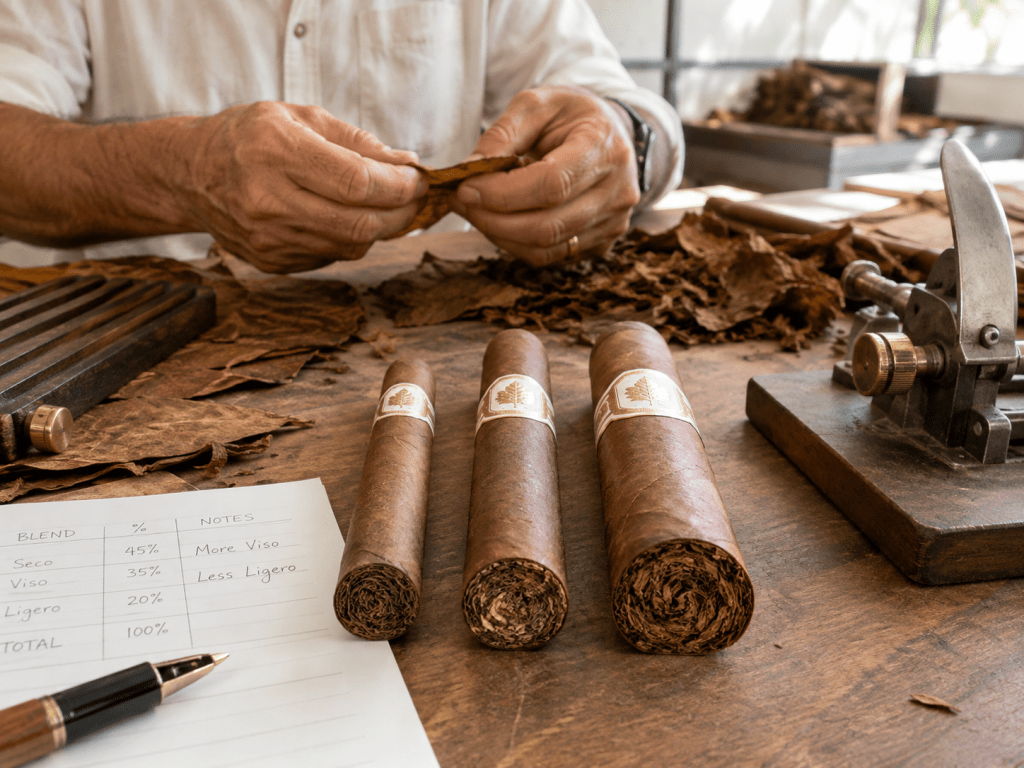
But the blender has something to say about that…
When I first started getting into the hobby back in the ’90s, Greg, a good friend of mine and cigar mentor, once told me, “Most cigars come in different sizes. In general, the fatter the cigar, the more the binder and filler influence the flavor. As it gets skinnier, there’s less filler and binder, so the wrapper shines through more. When I try a new brand, I usually buy different sizes to see which one I like.”
As I’ve learned more about cigars, that “in general” has taken on a lot more meaning. If there’s one thing I’ve learned over the years, it’s that cigars leave a lot of room for ambiguity.
Ring gauge is no exception.
Greg wasn’t giving me an unusual theory. He was repeating one of the most accepted ideas in cigar culture. You hear it in shops, read it in beginner guides, and see it repeated in reviews: thinner cigars give the wrapper more influence, while thicker cigars lean more heavily on the binder and filler.
And I’ve followed Greg’s example whenever I’ve tried a new cigar. For instance, I used to smoke the Robusto and Gran Toro vitolas of the Undercrown Maduro religiously. But once I discovered the Corona Viva, that’s all I’ll buy. The same goes for the Crowned Heads Mil Días. I tried the Toro and Robusto first and loved them, but the Corona Gorda blew me away.
After smoking cigars like those, I never had much reason to question it.
But that assumes every vitola in the line uses the same recipe. The more I’ve learned about blending, the more I’ve found that isn’t always true.
For the most part, the policy works. But how it works depends on the blender.
A good example is the Auremio Collectio Maduro Toro. On paper, it looked like a larger version of the Deliciae Maduro Robusto. Both listed a Cuban-seed Maduro wrapper, Sumatra binder, and Jalapa filler. But Auremio told me the Collectio was a completely different blend. Eduardo used leaves from the same region, but he adjusted the amount of seco and viso he used in the Collectio.
So what I was tasting wasn’t just a difference in size. The Collectio and Deliciae were built differently, even though the published blend information made them look nearly identical.
There are also blenders who make small adjustments from one vitola to the next because they want the line to smoke consistently. The published blend may be the same, but what goes into the bunch can change.
One blender may let each size show a different side of the cigar. Another may tweak the blend so the differences aren’t nearly as noticeable.
Then there are cigars like the Ferio Tego Generoso and its sister blend, the Elegancia.
Michael Herklots treats the annual releases of both lines much like wine vintages. The recipes remain the same, but the tobacco reflects the growing conditions of the crops used for each release. The regions, primings, and proportions remain constant while the character of the leaf changes from one year to the next.
So even “the same blend” isn’t always as fixed as it sounds. With the Generoso and the Elegancia, the blend stays the same while the tobacco changes. With those lines, Michael doesn’t want the cigars to be consistent among releases. He wants each release to show the effects of terroir.
And that’s the challenge with treating ring gauge alone as a reliable predictor of flavor. You need to know what the blender actually did.
But here’s the rub: you almost never get that information.*
I’m not trying to be a Negative Nellie here. I’m just pointing out that when it comes to cigars, nothing is set in stone.
But that’s part of the fun of exploring cigars.
* You can actually find out. You just have to ask the blender. Most blenders are on Instagram or other social media platforms. Though not all of them answer, many do.




Leave a comment