
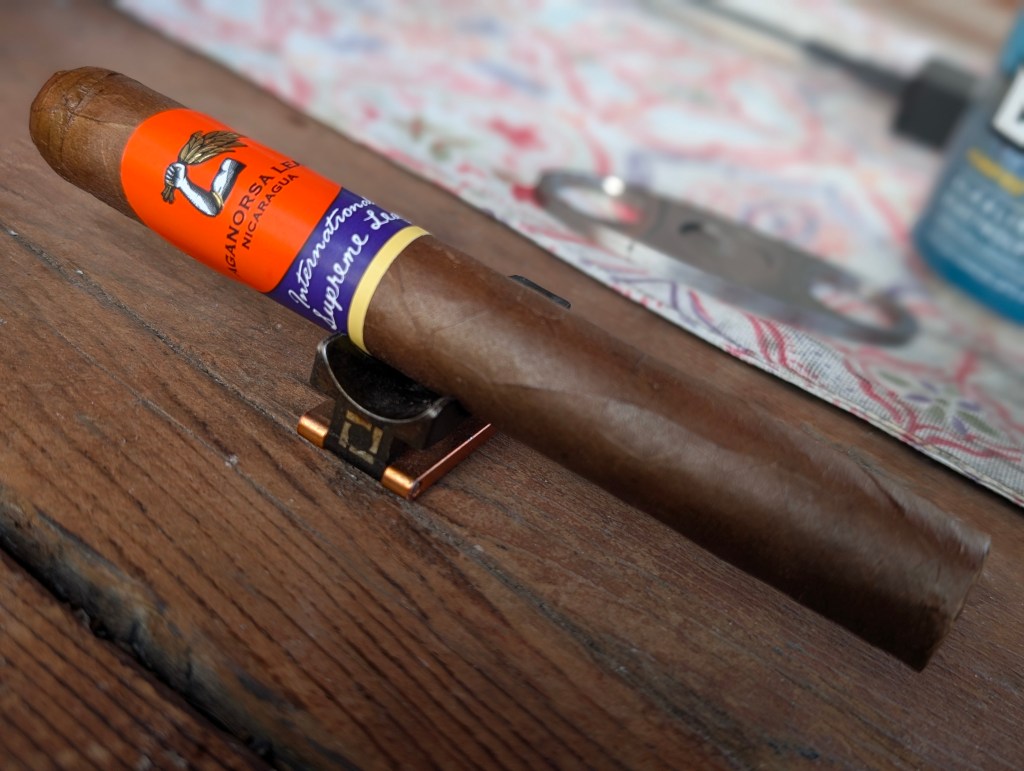
Wrapper: Corojo ’99 / Nicaragua
Binder: Nicaraguan
Filler: Nicaraguan (Aganorsa-grown)
Size: Euro Toro (6 × 50)
Strength: Medium → Full (final inch)
Body: Medium → Full (final inch)
Price: $12.99 (USD)
Factory: Agricola Ganadera Norteña S.A. (AGANORSA), Estelí, Nicaragua
Release: September 2024, InterTabac, Dortmund (International Limited Edition); April 2026, PCA, New Orleans (U.S. Limited Edition — one-time allocation of 1,000 boxes)
Smoking Time: 1:30
Experience Rating: 94
This is a cigar I’ve been wanting to get my hands on for a few years, but I’ve always missed the release. And it was only through dumb luck that I happened to scroll through the promotional emails in my inbox and saw that Hiland’s had them in stock. So I purchased a box. Insurance, if nothing else.
When I finally had time to sit with it, I thought about where to place it among my other sticks.
I used to coach ice and roller hockey. The challenge of any hockey coach is finding the right balance of lines. You have a mix of abilities and skills, and the trick is finding the right combinations.
I liken the cigars in my collection to hockey players. I have my first-liners that stand head and shoulders above the rest. These are like Connor McDavid or Macklin Celebrini, generational talents that leave me thinking, how the hell do they do that? Then I have my performers: excellent, solid sticks that comprise the bulk of my humidor.
Like Joe Pavelski.
Joe Pavelski scored 476 goals over 18 seasons. Four All-Star appearances. Never a liability. You put him on the ice knowing exactly what you were going to get. He wasn’t the flashiest player on the ice, and he didn’t need to be. He was Joe Pavelski — smart, steady, dependable, and dangerous when it mattered.
The International Supreme Leaf belongs in that company.
It may not be a generational talent, but it’s not merely “good” either. It’s a cigar with enough structure and repeatability to earn rotational status. I bought a second box.
If you’ve smoked Supreme Leaf before, you know that each release comes in a single vitola that is different from all the previous releases. For the most part, the blend recipe stays the same, but the leaf proportions are calibrated for each vitola. This is a really cool concept because it challenges the blender to maintain the basic idea of the blend, but make it suitable for the vitola.
I reached out to Terrence Reilly to see if he’d share any changes made to the blend based on what I had read on a retailer’s site, saying Aganorsa made “tweaks and changes” to this release. Here’s his reply:
“Hi! Yes the blend was tweaked for the European palate. Although the original Supreme Leaf is dominant Corojo 99 (not 100% but heavily reliant on it), the International edition increases the amount of Criollo 98 from Estelí to balance out the Corojo 99 from Jalapa. I hope that helps!”
It helped a lot because it explained why this cigar was so balanced and articulate. And more to the point, that balance and articulation are why I bought a second box.
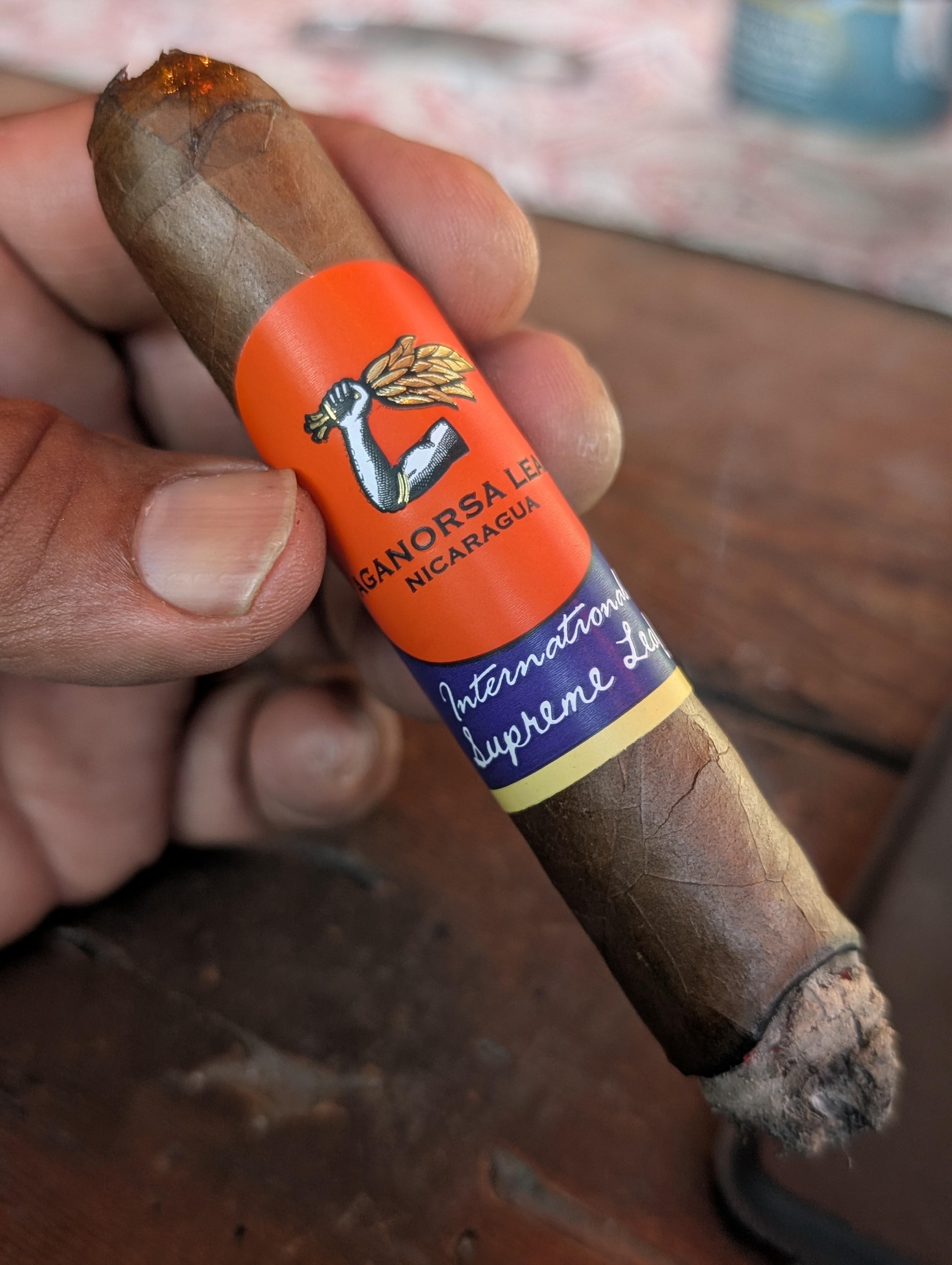
The one thing I can say about Aganorsa Leaf cigars, they always smell pretty, and the International Supreme Leaf is no exception. The wrapper presents a beautiful bouquet filled with sweet floral, rich Corojo sweetness, and fresh-baked bread. The smooth skin has an oily sheen. While not as complex, the foot has a strong aroma of dried fruit, figs, and just a touch of barnyard.
Lighting it up, the cigar stands up so fast, with such complexity, that it startles me. First comes a gorgeous hit of cedar and espresso. Then baking spices, dark chocolate, earth, molasses, malt, leather, and dark cherry flow into the frame. A pleasing, simple syrup punctuates the finish, with a light, ambient spice wrapping the profile.
I feel like the cigar is saying, “Hello? Pay attention!”
Once it settles, espresso and dark chocolate establish the center, with a simple syrup sweetness carrying through the finish. A mouth-coating cream enters and starts tugging against the spice, while the spice tugs against the core, both actions adding a vertical dimension to the profile.
The flavors from the beginning seem to float aimlessly about the center, returning at random, while new arrivals appear: cinnamon, popcorn, white pepper, Hawaiian bread, banana bread, and cardamom. The ambient spice seems to form a boundary around the entire profile. I get a slight hit of nicotine as the strength and body both move to a solid medium.
At this point, I find myself having to take a breather. This cigar is complex. The flavors are bouncing around each other in the profile, throwing all sorts of combinations at me. And their motions are different. Some flash, some pulse, and some come in waves.
And that was just the first damn third.
That took about 30 minutes. The burn rate slows to a crawl, like it was speeding down the highway and suddenly hit a wall of brake lights. For a moment, it worries me. I thought I was staring at a cigar that might be over in just over an hour. Then it occurs to me that they may have changed the bunching to slow the burn.
As I progress, the Hawaiian bread from earlier steps forward, joined by yeasty dinner rolls. Their tension against the core provides yet another pull on the profile. Most cigars usually have one or two tension points. But with the International, there are a few points that make this blend so interesting. Cream pulls against the spice. Sugar and bread pull against the core. Such great structure.
Halfway in, the profile becomes a little denser as the spice intensifies, seeming to contract its boundaries. Body moves to medium-plus, though strength remains at a healthy medium. The tension points continue to hold everything together, and the circulating flavors seem to move closer together, as if their movable area has been reduced.
What I’m realizing is that, unlike a flavor bomb that throws everything at you with little to no organization, the flavors in this cigar are well-behaved and stay within the boundaries of the profile. They’re allowed to drift, but only within a finite space.
As I reach the home stretch, the Hawaiian bread is now fixed to the front of the core. Sweetness also steps forward, leading the coffee and chocolate. Strength pushes just past medium, and body is still medium-plus.
Spice inches forward and is accompanied by a darkening of the core. Coffee becomes ristretto. Chocolate darkens to dark-roasted cacao bean. Sugar browns and moves back. Nicotine ticks up, but it’s still gentle. And the burn is still taking its sweet time. The other flavors continue to circulate within the profile, while the lingering sweetness on the finish seems to provide an emotional lift. If it weren’t for the ever-present spice, this would be a nice, smooth glide.
Then I hit an abrupt transition.
Cacao breaks off from the coffee and joins the flavors in the space above. But it still feels tethered. The Hawaiian bread still leads, but it’s quickly overtaken by the ristretto, which has become more pronounced without becoming overpowering.
I can feel the inherent energy in the profile rise as it becomes a little denser, reducing the free space even further. More collisions are occurring as the flavors seem to be crowding together, like sheep being herded into the fold. The interesting thing is that despite this increase in density, everything is still incredibly articulate.
In the last couple of inches, the spice continues to intensify and creep forward. The profile compresses yet again, but the move feels structural, like it’s trying to find its balance point. It’s not at all muddy.
The ristretto is now the structural core. Taking a puff produces a bitter, astringent aftertaste like a sip of strong coffee. But it never gets to fully assert itself as the spice mitigates its force.
Even though I’ve listed plenty of flavors, the complexity in this cigar doesn’t come from the list. It comes from the interplay between elements: the tension points, the increasing density, the collisions that density creates, the structure that keeps each flavor articulate, and that finishing sweetness providing its constant lift.
By the last inch, strength and body are full, and I’m starting to feel the nicotine. It has been sneaky, slowly and quietly creeping along the whole time. Ristretto still dominates, but Hawaiian bread, sweetness, and spice work together to keep it in check.
It looks like the sheep have left the fold, as the profile is now all about the core. The spice has moved to the front of my mouth. Little pinpricks of grape jelly, yeast, and raw dough appear, then immediately fade.
The profile is dense and powerful now, but it’s not soupy or muddy. Interestingly enough, the cream is still present, and even though it pulled against the spice earlier, it didn’t play as big a role as it usually does. Yet the profile remains rich and luxurious. The bread-like quality has been the component smoothing everything out.
The sweetness fades from the finish. I’m almost sad to see it go. But the ever-present spice continues to lift the profile, preventing collapse. It’s mouth-coating, but it doesn’t burn. Classic Corojo spiciness.
Structured, composed, and articulate to the end.
After finishing my first review cigar, I knew that I really liked it, but I also thought it had a lot of competition in my humidor. But once I smoked a couple more, it became clear that I had to add it to my rotation. Maybe not my regular rotation since Supreme Leaf only appears once a year, but it has earned a place.
You can get these for now at Hiland’s Cigars. The price is $112.98. But use code “SNOW” and the price drops to $99.42. And it’s free shipping.




Leave a comment