
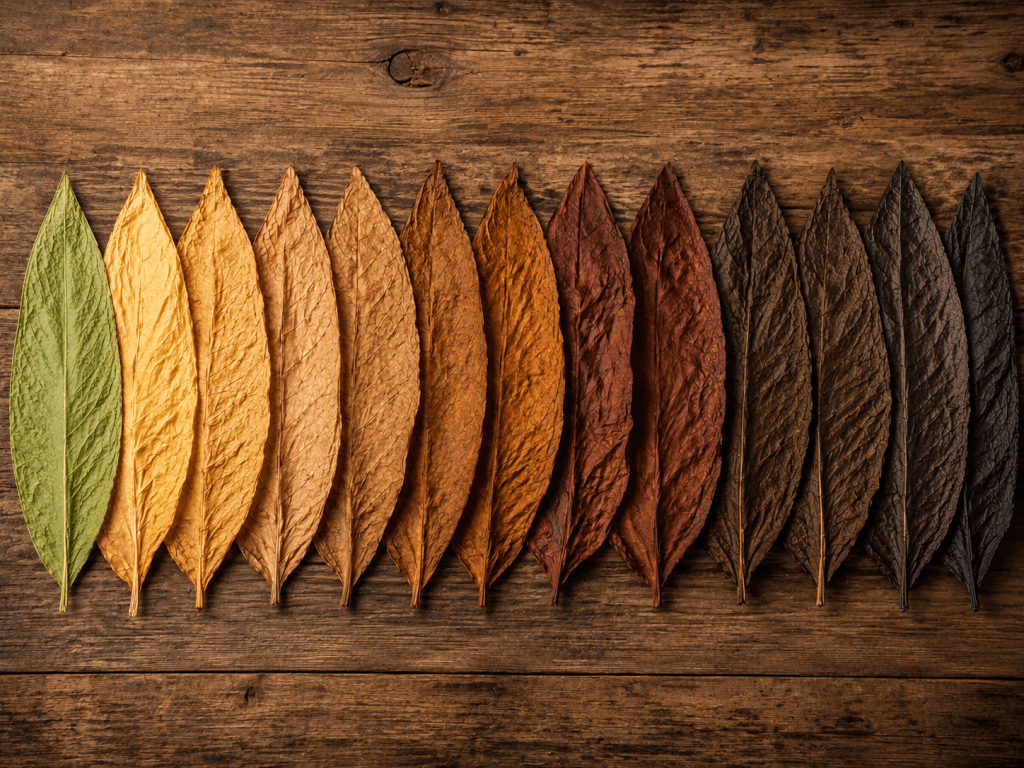
While researching the new Domain Attenuation cigar, I reached out to Daniel Lance to get some background on his ideas about it. As a gigging musician, I’ve used an attenuator on my amps for years, so I knew the term from an audio perspective, but I wanted to hear Daniel’s thoughts.
In music, attenuation isn’t about killing the signal. It’s about controlling it. You reduce the force hitting the room without losing the character of the amp. The energy is still there. The shape is still there. The voice is still there. It just arrives with less weight.
I won’t go into the full conversation, but Daniel said the term “Attenuation” comes from his physics background, where it’s “best understood as what happens to light whenever it passes through a medium.” In the case of this cigar, the idea was to attenuate the natural browning process.
Then he took it a step further.
“This isn’t even a natural process because it’s a Claro. So, they call it a Claro. It’s a Virginia Gold process.”
That stopped me cold.
I was like, “Wait. WTF? What the hell is the Virginia Gold process?”
Rabbit hole time.
My initial research revealed that the Virginia Gold process points back to flue-curing, a method normally associated with Virginia/Brightleaf tobacco used in pipe and cigarette tobacco. I shared some of the implications of that in a previous article about the Domain Attenuation.
But that research opened several other doors. Once I started looking into flue-curing, I had to consider air- and fire-curing, which then led to Candela. And once Candela entered the room, wrapper color stopped being a simple shade chart and became something more nuanced.
After spending the last few days researching tobacco curing, one thing became clear: wrapper color doesn’t begin with fermentation.
It begins in the curing barn.
What Is Curing?
Curing is the first major transformation after tobacco is harvested.
The leaf has been cut from the plant, but it isn’t cigar tobacco yet. It’s still green, wet, raw, and full of chlorophyll. Before it can be fermented, aged, sorted, blended, or rolled, it has to be cured. At the simplest level, curing is controlled drying, but drying is only the beginning.
During curing, the leaf loses moisture. Chlorophyll breaks down. Pigments change. Starches and other compounds begin transforming. The raw green character of fresh tobacco gives way to something more stable, more flexible, and more usable. This is also where color first starts to declare itself.
Curing doesn’t make tobacco smokable. Ammonia and other harsh compounds remain in the leaf after curing, which is why fermentation still has to do its work. But curing is a critical step in preparing the tobacco for fermentation.
Fermentation may deepen the color later, especially with maduro and oscuro wrappers, but curing is where the first color direction is established. It’s where the leaf stops being green field tobacco and starts becoming the material a blender can actually work with.
A green tobacco leaf doesn’t automatically become brown just because time passes. The path it takes depends on how it’s cured. Air-curing lets the leaf slowly move from green into yellow, tan, and brown. Flue-curing uses indirect heat to preserve yellow and gold. Fire-curing exposes the leaf to smoke and slow heat, creating a darker, smokier character. Candela interrupts the usual browning path and preserves green.
With that in mind, let’s look at the different curing methods.
Air-Curing: Where Most Cigars Start
For premium cigars, air-curing is the common curing method. The tobacco is harvested, tied or sewn onto poles, and hung in curing barns, where air, shade, humidity, ventilation, and time do the work. The leaf cures slowly, for around 50 days, in a controlled yet relatively natural environment.
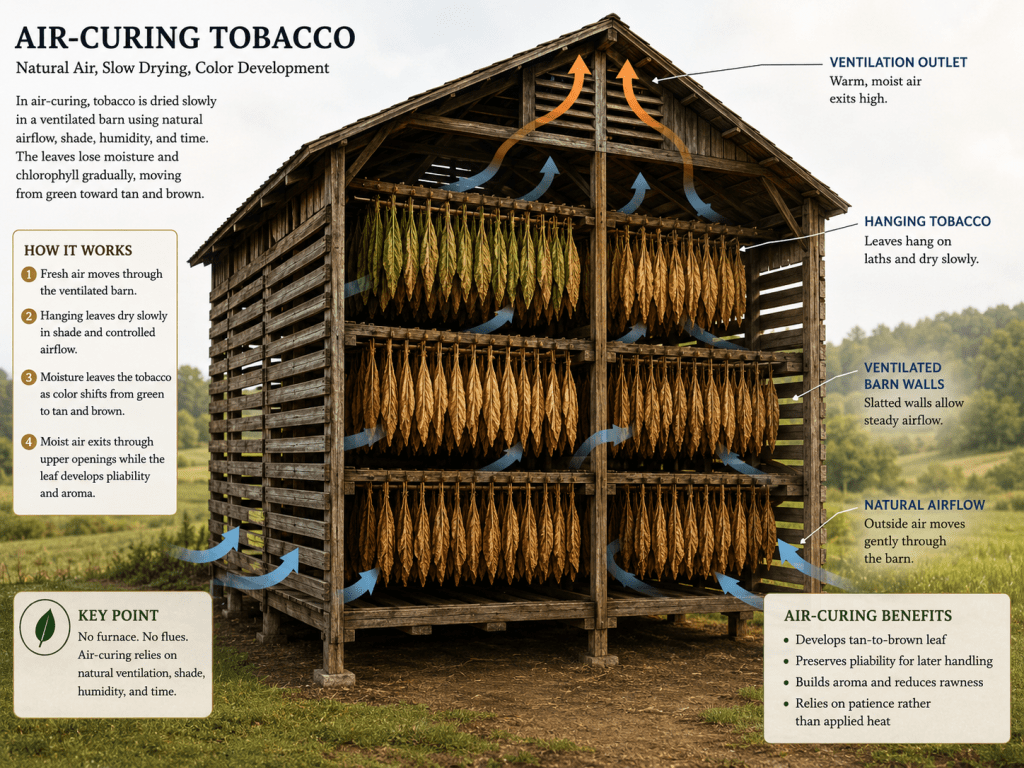
As the leaf hangs in the barn, moisture evaporates, and the green begins to fade. The tobacco moves through yellow and tan, eventually into the brown range we associate with cigar leaf. This is the first major color transformation.
Air-curing lets the leaf brown slowly. It prepares the leaf for fermentation and establishes the starting point for later development. From there, fermentation can deepen the color, depending on the leaf, the process, and how far the maker wants to take it.
In general, thicker, oilier leaves can tolerate more heat, pressure, and fermentation time than thinner, more delicate leaves. But that isn’t a law. Specialized processes can push delicate leaf much further, as with Raul Lanuza’s ultra-fermented Cameroon Negro wrapper.
When we talk about claro, colorado, maduro, or oscuro, we aren’t only talking about fermentation. We’re also talking about where the leaf began after curing. Fermentation may deepen the color later, but air-curing is where cigar tobacco first turns brown.
Flue-Curing: Preserving Yellow and Gold
Flue-curing is probably the least-used method of curing cigar tobacco. The only cigar I know of that uses a flue-cured wrapper is the new Domain Attenuation. But since it’s on the market, it made sense to include the curing method used for it.
Daniel Lance also called it an “unnatural” process because it prevents the leaf from following its normal path toward browning. The color is artificially arrested before the leaf continues into the darker range.
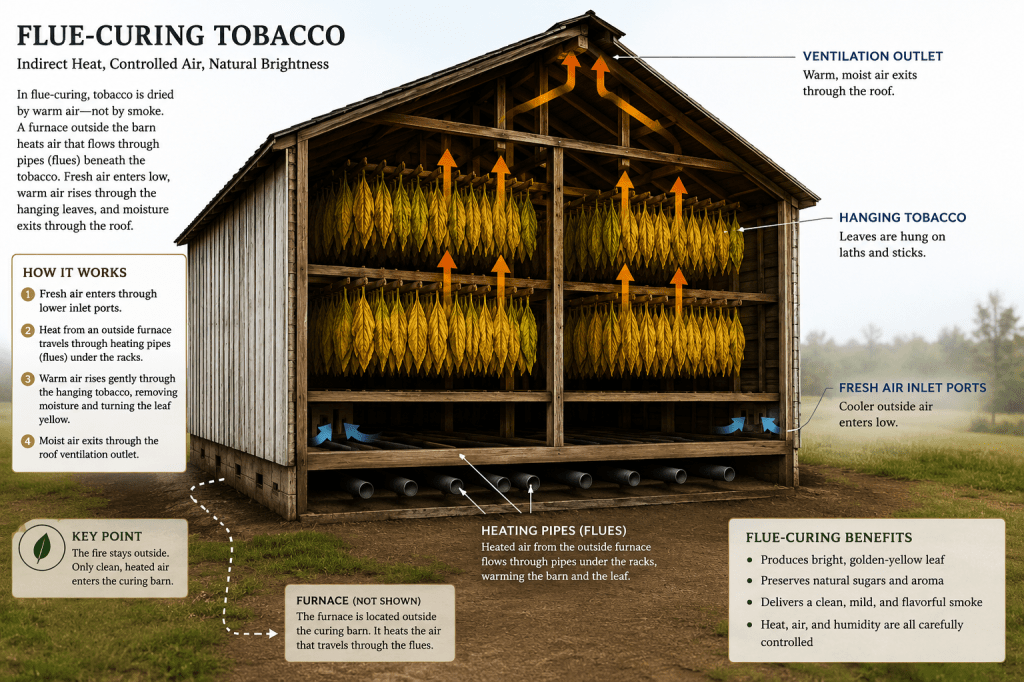
With flue-curing, tobacco is hung in a barn, and heat is carried through pipes or flues that run through the curing space. The fire itself is kept separate from the tobacco, so the leaf isn’t exposed to smoke.
While air-cured cigar tobacco is allowed to slowly turn brown as chlorophyll breaks down and other pigments become more visible, flue-curing takes a different path. In the early stages, the leaf is kept warm and humid enough for yellowing to occur before it’s fully dried. Heat is then increased to dry the leaf and halt biological processes before the color progresses to the deeper browns typical of air-cured tobacco.
This is how Virginia or Brightleaf tobacco develops its characteristic yellow-to-gold appearance, a style of tobacco more commonly associated with pipe and cigarette blends. The yellow-gold color isn’t a fermentation color. It comes from controlled curing. The process keeps the leaf alive long enough for yellowing to occur, then uses heat to prevent the color from progressing further toward brown.
From a wrapper-color standpoint, flue-curing is useful because it shows that not all light tobacco gets there the same way. A light Connecticut-style cigar wrapper and a flue-cured Virginia leaf may both suggest brightness, but they come from different curing methods.
Fire-Curing
Fire-curing is a much less common method for curing cigar tobacco, but several brands have employed it, including Drew Estate’s Kentucky Fire Cured. Unlike flue-curing, fire-curing doesn’t preserve a lighter color by stopping the browning process. It pushes the leaf darker by exposing it to slow heat and smoke.
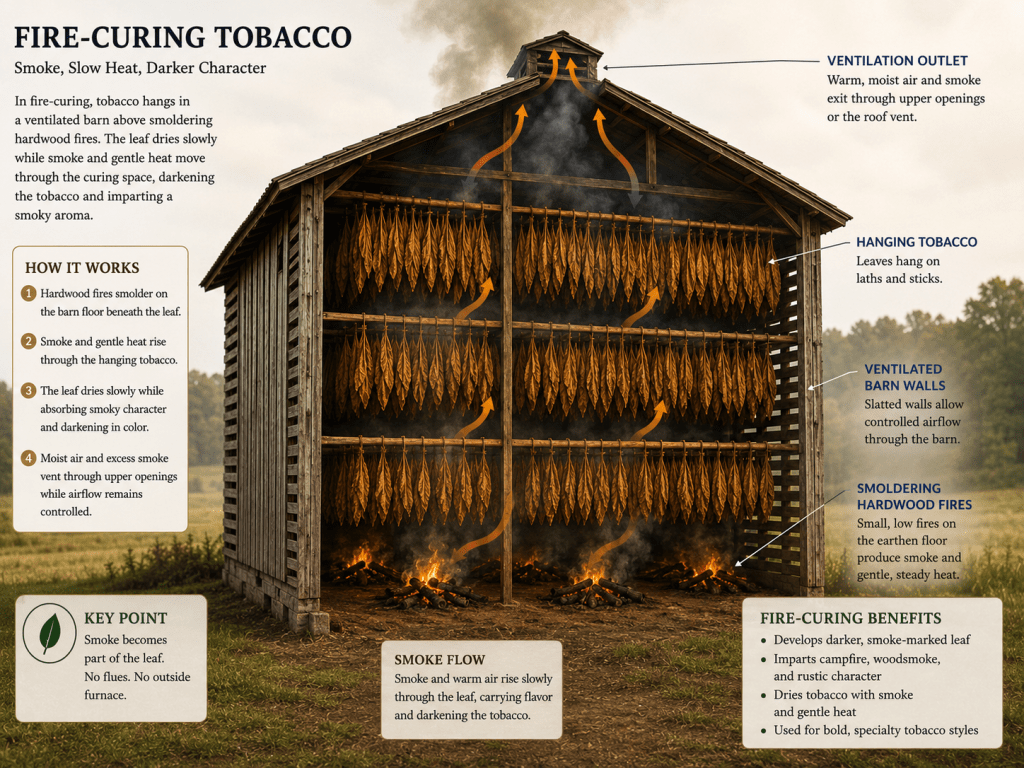
The tobacco is still hung in a barn, and slow-burning hardwood fires are built below the hanging leaves. The smoke enters the curing space and becomes part of the tobacco.
Where flue-cured tobacco is heated, fire-cured tobacco is heated and smoked.
The process usually begins with yellowing, just like other curing methods. But once the fires are started, the leaf moves in a darker direction. Heat, smoke, airflow, and time dry the tobacco while adding the character we associate with fire-cured leaf: smoke, char, barbecue, leather, dark wood, and campfire.
For premium cigars, fire-cured tobacco is usually a specialty component, used when a blender wants that smoky signature built into the leaf before the cigar is ever rolled.
Candela: Green on Purpose
Candela is also an unnatural interruption of the normal curing sequence. Instead of letting the leaf slowly turn brown, the leaf is cured quickly in a heated barn to stop the progression early. The barn is sealed more tightly than a normal air-curing barn, and then propane heaters or charcoal fires are used to raise the temperature and quickly drive moisture out of the leaf. Lower vents and the roof vent control airflow as the heat rises through the hanging tobacco.
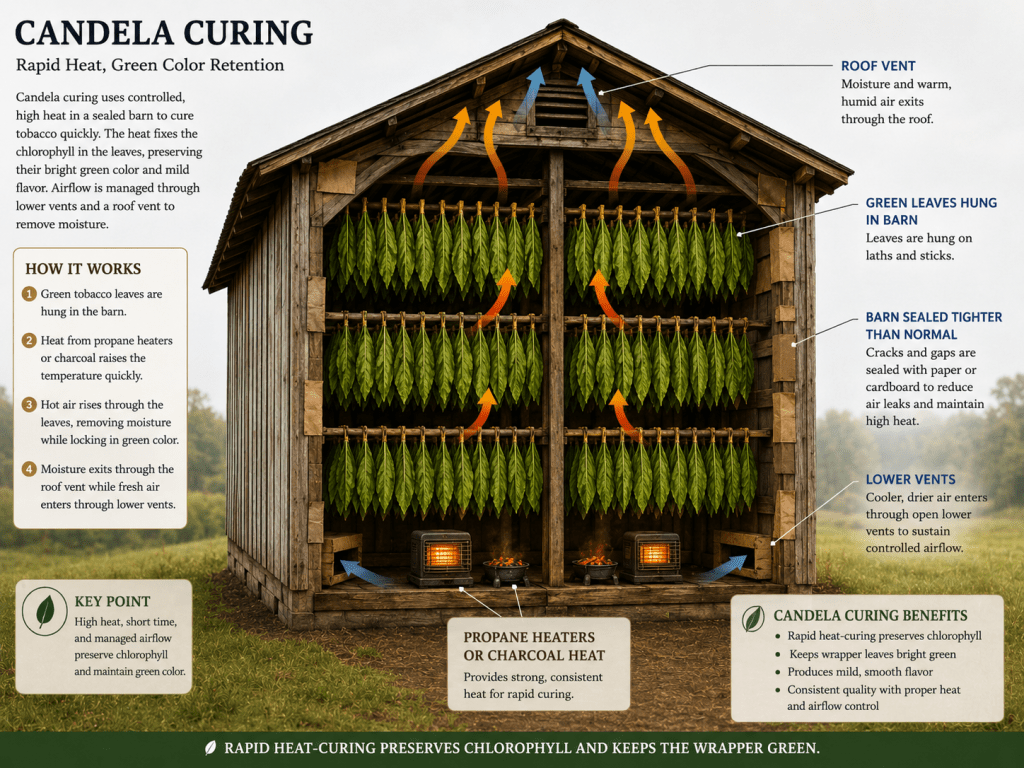
The goal is to fix the green color before the leaf has time to brown. It’s not raw tobacco, and it didn’t skip curing. It was cured in a way that preserved the color most cigar curing methods remove.
That’s why Candela can look unfinished even when it isn’t. The color comes from technique, not neglect.
From a wrapper-color standpoint, Candela belongs in the curing conversation more than the fermentation conversation. Maduro and oscuro wrappers darken with deeper development after curing. Candela goes the other direction. It keeps the leaf from turning brown in the first place and doesn’t usually undergo the same deeper fermentation that other cigar wrappers do.
That also explains the flavor expectation. Candela wrappers often bring grass, herbs, hay, green tea, and a sharper vegetal edge. Whether that works depends on the blend, but the color itself comes from the cure.
Candela isn’t green because it’s raw. It’s green because the curing process stopped the leaf before brown took over.
Color Is the Record
Wrapper color is easy to treat as a shortcut. Light means mild. Dark means strong. Green means fresh. Red means spicy. But the more I looked into curing, the less useful those shortcuts became.
Color isn’t a flavor promise. It’s a record of what happened to the leaf. Air-curing allows cigar tobacco to move from green to brown. Flue-curing preserves yellow and gold. Fire-curing brings smoke into the cure. Candela stops the leaf before it turns brown. Fermentation may deepen the color later, but curing is where the first direction is set.
That doesn’t mean wrapper color tells us everything. It doesn’t. Seed, soil, priming, fermentation, aging, blending, and construction all still have their say.
But wrapper color does tell us the leaf has already undergone a process before we ever cut, light, or taste it. The color we see isn’t just decoration. It’s the visible part of a much longer story.
Sources
- Tobacconist University. “Tobacco College: Curing & Fermentation.” Tobacconist University.
- Reed, T. David. “Curing Tobacco.” In 2024 Flue-Cured Tobacco Production Guide. Virginia Cooperative Extension / Virginia Tech Southern Piedmont Agricultural Research and Extension Center, 2024.
- Bailey, Andy. Harvesting, Curing, and Preparing Dark Fire-Cured Tobacco for Market. AGR-152. University of Kentucky Cooperative Extension Service, 2006.
- Cigar Aficionado. “Candela.” Cigar Aficionado Glossary.
- Cigar Aficionado. “It’s Not Easy Being Green.” Cigar Aficionado, 2002.




Leave a comment