
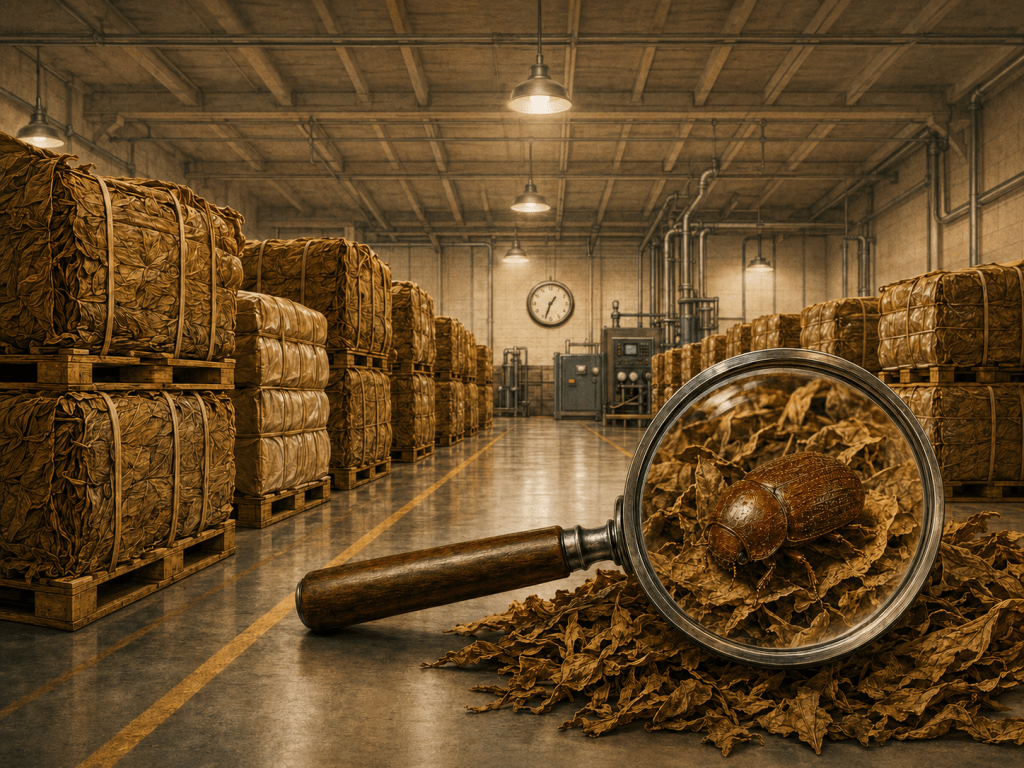
The other day, I was perusing Instagram when I came upon a post by Jonathan Drew Sann, founder of Drew Estate Cigars, giving a sneak peek at his new J. Sann & Son cigar factory in Miami. Near the end of the reel, while speaking about his son, he said, “He will learn the importance of freezing, both tobacco coming in, and finished boxes coming out.” Hearing that, my mind immediately went to cigar beetles and pest control.
But freezing? I wasn’t familiar with the technique. And when I run across something unfamiliar, I have to dig into it. I found a great video by Nick Perdomo discussing how he freezes his boxes before shipping them. So, I confirmed it was a thing. But that only made me ask another question.
What do cigar manufacturers do for pest control?
In my research, I came across several technical guides and scientific papers on tobacco pest control and the various techniques that can be used for pest control. But surprisingly, beyond Nick Perdomo’s explanation of his freezing process, I found no comprehensive discussion of pest control from within the cigar industry itself.
Undaunted, I reached out to a well-known brand and factory owner. He was gracious enough to give me some insight into the subject. According to my source, pest control is a touchy subject in the cigar industry, especially when it comes to the use of chemical fumigants. In the country where he operates, you can get the equipment, but you require a license to use it.
I’m interpolating, but I think another reason this could be such a touchy subject is that cigar culture romanticizes the production process. Cigars are presented as an all-natural product, so the thought that chemical fumigation might be part of that process seems almost unthinkable.
But let’s be clear about this: the threat of pest infestation is constant, from the fields to the finished cigars. Tobacco is an agricultural product. As much as we’d like to believe that anything “unnatural” isn’t used in the process, controlling and eradicating pests is simply a fact of life.
And while this article focuses on controlling and eradicating insects, tobacco processing as a whole is reductive. Curing removes moisture. Fermentation and añejamiento transform the leaf by breaking down and driving off unwanted chemicals and byproducts. Despalillo removes the central midrib. Even rolling cuts the leaves down into usable pieces. At every stage, something has to go.
That includes the bugs.
Two insects are the primary targets of tobacco pest control: the cigarette beetle and the tobacco moth. The tobacco moth doesn’t attack cigar tobacco, but it wreaks havoc on other stored tobaccos, particularly high-sugar, low-nicotine leaf. The cigarette beetle, on the other hand, loves cigar tobacco, and every stage of its life cycle can be present at any point in the process.6
And because it poses the greatest threat to cigar tobacco, going forward, I’ll focus on the cigarette beetle and the methods used to control and eradicate it.
Preventive Maintenance
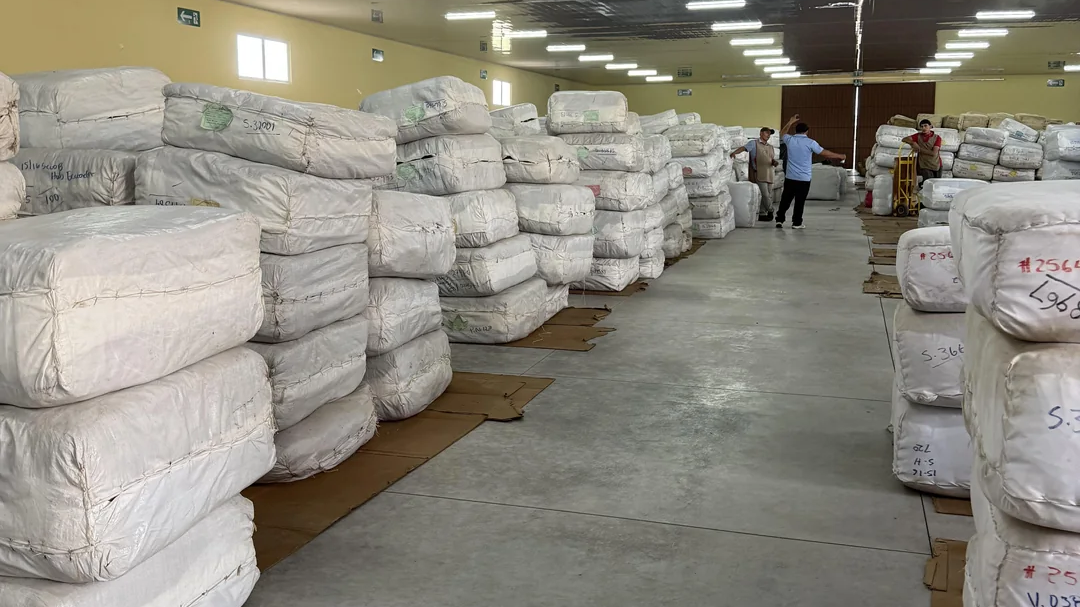
Look inside a tobacco storage facility, and you’ll notice that the bales are neatly stacked and the aisles are wide, clear, and clean. That isn’t just organization.
A critical part of pest control is cleanliness.
Scraps and dust can carry insects and their eggs, so keeping things clean helps to mitigate the risk of infestation.
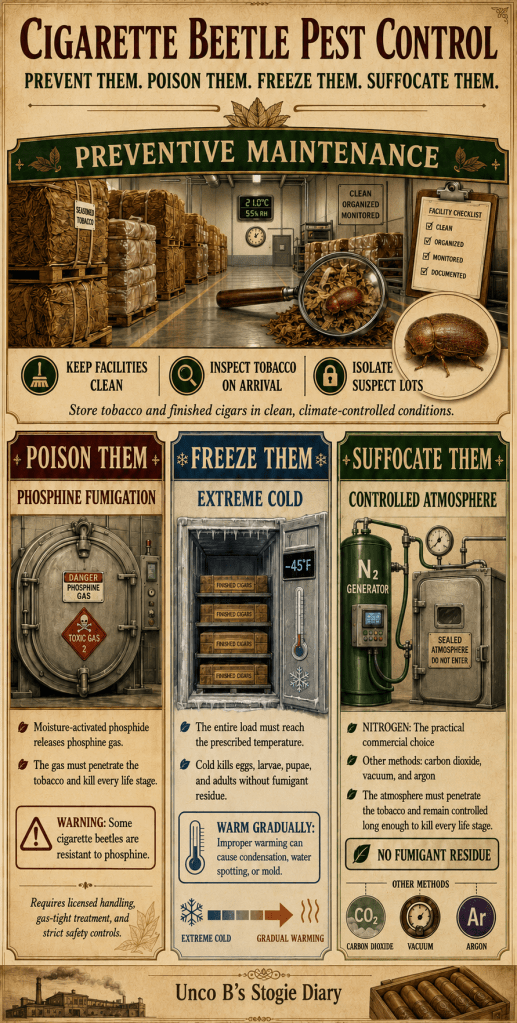
Preventive maintenance focuses on keeping facilities clean, sealed, and closely monitored. Tobacco is inspected on arrival, suspect lots are isolated, and conditions like temperature and humidity are controlled to reduce the risk of infestation.6
None of this kills an established infestation. It keeps beetles out, denies them places to hide, and exposes them before they can spread. But despite all those efforts to reduce the chance of infestation, it still happens, and the bugs have to be eradicated.
The methods can be distilled down to three basic approaches:
Poison them.
Freeze them.
Suffocate them.
Getting Rid of the Bugs
To be clear, factories don’t wait until they see beetles flying around before they act. By then, the infestation is already established. The adults are the warning. The larvae are doing the damage.
Once the eggs hatch, the larvae burrow into the tobacco and feed as they grow. They remain hidden inside the leaf until they pupate and emerge as adults. Those familiar pinholes are exit wounds. By the time they appear, the tobacco has already been eaten.5
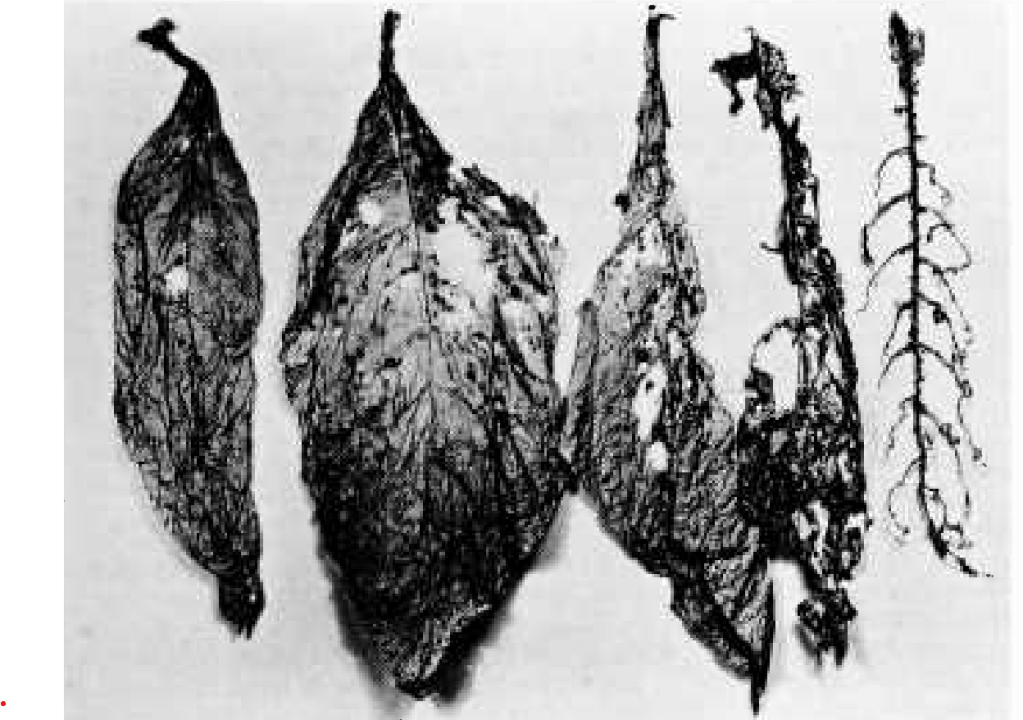
As an aside, tobacco moth larvae cause the worst damage. They eat the leaf down to its stems and major veins, leaving trails of silk studded with their excrement—shit on a string. When the damage is extensive, the entire leaf is webbed in it.
Gross.
Pest control can’t be aimed only at the beetles you can see. Whatever method a factory uses has to penetrate the tobacco and kill the pest at every stage of its life cycle.
Poison Them
Fumigation involves sealing tobacco inside a warehouse, chamber, shipping container, or beneath a gas-tight covering, then introducing a poisonous gas that can penetrate the leaf. The gas has to remain at the proper concentration and temperature long enough to kill every stage of the insect’s life cycle. If the enclosure leaks or the gas doesn’t penetrate the tobacco completely, some of the bugs can survive.
The most widely used fumigant is phosphine. It’s effective, relatively inexpensive, and leaves little residue, but it isn’t infallible.
Some cigarette beetles have developed resistance to it.
A study of beetles collected from six tobacco facilities in the eastern United States found phosphine-resistant populations in all six. At four of the facilities, more than 90 percent of the beetles tested were resistant, and some survived exposure to 600 parts per million of phosphine for six days. Continuing to fumigate those populations with phosphine may accomplish little more than killing the susceptible insects and allowing the resistant ones to reproduce.5
In other words, a fumigation can be performed correctly and still fail.
There are alternative chemicals, but they aren’t necessarily available, approved, or practical everywhere. Replacing one poison with another also doesn’t eliminate the licensing, safety procedures, gas-tight facilities, and regulatory controls that come with fumigation.
And while fumigation appears to be the most common eradication method, it carries a stigma because of the perception that it might leave chemical residue behind.
So, the other option is to stop poisoning the bugs.
Freeze Them
Freezing is exactly what it sounds like, but it isn’t as simple as putting tobacco into a cold room for a few hours.
The entire load has to reach the required temperature, including the tobacco at the center of the densest bale, carton, or pallet. The outside can be frozen while the interior remains warm enough for the insects to survive. Treatment time therefore depends on the size and density of the load, the freezer temperature, and how long it takes the center of the tobacco to reach the target temperature.2,5
Once it does, the cold kills the eggs, larvae, pupae, and adults without introducing a fumigant or leaving a chemical residue.
That brings me back to Nick Perdomo. In the process he describes, finished cartons are loaded into a freezer room built from a 45-foot shipping container. The temperature is driven down to 45 degrees below zero Fahrenheit, then gradually raised in ten-degree increments. Evaporators control the moisture so the cigars emerge without condensation or dew.
Bringing the tobacco back up to temperature is just as important as freezing it. If it’s exposed too quickly to warm, humid air, condensation can form on the surface, creating the potential for water spotting or mold. The tobacco has to warm gradually under controlled conditions.2,5
Freezing doesn’t depend on the insect being susceptible to a particular poison. If the tobacco reaches the prescribed temperature and remains there for the prescribed time, the beetles die.
J. D. Sann also mentioned freezing incoming tobacco. When I brought this up with my source, he was skeptical that it would be practical. “We’re talking thousands of pounds of tobacco,” he told me. I don’t know how Sann plans to do it, so I’m not going to venture a guess.
Suffocate Them
The third method replaces the air surrounding the tobacco with an atmosphere the insects can’t survive. This is known as controlled-atmosphere pest control.3
It can be done by filling a gas-tight chamber with nitrogen to displace the oxygen, raising the concentration of carbon dioxide to a toxic level, or applying a vacuum to reduce the amount of oxygen available.3,5
My source also mentioned argon and specifically said that Scandinavian Tobacco Group uses it in Danlí, Honduras, although I haven’t been able to confirm that. In one comparative study, argon killed the tested insects faster than nitrogen under comparable conditions.8
Nitrogen, however, is the practical commercial choice. It can be separated from the air on-site using a generator, making it considerably less expensive than bringing in cylinders of argon.
“Suffocation” is a convenient way to describe the process, although the methods don’t all work in precisely the same way. Nitrogen and vacuum treatments kill primarily through oxygen deprivation. High concentrations of carbon dioxide also disrupt the insects physiologically. Either way, the atmosphere has to penetrate the tobacco and remain at the prescribed concentration and temperature long enough to kill every life stage.
As with fumigation, the enclosure has to be gas-tight. Ordinary warehouses are often too leaky, so the tobacco is generally treated inside sealed chambers or beneath specially designed coverings. Controlled-atmosphere treatments can also take longer than chemical fumigation, particularly at lower temperatures.
But they leave no pesticide residue, and phosphine-resistant beetles have no special protection against them.
Summing It Up
After digging into all of this, what surprises me most isn’t how manufacturers deal with cigarette beetles. It’s how rarely anyone in the cigar industry talks about it. We hear endlessly about cultivation, curing, fermentation, aging, blending, and rolling. Pest control remains backstage, perhaps because acknowledging chemical fumigation threatens some of the romance surrounding an “all-natural” product.
But mitigation and eradication are simply a part of handling an agricultural product that remains vulnerable to infestation throughout its journey from the field to the finished box.
And it certainly isn’t as simple as spraying a warehouse. Effective pest control involves the design and maintenance of the facility, the movement and separation of tobacco, constant monitoring, specialized equipment, trained personnel, and treatments that must reach every insect at every stage of its life cycle. Killing the bugs is only one part of a much larger process designed to keep them from spreading in the first place.
The cigar in your hand isn’t merely the product of the field, the pilón, and the rolling table. It’s also the product of everything manufacturers do to protect the tobacco between those stages.
The industry may not like talking about the bugs.
But getting rid of them is part of making cigars.
Sources
- Cooperation Centre for Scientific Research Relative to Tobacco (CORESTA). Technical Guide for Phosphine Fumigation Parameters for the Control of Cigarette Beetle and Tobacco Moth. CORESTA Guide No. 2, Version 4, August 2019.
- Cooperation Centre for Scientific Research Relative to Tobacco (CORESTA). Freezing Parameters for the Control of Cigarette Beetle and Tobacco Moth. CORESTA Guide No. 9, second edition, August 2019.
- Cooperation Centre for Scientific Research Relative to Tobacco (CORESTA). Technical Guide for Controlled Atmosphere Parameters for the Control of Cigarette Beetle and Tobacco Moth. CORESTA Guide No. 12, April 2020.
- Cooperation Centre for Scientific Research Relative to Tobacco (CORESTA). Technical Guide for Sulfuryl Fluoride Parameters for the Control of Cigarette Beetle and Tobacco Moth. CORESTA Guide No. 31, June 2025.
- Edde, Peter A., and Thomas W. Phillips. “Integrated Pest Management Strategies for Cigarette Beetle Control in the Tobacco Industry—A Mini Review.” Contributions to Tobacco & Nicotine Research 31, no. 2 (July 2022): 90–100. https://doi.org/10.2478/cttr-2022-0009.
- United States Department of Agriculture, Agricultural Marketing Service, Stored-Product Insects Branch. Stored-Tobacco Insects: Biology and Control. Agriculture Handbook No. 233. Washington, D.C.: United States Department of Agriculture, October 1962.
- Köhler, Andreas, Kassia Cristine Freire Zilch, Daniela da Costa e Silva, Rafael Martins da Silva, Milena Isabel Rauber, and Ana Lúcia Köhler. “Lasioderma serricorne (Coleoptera: Anobiidae) and Ephestia spp. (Lepidoptera: Pyralidae): Pests of Tobacco and Tobacco Products.” Revista DELOS 17, no. 62 (December 2024): e3144. https://doi.org/10.55905/rdelosv17.n62-079.
- Valentín, Nieves. “Comparative Analysis of Insect Control by Nitrogen, Argon and Carbon Dioxide in Museum, Archive and Herbarium Collections.” International Biodeterioration & Biodegradation 32, no. 4 (1993): 263–278. https://doi.org/10.1016/0964-8305(93)90029-2









Leave a comment