
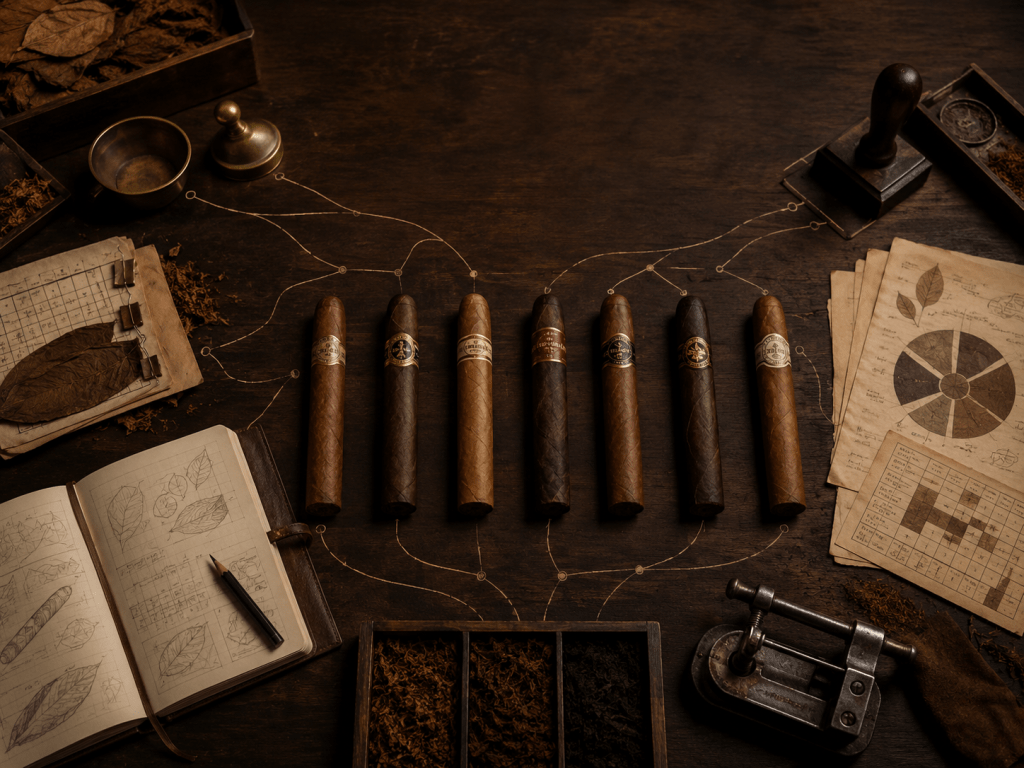
You may have noticed that I talk a lot about blenders. That’s because when I’m trying to understand a cigar, I’m also trying to understand the intent behind it. And to understand the intent, I’ve found it useful to study the blender behind it.
That has become especially important in the boutique cigar world. Smaller brands have changed the way many of us look at cigars. They’ve made the people behind the cigars more visible. We’re no longer just talking about wrapper, binder, filler, factory, or flavor notes. We’re talking about identity, point of view, and authorship.
A boutique cigar can feel personal in a way larger legacy brands sometimes don’t. The blender’s fingerprints are easier to see. The choices feel closer to the surface. When a cigar works, it doesn’t just taste good. It feels like someone had an idea and followed it all the way through.
These are some of the blenders and blending teams I pay attention to. This isn’t a ranking. It isn’t a “best of” list. These are people whose cigars make me stop, listen, and ask what they were trying to say.
To put a fine point on it, all these blenders and blending teams have a few things in common:
- The intent behind their cigars is usually easy to see. Sometimes they say it upfront. Sometimes the cigar says it for them.
- They all make consistently good cigars across their brand. Sure, there are some I like more than others, but I can usually trust that what I smoke will not disappoint me.
- Their stories are not bigger than their cigars, which happens more often than it should in the boutique world.
Luis Barragan — Dunamis Cigars
Originally, I was going to put Luis Barragan and Raul Lanuza together because, technically, they form the blending team that makes Dunamis Cigars possible. But as I’ve gotten to know Luis, I’ve come to admire his instincts and depth of knowledge as a blender, as he has also blended cigars outside of Dunamis. I’ve learned so much about the process of producing a cigar, from leaf selection to finished cigar, through my conversations with him.
More importantly, I’ve been fascinated by listening to him explain how he envisions the experience of one of his cigars. It’s not just the flavors it presents, but how he wants a profile to move and shift, how strong it should be to convey the idea, and what the smoker should walk away with. That level of intent is what draws my attention.
To be clear, none of it is explained in thirds.
Raul Lanuza — Tabacalera Lanuza/Lanuza Cigars
Luis explained to me that Dunamis wouldn’t exist without Raul. I suggested that it’s their teamwork that has made Dunamis possible. What they’re doing together is very different from what either of them does on his own.
But Raul is also a blender I’ve been following since I smoked the LCA Super Sea Monkeys 2025. I was so blown away by that cigar that I wanted to find out as much as I could about its creator. What I’ve discovered is a true artist, someone who seems to understand tobacco as both material and medium.
Michael Herklots — Ferio Tego Cigars
What can I say about Michael Herklots that hasn’t already been said?
For me, the answer starts with restraint. Herklots has a way of making cigars that feel composed without feeling static. His blends don’t shout for attention. They invite attention. And the more time I spend with Ferio Tego, the more I appreciate how much thought seems to sit underneath the surface.
Jamond Hackley — Definition Cigars
When I think of Jammond Hackley, I think of someone who is willing to challenge how we think about cigars.
Definition Cigars has made me pay attention because Jammond doesn’t seem interested in simply repeating what already works. With cigars like GEN413 and One13, there’s a sense of exploration. Sometimes that means the cigar asks more of the smoker. Sometimes it means the idea is easier to recognize after the smoke than during it. Either way, I respect his willingness to push conceptual boundaries.
Paul Stulac – Paul Stulac Cigars
Paul Stulac is one of those blenders who makes me shake my head. His cigars are bold, rich, and unapologetic, but they’re not careless. They have power, but they also have movement. They can be dense, strong, and full-throttle, yet there’s usually more going on than the first wave of intensity suggests.
They remind me that value doesn’t have to mean compromise. Sometimes value means the blender gave you more than you had any right to expect. With Paul Stulac, it boils down to his absolute focus on the blend. And that focus shows up in the cigars.
Daniel Lance/Esteban Disla — Domain Cigars
This blending team is the epitome of intent. For every cigar they make, Daniel explains exactly what they want it to do. I’ve only had the Entropy and Neutron thus far, but each one behaved just as Daniel described.
What I love is that they’re so upfront about their intent. It’s like Lucy from Peanuts yelling, “I say what I mean. I mean what I say.” That takes gumption. Read: big steel ones. But to say it clearly and then actually pull it off is nothing short of amazing.
Don Emmanuel/Eladio Diaz — Don Emmanuel Cigars
Don Emmanuel and Eladio Díaz fascinate me because they represent the true meeting of vision and execution. Don Emmanuel speaks about cigars in a way that can sound almost spiritual. He talks about the experience, the energy, the intention, and what a cigar should give back to the smoker. That kind of language can fall apart quickly if the cigar doesn’t support it.
That’s where Eladio Díaz matters.
Eladio brings the weight of a master blender. He gives Don Emmanuel’s ideas shape, discipline, and credibility. Don may know what he wants the cigar to express, but Eladio knows how to translate that into a finished cigar. That partnership is what makes me pay attention.
Jon Huber is a little harder for me to write about because Crowned Heads has a lot of blends. A lot. There are core lines, limited releases, collaborations, regional releases, and cigars made at different factories with very different identities. Trying to reduce all of that to one neat signature would miss the point.
What makes Huber interesting to me is not that every Crowned Heads cigar tastes or behaves the same. It’s that so many of them feel like they began with a clear idea. Crowned Heads has always been good at turning concepts into cigars without letting the concept become bigger than the cigar itself.
Though I haven’t studied him deeply, I get a sense of humility in Reinier Lorenzo’s approach to blending. He relies heavily on his Cuban roots, but doesn’t lean into nostalgia or let his story speak louder than his cigars. HVC has given me some of the clearest examples of Cuban sensibility expressed through Nicaraguan tobacco. In other words, he lets his cigars do the storytelling.
That matters to me because Cuban influence is easy to claim and hard to express. A cigar can lean on Havana imagery, Cuban-seed tobacco, or nostalgia and still miss the point. What impresses me about HVC is that the best of those cigars seem to understand the behavior behind the reference. They don’t imitate Cuba. They understand it.
Raymond Pages — Tabacalera Pages de Nicaragua
Raymond Pages is the blender I was probably most unfair to. He spent years inside the A.J. Fernandez operation, where he was deeply involved in tobacco selection, sourcing, test blends, and production. But when I first started seeing his name, I reduced him to “the guy who blends those cheap Cigar Page cigars.”
Then I started smoking them. Once I recognized the intent and architecture behind his blends, he became someone I paid close attention to.
It would be easy to dismiss his work for Cigar Page as little more than high-volume, inexpensive house blends. But creating great cigars under what appear to be tight budget constraints takes real skill. I wouldn’t hesitate to stand some of his blends against top boutique cigars.
The more I smoke, the more I realize that great cigars rarely feel accidental. They may surprise me. They may challenge me. They may even confuse me at first. But when they work, there is usually a sense that someone knew what they were trying to make.
That’s why I pay attention to blenders.
Not because the name behind the cigar matters more than the cigar itself. It doesn’t. The cigar still has to deliver.
But when the cigar does deliver, understanding the person behind it helps me understand why it works. It gives me another way to see the decisions, the discipline, the risks, and the intent that made the experience possible.
And in the boutique cigar world, that intent is often where the real story begins.





Leave a comment