
Recently, I got into a deep discussion with a blender about his approach to one of his cigars. At one point he said, “Yeah, I wanted to use a higher priming for some added oomph, but that wasn’t available, so I went with what they had.”
We talked about the benefits of the different priming levels. His first thought was to go with ligero for more punch, but he ended up using a combination of seco and viso for the filler.
I remarked that it might’ve been a blessing in disguise because the end result, while still strong and full-bodied, was so aromatic and flavorful. That might have been lost with a higher priming.
Recalling that conversation made me realize that “priming” is yet another thing in the industry that gets flattened and conflated with related terms that, in practice, aren’t interchangeable. Namely, grading and sorting.
Unfortunately, even manufacturer marketing perpetuates this.
I don’t know how many marketing blurbs I’ve seen that say something like, “We used the highest primings available to deliver the highest quality experience to the smoker.” It’s not necessarily wrong, but as I explained about wrapper color versus strength in “Recommending Cigars to Beginners,” it’s incomplete.
In light of that, I thought it would be useful to have a more in-depth discussion on priming, grading, and sorting, because they’re not the same thing.
Priming
In “The Leaves of the Blend,” I discussed tobacco harvesting and the general qualities each priming level brings to the flavor profile and burn qualities of a cigar.
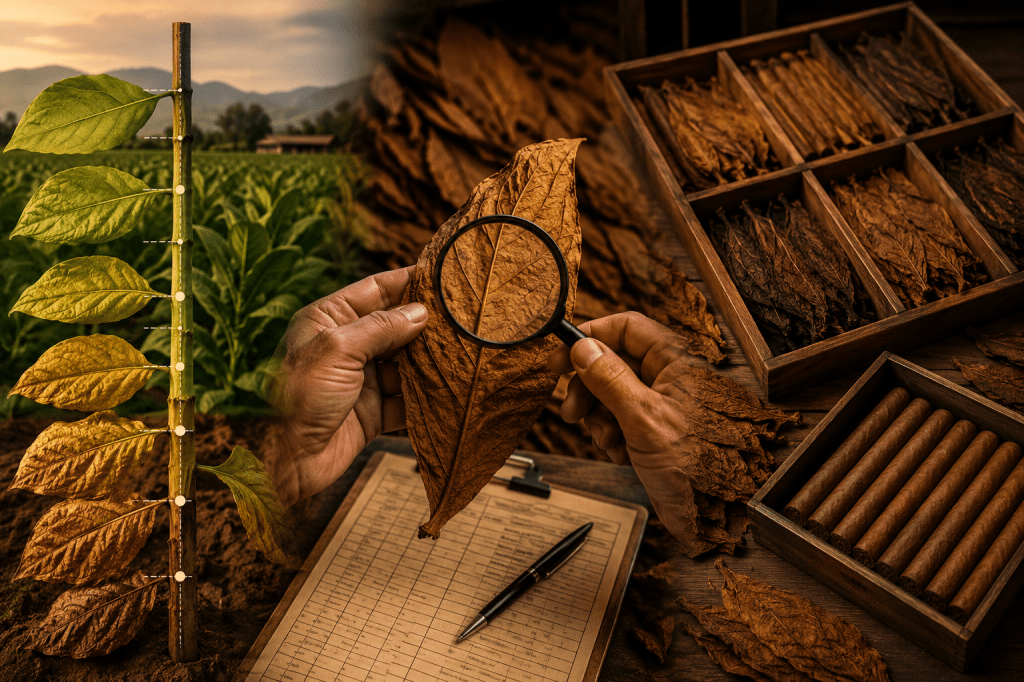
For the purposes of this discussion, priming refers to where the leaf grew on the tobacco plant.
That’s it.
If a blender says they wanted a higher priming, they’re usually talking about a certain kind of behavior like strength, body, flavor, or “oomph.” But that doesn’t necessarily mean the higher priming would have made the cigar better. It only means it would have changed the cigar.
A higher leaf isn’t a better leaf.
It’s just a higher leaf.
Priming simply describes where a leaf grew on the stalk. It doesn’t describe quality.
Stalk position influences certain tendencies, including thickness, strength, oil, size, and combustion. But the leaf’s actual role and grade are determined later through grading and sorting.
Grading and Sorting
This is where things get a little messy.
Not in a bad way, but the process of grading and sorting leaves by quality and intended use is incredibly complex, highly iterative, and varies wildly between manufacturers.
When I first started researching for this piece, I assumed that grading and sorting were single, monolithic steps in the process. But as I dug deeper, I realized that they happen repeatedly, at different points in the leaf’s journey, and for different reasons.
And there isn’t one universal system.
How Quesada grades and sorts its tobacco may be very different from how Davidoff, Padrón, or Perdomo does it. Each manufacturer has its own standards, vocabulary, tolerances, and priorities.
I also went into my research thinking that sorting was simply about separating leaves into wrapper, binder, and filler. But it turns out there are far more levels of sorting than that, with manufacturers combining and applying grading parameters in all sorts of ways.
And here’s another interesting tidbit I discovered: any priming can be used for wrapper, binder, or filler. A leaf’s stalk position may influence its tendencies, but it doesn’t lock that leaf into a particular role. That depends on how it measures against the manufacturer’s grading and sorting standards.
Messy.
The diagram below is the easiest way I found to make sense of it. The details change from one manufacturer to another, but the basic idea is that grading, sorting, and processing can keep feeding back into each other until the leaf ends up where it belongs.

What’s Going On?
As the diagram illustrates, grading, sorting, and processing are cyclical and iterative. They keep feeding back into one another throughout the leaf’s journey.
And to be clear, “tobacco processing” is a broad term for the various steps involved in preparing premium tobacco, such as curing, fermentation, and aging. What I’ve provided is a bit of an oversimplification. But the relationship between processing, grading, and sorting is what matters.
In grading, a leaf is judged using the parameters that apply at a given point in the process. It may be assigned a grade, sorted with similar leaves, and designated as wrapper, binder, filler, or any number of other classifications depending on the desired outcome.
But another processing step can change the leaf or reveal something that wasn’t apparent before, sending it back through grading and sorting under a different set of parameters. And that can happen several times from curing through rolling.
Like I said, it’s messy.
What Gets Graded?
Pretty much everything that tells a manufacturer what a leaf can do.
That can include size, color, texture, thickness, elasticity, vein structure, damage, fermentation condition, aroma, flavor, strength, body, and combustion. It can also include how much usable leaf is available, whether it fits a particular vitola, and whether it belongs in a specific blend.
But those parameters aren’t always judged at the same time, and they aren’t always weighted the same way.
A leaf being evaluated for wrapper is judged differently from one being considered for filler. And after another fermentation, stripping, aging, or other processing step, the same leaf may be graded and sorted again under a different set of criteria.
And although I simplified the cycle in the diagram above, different leaves and lots may be moving through several grading, sorting, and processing cycles at the same time. It’s a sophisticated and intricate dance that’s not easy to illustrate.
That’s why grading and sorting aren’t just about deciding whether a leaf becomes wrapper, binder, or filler. They’re about deciding what that leaf is best suited to do at a particular point in the process.
It’s Not About Better
When a manufacturer says it used a higher priming, that tells us something about where the leaf came from and what kind of behavior it may bring.
It doesn’t tell us that the leaf was better.
That determination happens afterward, when the leaf is graded and sorted according to what it can actually do.
So, priming tells us where the leaf started.
Grading and sorting tell us where it belongs.
Sources
- Rocky Patel Premium Cigars, “Chapter 4: Sorting & Fermentation.” Covers the classification of cured leaves as wrapper, binder, or filler and the physical standards applied during sorting. (Rocky Patel Premium Cigars)
- Gary Korb, “Binder Tobacco’s Role in Premium Hand-Rolled Cigars,” Cigar Journal, Winter 2017. Interview with Ernest Gocaj, then director of tobacco procurement for General Cigar Company, discussing fermentation by grade, sorting, and the principle that tobacco may be designated as wrapper, binder, or filler according to the manufacturer’s standards. (Cigar Journal)
- Scandinavian Tobacco Group, “From Seed to Handmade Cigar.” Provides an overview of harvesting, curing, fermentation, conditioning, grading, sorting, stripping, rolling, inspection, and final color sorting. (Scandinavian Tobacco Group)
- Cigar World, “Sorting & Grading Tobacco,” May 23, 2022. Discusses sorting before fermentation and rolling, including evaluation by size, shape, texture, color, and intended use as wrapper, binder, or filler. (Cigar World)







Leave a comment