
Recently, a reader commented on Kill the Beast: Pest Control in Cigar Tobacco, saying they’d like to know more about pests and pesticides in the field. That got my wheels spinning, so I researched the topic. And researched. And researched. There was a lot more to dig through than I’d expected.
The pesticide part of the question is fairly easy to look up. Tobacco production guides list the products growers can use for a particular pest. But read the rest of an entry and you start to see how much goes into deciding whether to use one. Has this pest caused trouble in the field before? Is something still feeding, or did the grower find damage from a week ago? How many plants are affected, and how much more damage can the pest do at this stage of the crop?
Those questions are part of an approach the U.S. Environmental Protection Agency describes as integrated pest management, or IPM. The idea is to prevent damage where possible and recognize when the crop needs protection. Growers use what they know about the field to prevent problems, scout the crop to find out what’s happening, and account for any control that’s already at work. If an infestation does warrant treatment, they can choose a method, a time, and sometimes even a particular set of rows to treat. To see how those pieces fit together, it helps to start before there’s any tobacco in the ground.
What happened in this field last season?
Take root-knot nematodes. These microscopic roundworms feed on the roots, where they cause swollen galls and can stunt the whole plant. A grower with a history of nematode damage can have the soil tested before planting. Knowing which nematode is present helps the grower choose a resistant tobacco variety or rotate to a crop that particular nematode can’t reproduce on. In the case of rotation, one of the decisions that protects the next tobacco crop is what to grow in its place this season.
Field history figures into wireworm management for a different reason. Wireworms feed underground and can tunnel into the stem of a newly set tobacco plant. Once a larva is inside, spraying the leaves won’t reach it. A grower who knows wireworms have been a problem in that field can decide whether a soil treatment before planting or a treatment in the transplant water is warranted. Waiting to see a struggling seedling can mean missing the opportunity to protect it.
What’s feeding now, and how much of the field is affected?
Once the tobacco is growing, that’s what scouting is meant to establish. A tobacco budworm feeds at the growing tip, where the young leaves are still folded together. One caterpillar can chew through several of them. As those leaves open and grow, so do the holes. The curious thing about budworm damage is that it can look worse even after the budworm is gone. To find out how much of the crop is still under attack, growers open the buds on a sample of plants and count the ones with live larvae.
With cutworms, where the grower finds the damage can change the extent of the treatment. A cutworm can clip a newly transplanted seedling at the soil line. Freshly cut plants give the grower a place to start looking, and dusk is a good time to check because that’s when cutworms are active. If the feeding is confined to the field edge, treating that edge may be enough. Walking farther into the rows helps establish where the treatment can stop.
How much damage are the pests likely to do?
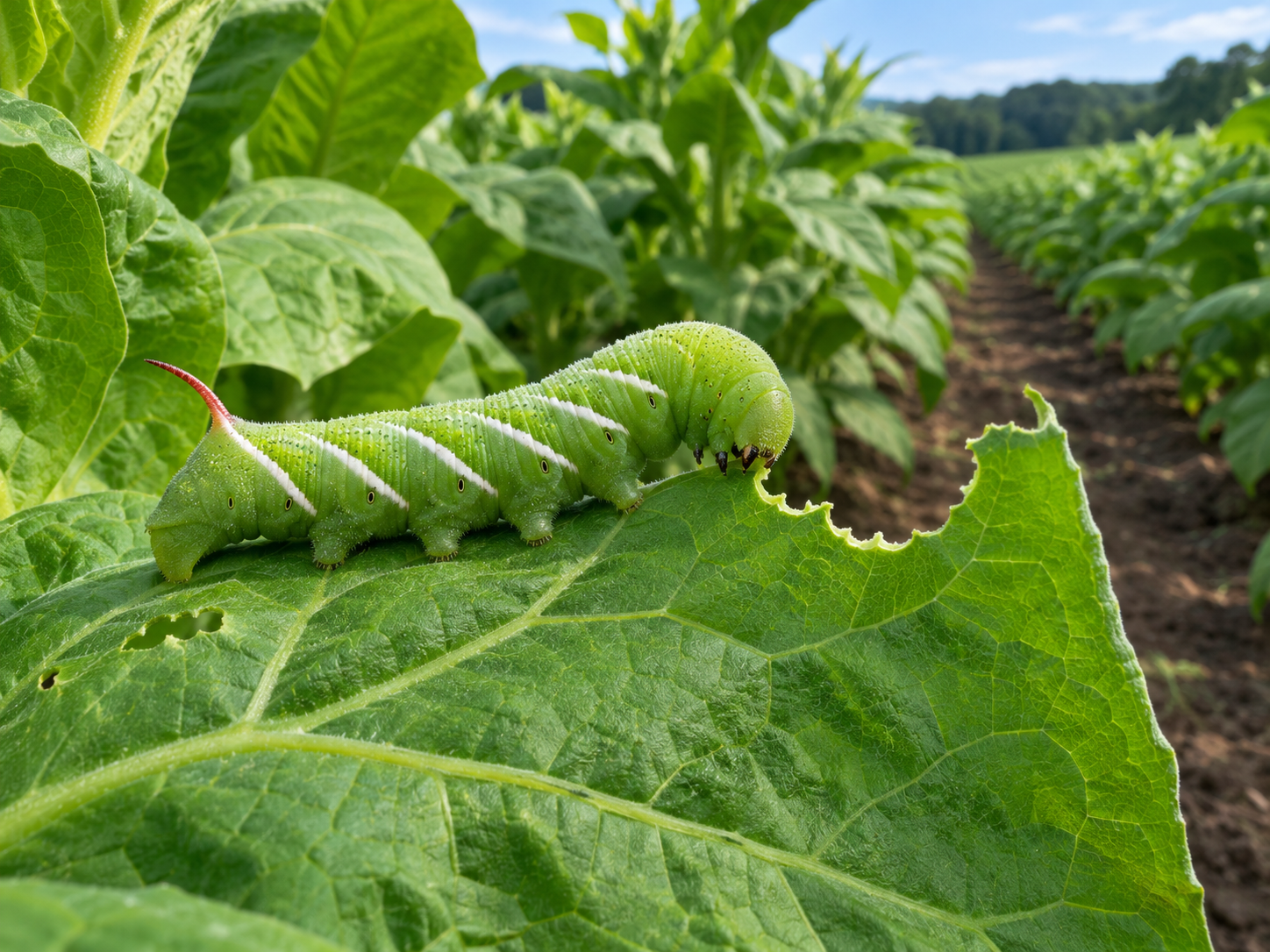
This is where a treatment threshold comes in. It gives the grower a way to decide when an infestation is large enough to justify taking action. The hornworm is my favorite example because even after you’ve found the caterpillars, you need to look at their backs before you can get a meaningful count.
A couple of large hornworms can strip a tobacco plant. But if a hornworm has little white cocoons on its back, a parasitic wasp has already gotten to it. By the time those cocoons appear, the caterpillar is eating about a fifth as much as one without them. NC State accounts for that in its scouting guidance. It takes five hornworms carrying cocoons to count as one toward the treatment threshold. Growers leave those caterpillars in place so the adult wasps can emerge and lay their eggs in other hornworms.
What I like about that example is that the wasp changes two decisions at once. It changes how the grower counts the infestation, and it gives the grower a reason to leave a live pest on the plant. If enough young, actively feeding hornworms are present to warrant treatment, growers still have options, including Bacillus thuringiensis (Bt) and spinosad. Both work best while the caterpillars are small.
I’ve put the field reference below so you can look up a particular pest, see what its damage looks like, and follow the sources for how it’s managed. Most of the production guides are from the U.S. I’ve also included a Cuban budworm study and a field trial on Habano tobacco in Estelí.
| Pest | What it does to the tobacco | Treatment |
|---|---|---|
| Tobacco and tomato hornworms both eat tobacco leaves. Large caterpillars can strip a plant. Their barrel-shaped droppings often give them away before the grower sees them. | On small plots, growers can pick them off by hand. For larger infestations, Bacillus thuringiensis (Bt) and spinosad are most effective while the caterpillars are small. Chlorantraniliprole and indoxacarb are also effective against hornworms. Growers leave caterpillars carrying white wasp cocoons in place so the next generation of parasitic wasps can emerge. | |
| Feed inside the folded leaves at the growing tip. As the leaves unfurl, the holes enlarge. One caterpillar can damage several future wrapper leaves. | Growers open the bud and check for live larvae. When enough plants are infested to warrant treatment, NC State identifies spinosad or a product combining lambda-cyhalothrin and chlorantraniliprole. In crops that are topped, timely removal of the flower head also reduces budworm damage. | |
| Chew small, round “shot holes.” Heavy feeding slows young plants, and even scattered holes can reduce the value of mature wrapper leaf. | Broadleaf growers can protect seedlings with imidacloprid or thiamethoxam in the seedling tray or transplant water. The roots absorb the insecticide. Acetamiprid is a foliar option for flea beetles, with restrictions based on which insecticide the crop received earlier. | |
| Both attack newly set plants. Cutworms sever the stem near the soil line. Wireworms feed underground and can bore into the stem. | For cutworms, growers check freshly clipped plants at dusk. Acephate is one treatment for active feeding, and treating the field edge may suffice when damage is confined there. For wireworms, protection comes earlier. In fields with a history of damage, bifenthrin can be applied to the soil before planting or in transplant water. A spray after larvae have tunneled into stems offers no effective rescue. | |
| Both draw sap. Aphids also leave sticky honeydew on which dark sooty mold can grow. Whiteflies are a documented pest of Habano tobacco in Estelí. | For aphids, Broadleaf guides list imidacloprid or thiamethoxam for early systemic protection. For whiteflies, the Estelí researchers compared thiocyclam with three fungal biopesticides: Beauveria bassiana, Metarhizium anisopliae, and Isaria fumosorosea. All three fungi suppressed whiteflies better than thiocyclam in that trial. Whitefly pressure was low, and dry-leaf yields were statistically similar. | |
| Scar the leaf as they feed. In the southeastern United States, tobacco thrips can also transmit tomato spotted wilt virus. | Growers remove weeds and volunteer crops before transplanting so displaced thrips have time to disperse. In areas with recurring spotted wilt, imidacloprid or thiamethoxam applied to seedling trays can suppress thrips and reduce early infections. Spinosad is another option at transplanting. These insecticides target the thrips that carry the virus. | |
| These microscopic roundworms cause swollen galls on the roots and can stunt the whole plant. | Soil testing helps growers choose a resistant tobacco variety or a rotation crop the local nematode species cannot reproduce on. Where a nematicide is warranted, tobacco guides list 1,3-dichloropropene as a soil fumigant before planting and fluopyram as a nonfumigant option applied in transplant water. |


What did the treatment accomplish?
The Estelí trial illustrates why that question is worth asking. Researchers compared an insecticide called thiocyclam with three fungal biopesticides for controlling whiteflies. All three fungi did a better job of suppressing whiteflies than thiocyclam did in that trial. Did that give the growers more tobacco? Whitefly numbers were low to begin with, and the researchers found no statistically significant difference in dry-leaf yield among the treatments.
That gets to the purpose of IPM. The grower is trying to protect a crop, and a lower insect count is only useful to the extent that it helps do that. In one field, protecting the tobacco can mean rotating crops before the next planting. In another, it can mean treating the few rows where cutworms are still feeding. And sometimes it means finding a hornworm halfway through lunch, taking one look at the cocoons on its back, and leaving it to the wasps.








Leave a Reply