
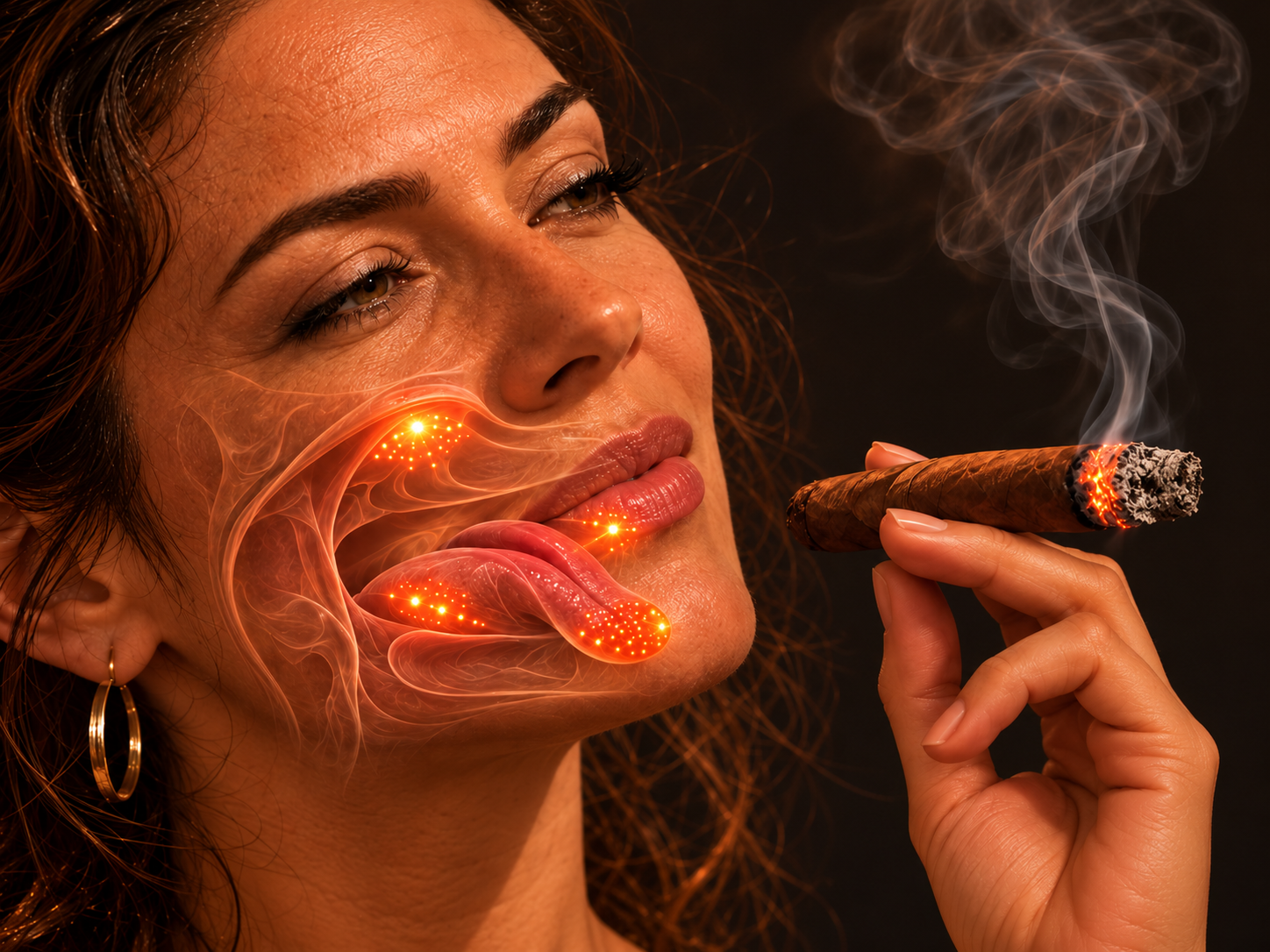
I read an article where the author said that “spice doesn’t have an address.” That bothered me. I’ve been smoking cigars for over forty years, and I can usually tell you where the spice is registering in my mouth. Sometimes it’s on the tip of my tongue. Sometimes it runs along the sides. Other times, it settles toward the back of my mouth.
While evaluating a prototype blend recently, I was reminded of that statement. The spice began at the back of my mouth. As I worked through the first inch, it showed up at the front of the roof of my mouth. By the first half, I was feeling it along the sides of my tongue. The location was as much a part of the experience as the intensity.
That got me thinking about the physiology behind something I routinely describe in my reviews.
When I write “spice,” I’m referring to a physical sensation: warmth, tingling, prickling, or a peppery sting. “Black pepper” describes a flavor. Keeping those terms separate lets me describe both what the cigar tastes like and what I’m feeling as I smoke it.
There are reasons I talk about spice quite a bit in my reviews.
Most conventional reviews mention it in passing, usually to establish how much is present. But I’ve always noticed its movement. Where it registers and how that changes over the course of a smoke are things I naturally follow.
To me, spice is a source of a profile’s energy, and energy is a big part of how I read cigars. With that prototype, the opening was structured and enjoyable, though the arrangement felt familiar. Past the first inch, the spice started glowing brightly, providing a pull that moved the profile forward.
Tracking spice helps me understand how a profile carries itself and develops. That’s why it gets so much attention in my notes. It contributes to the character of the experience, and I want my descriptions to account for that.
I wanted to know if there was a scientific basis for what I was experiencing, so I did some research.
The scientific term for chemically evoked sensations such as burning and cooling is chemesthesis. The tissues in our mouths contain sensory nerve endings that respond to chemical stimulation. Much of that information travels through the trigeminal nerve, which also carries information about touch, temperature, and pain from the mouth and face. Other sensory nerves serve areas farther back, including the throat.
On those nerve endings are channels that work like tiny gates. Certain chemicals can open them, allowing electrically charged particles to enter and help trigger a nerve signal. TRPV1 and TRPA1 are two channels involved in this process. TRPV1 responds to capsaicin, the pungent compound in chili peppers, as well as to heat. That helps explain why a chili pepper can feel hot even when it’s at room temperature. Nicotine can also stimulate sensory pathways that produce burning and irritation.
Those signals come from nerves serving particular areas. Your brain receives information about both the sensation and where it originated, much as it does when you feel something touching your tongue or the inside of your cheek. We can therefore describe spice by its location as well as its intensity. The research has examined that ability directly.
You don’t need to memorize those names to recognize the experience. The useful part is understanding that the mouth can detect chemical stimulation in particular places.
In a 2017 study published in Frontiers in Physiology, researchers gave participants chewing gums containing nicotine, menthol, or cinnamaldehyde, a compound associated with cinnamon. Participants recorded the sensations and drew where they felt them on diagrams of the mouth and throat. Nicotine burning was consistently reported toward the back of the throat, while cinnamaldehyde burning was reported on the tongue. The researchers could compare the locations because participants could identify them. The figure below, taken from the study, illustrates their findings.

A 2020 study by Danica Berry and Christopher Simons examined capsaicin responses on the tongue, cheek, hard palate, and lip. Those tissues differed in sensitivity and in how the sensation developed over time. In the initial experiment, irritation was strongest on the tongue, followed by the hard palate, with weaker responses on the cheek and lip. The hard palate also took longer to reach peak irritation. This was capsaicin research, but it demonstrates that chemically evoked burning can register differently across the mouth.
That gives us a physiological basis for describing where spice appears. “Along the sides of my tongue” communicates something that “spicy” leaves out. So does “a prickling sensation on the roof of my mouth.” Location adds information to the description.
That prototype gave me another useful example in the final third. The spice spread from the front of the roof of my mouth onto the tip of my tongue and across more of the roof. Its coverage expanded while its intensity stayed the same. I even took a drink of water to rinse my mouth and checked again. The broader sensation remained.
Later, I noticed a pumping action within each puff. The spice felt expansive on the draw, settled onto the top of my tongue, then moved toward the sides on the finish. I was following movement within the puff itself as well as changes over the course of the cigar. Simply calling it “spicy” would have left all of that out.
The blend and the way the tobaccos are bunched also shape what reaches my mouth. The selection and proportions of the leaves establish the profile, while their arrangement affects combustion and airflow through the cigar. Bunching is part of how that blend delivers its character as it burns. Cigar Journal’s examination of bunching methods describes how construction influences burn, draw, and the resulting smoking experience.
I also noticed how the whole profile came back into balance. Espresso had stepped forward, and the profile had developed a sense of gravity. Then the espresso eased, the spice returned to the sides of my tongue, and the secondary flavors had room to express themselves again. The shifting combinations became clearer, and the sense of weight lifted. All of those changes happened together.
To me, that was the blend self-correcting, returning to its thematic center just as it seemed to be getting heavier. The spice participated in that return through its placement and its relationship with the other elements. That’s part of what I’m following when I describe a cigar’s energy: how the blend uses spice to help move the entire experience.
There’s also a practical possibility worth considering: the cut.
I favor a punch cut, and I love torpedos and perfectos. With those openings, I often feel the incoming smoke concentrated toward the tip of my tongue. That makes me wonder how much the opening influences where spice first registers.
Hypothetically, a punch could direct smoke toward a smaller area. A straight cut could allow a broader delivery, while a V-cut could produce a focused stream spread across a differently shaped opening. Punch diameter, V-cut depth, and how far down you cut a tapered head would all be part of that discussion.
That’s a hypothesis about smoke delivery. It’s something I’d be interested in comparing while smoking the same cigar with different cuts.
For now, the observation that started this discussion remains straightforward. While smoking that prototype, I could identify where the spice registered and follow the changes as the cigar progressed. Sensory research supports our ability to locate those kinds of sensations.
The point is: spice has an address.
The science backs that up.
If you’re wondering about the prototype, I’m not under an NDA, but I’m keeping its identity private out of respect for the blender and brand. They didn’t give me any blend stats, either, so this was a truly blind evaluation. When it’s released, I’ll publish a review.








Leave a Reply