
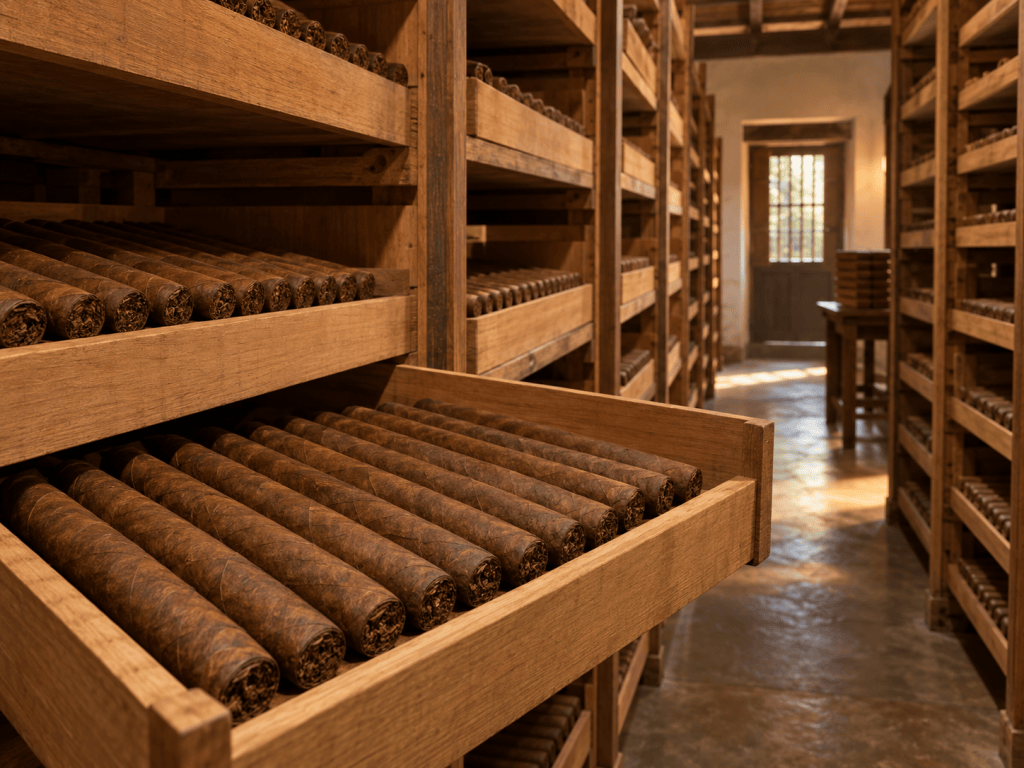
Sorry, I couldn’t resist the title. Fortunately, this article isn’t about people getting married. It’s about tobacco. In Añejamiento (Ah-nyae-ha-me-ento): It’s All About Aging, I mentioned the concept of “marrying”:
As it ages, a cigar continues to settle. Moisture equalizes. Leftover impurities are released. The tobaccos begin to marry. Sharp edges can soften, and the cigar may become smoother, rounder, and more integrated.
That’s the thirty-thousand-foot view. It’s all basically true, but there’s actually a lot more to it. You might think of marrying as a combination of simultaneous processes that include moisture equalization, microbial and enzymatic activity, integration of the different layers of the bunch, and aroma and flavor development.
Moisture Equalization
When a cigar comes off the rolling table, the tobaccos that make it up don’t all contain the same amount of moisture. The wrapper and binder are moistened before rolling to make them supple enough to work with, while the filler is generally drier. As the cigar marries, the moisture becomes more evenly distributed throughout the cigar.
Microbial and Enzymatic Activity
Microbial and enzymatic activity also continues inside the finished cigar during this period. A 2023 study followed handmade cigars through ninety days of aging and found that starch declined while reducing sugars and total sugars rose rapidly before declining. The researchers also found links between particular microbial communities and changes in starch, sugars, and certain alkaloids.
Microbes and enzymes break down and change compounds in the tobacco as it ages. Some of those reactions produce compounds connected to flavor and aroma.
Layer Integration
At the same time, the wrapper, binder, and filler begin to integrate. At A.J. Fernandez’s factory, the aging room is described as the place where the blend melds or marries. Joya de Nicaragua uses similar language, saying its cigars rest while the blend mellows, mingles, and marries. The individual tobaccos remain part of the original recipe, but they are now aging together as one complete system.
Aroma and Flavor Development
But aroma and flavor development is where marrying gets really interesting.
Much of what is shared about marrying comes from anecdotal accounts or articles that don’t scratch beneath the surface. The technologist in me wanted to understand it at a deeper level. So I did some research.
I found a 2025 study that explored the chemical transformations and mechanisms involved in cigar aging. It followed the same cigar blend from the day it was rolled through eighteen months of aging. It took me a while to get through all the scientific jargon, so I’ll spare you that and provide a summary.
The researchers detected 1,836 volatile compounds. Volatile simply means that these compounds evaporate into the air, allowing us to smell them. Some increased, some declined, and others fluctuated as the cigar aged.
The researchers grouped the changes into four stages, G1 through G4. G1 covered zero to one month. The freshly rolled and one-month-old cigars had similar mixes of aroma compounds, so this became the baseline. In G2, at two months, 180 compounds had increased and 28 declined compared with G1. In G3, at four months, 260 had increased and 26 declined. G4 covered seventeen to eighteen months, when 321 compounds had increased and 169 declined.
The balance of aromas changed along with the levels of the individual compounds. Coffee, roasted, hay, burnt, and spicy characteristics were more prominent early. Sweetness dipped at two months, then rose substantially by four months. By seventeen to eighteen months, the aroma profile showed more fruity, floral, honey, woody, and sweet characteristics, while the earlier coffee, roasted, hay, burnt, and spicy characteristics had declined.
What fascinated me about the study was the amount of change that occurred at the different stages. In the first month, not much happened. It’s not that there was no activity. The freshly rolled and one-month-old cigars were simply similar enough to be grouped into a single stage. By the second month, the changes had accelerated sharply and continued through month four, then eased through month eighteen. Here’s a graph that clearly illustrates this:
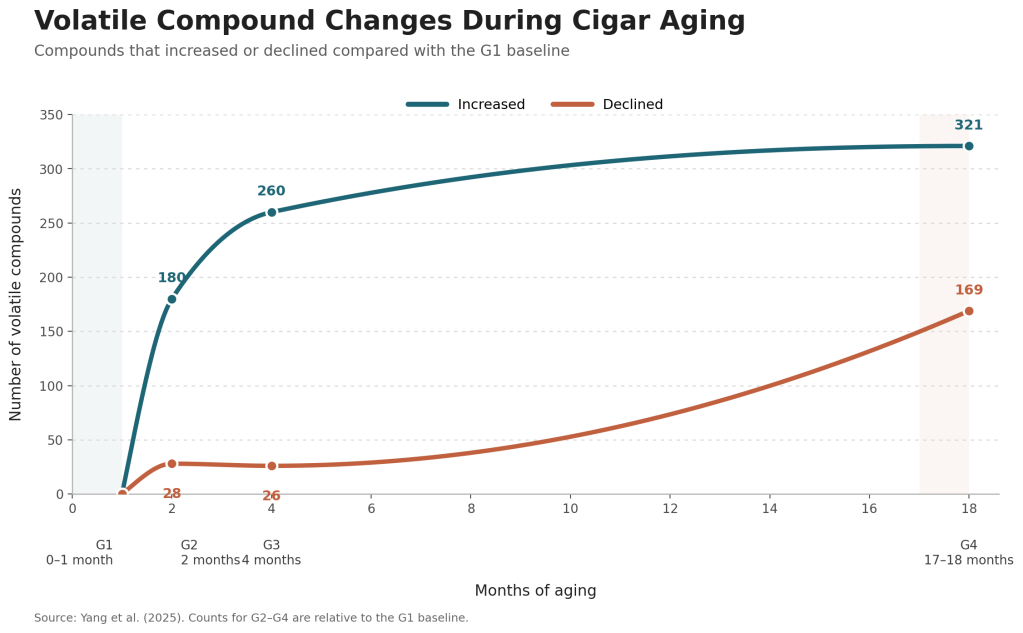
After seeing the shape of that graph, I was blown away. Not by the graph itself, but by what it suggests. For years, I’ve wondered how a blender decides it’s time to release a cigar. Everyone says they don’t release one until it’s ready. But maybe ready is when they feel the changes beginning to taper.
Who knows whether blenders are measuring changes in volatile compounds over time? It doesn’t matter. It stands to reason that even though a cigar continues to change, the rate eventually slows enough for a blender to feel it’s ready for release.
From conversations I’ve had with different blenders, sixty to ninety days seems to be the sweet spot for release. What amazes me is how closely those anecdotal accounts line up with the empirical evidence!
Of course, there are exceptions. One is Ferio Tego’s 2024 production of the Generoso and Elegancia. Both cigars received twenty-two months of aging. Michael Herklots hasn’t publicly given a specific reason for aging them that long. He has only said, “Our goal is to capture the best possible expression of Elegancia and Generoso in each annual production.” Perhaps he simply didn’t feel they had achieved their full expression until after that long marrying process.
Circling back to Añejamiento (Ah-nyae-ha-me-ento): It’s All About Aging, I wrote: “But añejamiento doesn’t stop when the cigars are boxed. It continues until a cigar is lit. In that sense, we are all stewards of añejamiento.” The graph illustrates that cigars continue to change and evolve long after we receive them. Furthermore, it jibes well with what Katman admonishes all of us to do: let our cigars sit.
We really are stewards of añejamiento.
The numbers don’t lie.




Leave a comment