
I wasn’t sure I was going to write this article.
My original idea was to write about the processes and people involved in the journey from curing through fermentation to aging, and the effects each step had on the tobacco leaves.
Then I read this excellent article by Brian Desind of Privada.
Deflation set in.
I knew implicitly that I needed to create a Foundations piece on fermentation, but I didn’t want to regurgitate information already out there. I had to find another angle.
Then I remembered my college education.
Before I ever considered computers and software engineering, I wanted to be a doctor or a medical research scientist. I studied Biology with a focus on Microbiology and Virology at the University of California, Davis.
For those who don’t know, Davis is an agricultural school. More specifically, it is home to one of the world’s preeminent viticulture and enology programs. Because of that, much of the science leaned toward agriculture and its various offshoots, including enology and fermentation science.
My first taste of fermentation came in Microbiology 10, where the instructor handed out samples of a San Francisco sourdough starter to anyone who wanted one. I used that starter for decades to make sourdough bread. More importantly, it helped me understand how microorganisms can transform the structure and chemistry of a medium.
And then it hit me.
That was my angle.
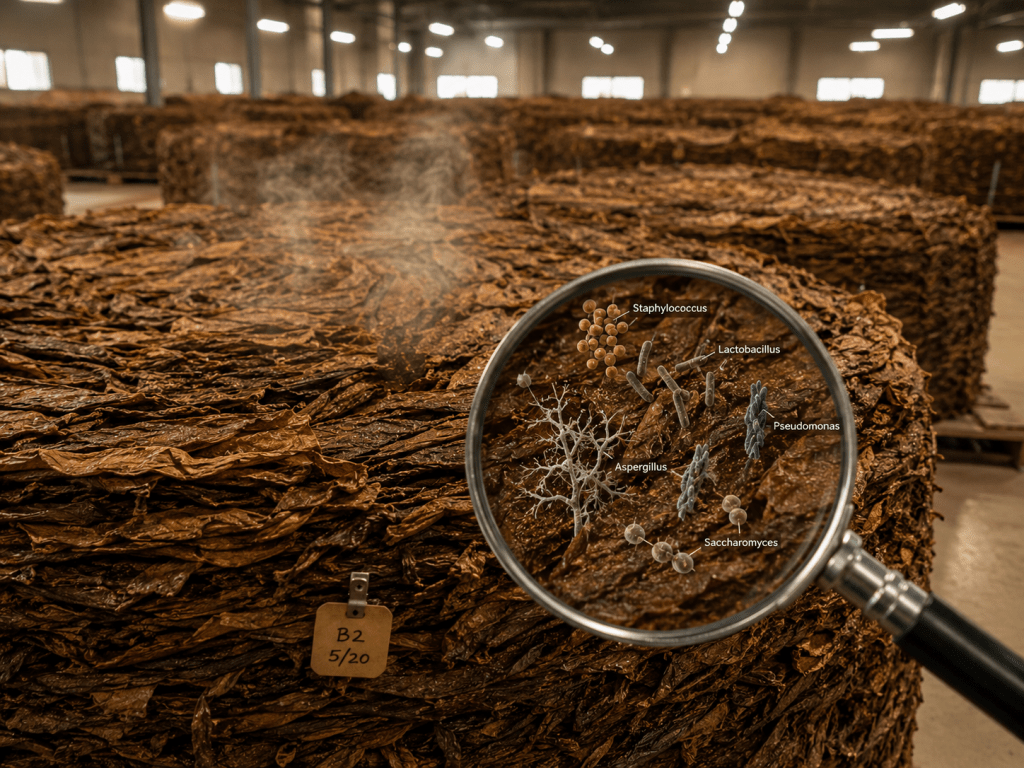
Don’t worry. Even though the title might suggest microbes and the image above shows some of the bacteria and fungi involved in fermentation, I’m not going to discuss them here. You can read the articles cited in the References section below for the hard science.
What I will discuss is what those microorganisms do to tobacco during fermentation.
To me, that is infinitely more useful than discussing the mechanics behind how Staphylococcus breaks down leaf compounds and reshapes the pool of flavor precursors (read: BORING).
So, what really is tobacco fermentation?
At its simplest, it’s the process of reshaping the structure and chemistry of tobacco leaves to develop flavor and color while removing unwanted compounds. That sounds simple enough.
It isn’t.
By the time tobacco leaves finish curing, they may have lost most of their green color, yet they remain chemically raw and structurally unstable. They can be brittle, harsh, bitter, difficult to handle, and full of compounds that have no business surviving into a finished cigar.
Fermentation changes that.
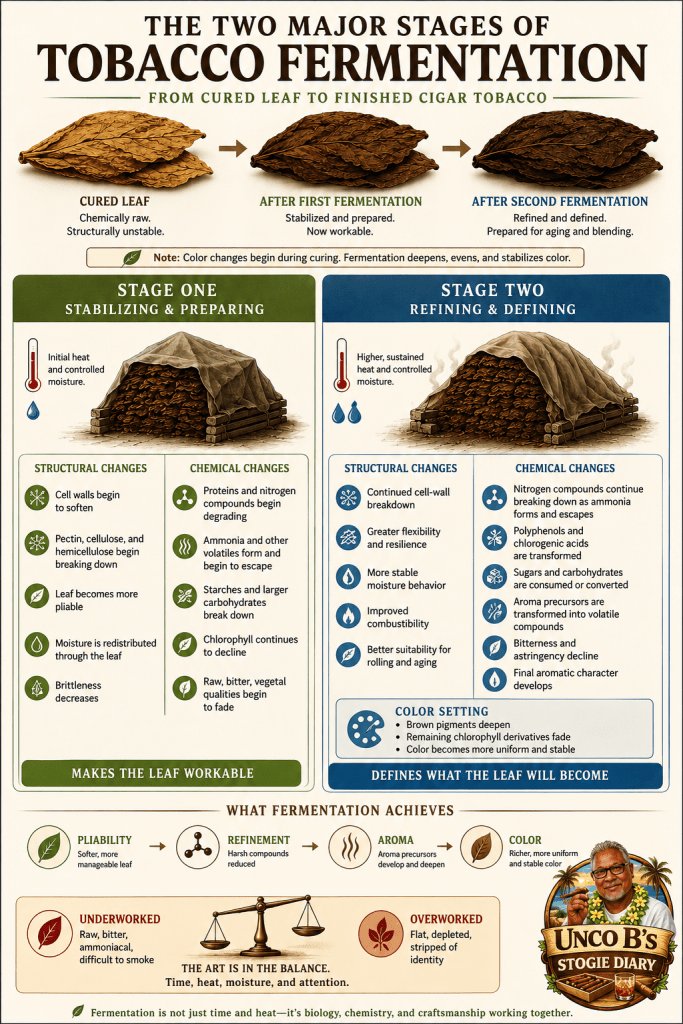
Broadly speaking, premium cigar tobacco goes through two major stages of fermentation. The first begins the process of stabilizing and preparing the leaf. The second pushes those transformations further, refining the tobacco’s chemistry, setting its color, developing aroma, and improving the way it burns.
The two stages overlap in what they accomplish, but they don’t do the same job to the same degree. The first fermentation makes the leaf workable. The second defines what the leaf will become.
It’s a LOT of Work
Before we get into the discussion of the stages, I think it’s important to distinguish tobacco fermentation from other types, such as dough or alcoholic fermentation. Unlike wine, beer, or bread, where fermentation is a comparatively static process, tobacco fermentation is the most physically demanding step in tobacco production, requiring constant monitoring and intervention.1
Temperature and moisture have to be controlled throughout fermentation. When a pilón or burro becomes too hot, workers disassemble the entire pile, shake out and separate the hands of tobacco, then rebuild it so the inner leaves move outward and the outer leaves move inward. Moisture is redistributed, trapped heat escapes, and the process begins again under more controlled conditions.
Depending on how quickly the temperature rises, this can happen more than once in a single day.
It is painstaking, physical work. Every leaf has to be handled without tearing it, every pile has to be rebuilt correctly, and every adjustment changes the environment driving the fermentation. It is arguably the most manually intensive stage of tobacco production.
The microorganisms may transform the leaf, but people control the conditions that allow them to do it.
Stage 1: Stabilizing the Leaves
When tobacco leaves finish curing, they may look ready, but they aren’t.
The curing process has removed most of the water and changed the leaf from green to brown, but the tobacco is still chemically raw and structurally fragile. It can be brittle, bitter, harsh, and difficult to handle. Residual chlorophyll, proteins, starches, polyphenols, and other compounds remain in forms that would interfere with the finished cigar.
The first fermentation begins changing that.
As microbial and enzymatic activity increases, proteins and other nitrogen-containing compounds begin to break down. Ammonia is produced during that metabolism and gradually escapes from the leaf. Starches and larger carbohydrates are reduced into smaller compounds, while residual chlorophyll and other green pigments continue to degrade.5
The structure of the leaf changes as well. Pectin, cellulose, and hemicellulose begin to break down, softening the cell walls and making the tobacco more flexible. Moisture becomes more evenly distributed through the lamina and veins, reducing brittleness and making the leaves better able to withstand sorting, stemming, and further fermentation.
The tobacco also begins to lose some of its raw character. Vegetal flavors recede. Bitterness and irritation begin to soften. Its color deepens, although the final color has not yet been set.
Stage One doesn’t finish the tobacco.
It stabilizes the leaf and makes it workable.
Stage 2: Refining the Leaves
After the first fermentation, the tobacco is sorted and classified by color, texture, and intended use as wrapper, binder, or filler. The leaves are then brought back to the proper moisture level before entering a second, deeper fermentation. Different leaf types won’t ferment at the same rate or tolerate the same heat, so they require separate handling.6
By this point, the leaves are more stable and easier to handle, but they are still not finished. The second stage continues the work begun in the first, pushing the tobacco further toward the aroma, color, texture, and combustion it will carry into the finished cigar.
Proteins, amino acids, and other nitrogen-containing compounds continue to break down. Ammonia forms and escapes. Polyphenols and chlorogenic acids are oxidized or degraded, reducing bitterness and astringency. Sugars, starches, and other carbohydrates are consumed, transformed, or converted into smaller compounds.2,3
At the same time, carotenoids, lipids, and other aroma precursors are reshaped into volatile compounds that contribute to the tobacco’s final aromatic character. Aldehydes, ketones, alcohols, acids, esters, and other compounds appear, disappear, or change in concentration as fermentation progresses.2,3,4
The structure of the leaf continues to change as well. Further breakdown of pectin, cellulose, and hemicellulose improves flexibility, resilience, moisture behavior, and combustibility. The tobacco becomes better suited to rolling, aging, and long-term storage.
This is also where the leaf’s color is set. Pigments and polyphenols continue to oxidize, residual chlorophyll compounds decline, and the brown coloration established during curing becomes deeper, more uniform, and more stable.
But refinement has a limit.
Underworked tobacco can remain raw, bitter, sharp, or ammoniacal. Overworked tobacco can lose aroma, energy, and identity.
The second fermentation defines what the leaf will become.
Below is an infographic that describes the two stages in more technical detail:
It All Boils Down to the Fermenter
Despite the technical nature of this discussion, tobacco fermentation is more art than science.
The chemistry may be understood, but the tobacco remains unpredictable. Every lot behaves differently depending on the seed, priming, thickness, moisture, growing conditions, curing, and the microorganisms already present on the leaves.
There is no single temperature, timetable, or number of turns that works for everything.
The fermenter has to read the tobacco. He watches how quickly the pile heats, feels the moisture in the leaves, smells the ammonia, and decides when to break the burro apart and rebuild it. He has to know when the tobacco needs more time, when it needs to be slowed down, and when it has gone far enough.
That judgment can’t be reduced to a chart. Science explains what’s happening inside the leaf.
Craftsmanship determines what survives the process.
References
1. Desind, B. (2025, September 18). Cigars: The Masterclass – Episode 6: The transformative process of tobacco fermentation. Privada Cigar Club. https://privadacigarclub.com/blogs/masterclass/cigars-the-masterclass-episode-6-the-transformative-process-of-tobacco-fermentation
2. Zheng, T., Guo, D., Shi, Y., Zhou, J., Zong, K., Ding, N., & Li, X. (2026). Microbial community assembly in the fermentation of cigar tobacco leaves. Frontiers in Bioengineering and Biotechnology, 14, 1779182. https://doi.org/10.3389/fbioe.2026.1779182
3. Zhang, M., Guo, D., Wang, H., Wu, G., Shi, Y., Zhou, J., Zhao, E., Zheng, T., & Li, X. (2024). Analyzing microbial community and volatile compound profiles in the fermentation of cigar tobacco leaves. Applied Microbiology and Biotechnology, 108, 243. https://doi.org/10.1007/s00253-024-13043-3
4. Wang, H., Guo, D., Zhang, M., Wu, G., Shi, Y., Zhou, J., Ding, N., Chen, X., & Li, X. (2024). Correlation study on microbial communities and volatile flavor compounds in cigar tobacco leaves of diverse origins. Applied Microbiology and Biotechnology, 108, 236. https://doi.org/10.1007/s00253-024-13032-6
5. Zhang, Q., Kong, G., Zhao, G., Liu, J., Jin, H., Li, Z., Zhang, G., & Liu, T. (2023). Microbial and enzymatic changes in cigar tobacco leaves during air-curing and fermentation. Applied Microbiology and Biotechnology, 107(18), 5789–5801. https://doi.org/10.1007/s00253-023-12663-5
6. Tobacconist University. (n.d.). Tobacco College: Curing & fermentation. https://tobacconistuniversity.org/curriculum_tobacco_college_curing3.php





Leave a comment