

Every cigar has something to say.
Some whisper. Others tell their stories with bold intent and aplomb. Some speak in tongues, while others choose measured, deliberate tones. But no matter the voice, every cigar has a story to tell.
The question isn’t simply how loudly it speaks, but how that story unfolds.
For decades, cigars have been described along a familiar scale: mild, medium, and full. It’s useful shorthand, but it’s also inadequate. Those three words are routinely asked to describe several different dimensions of the smoking experience at once. When someone calls a cigar “full,” they may be referring to its nicotine strength, the weight of its smoke, the intensity of its flavors, or the sheer amount of activity taking place within the blend.
Those aren’t the same thing. A cigar can be full-bodied without being especially strong. It can remain medium-strength while presenting a broad and complex range of flavors. It can increase steadily in physical force while remaining relatively static in character. It can also speak softly while telling an extraordinarily intricate story.
That’s why I’ve begun charting three separate dimensions in my reviews: strength, body, and activity. Strength tells us how much physical force the cigar carries. Body tells us how much weight and texture the smoke carries. Activity tells us how much is happening within the cigar and how sophisticated that activity is.
Strength Is Physical Force
Strength describes the physical force of the cigar. Nicotine is central to it, though the sensation may also be accompanied by pepper, heat, sharpness, or an increasing sense of pressure on the smoker.
The Partagas Black Label is a good example. It’s unquestionably a strong cigar, but its strength isn’t defined solely by nicotine. Much of its force comes from its dark, emphatic character and the incredible tension between all its components.
It’s the difference between a cigar that remains physically gentle and one that gradually makes its presence unavoidable. Strength may rise steadily, arrive in waves, spike unexpectedly, or remain almost unchanged from the first draw to the last.
A cigar that begins at medium strength and finishes at full has become more powerful. That doesn’t necessarily mean it has developed, become more complex, or told a more compelling story. It may simply have become stronger.
That distinction is easily lost when mild, medium, and full are used as catch-all descriptions.
Body Is the Weight of the Smoke
Body describes the physical character and weight of the smoke itself. Is it thin or dense? Airy or creamy? Dry or oily? Does it pass quickly across the palate, or does it coat the mouth and linger?
Body is mouthfeel.
A cigar can produce dense, substantial smoke while remaining mild or medium in strength. Another can deliver considerable nicotine through smoke that feels relatively lean, dry, or narrow.
I smoked the Lanuza Mechudo yesterday, and it’s a perfect example of a cigar with full body and medium strength. The smoke is dense and luscious, but the nicotine remains restrained, accompanied by only moderate spice.
This is one reason the word “full” causes so much confusion. A cigar may be full-bodied and medium-strength, yet both characteristics are often collapsed into the same descriptor. The cigar’s physical force and the texture of its smoke become indistinguishable on the page, even though they’re experienced quite differently on the palate.
Separating strength from body gives each its proper meaning. It also leaves room for a third dimension that cigar language has rarely defined with any precision.
And that brings us to what I call “activity.”
Activity: It’s More Than Movement
I’ve often spoken about movement in a cigar, but I realized that movement didn’t fully capture what I was experiencing, so I came up with a broader term.
Activity describes the scale and sophistication of what takes place within the cigar.
It combines four elements: the complexity and number of flavors, the frequency and significance of transitions, the amount of internal movement within the profile, and the sophistication of that movement. Together, they describe not only how much the cigar is doing, but how articulated, structured, and developed that activity is.
The activity line may be the most important of the three because it gives a name to a dimension of cigar performance that has usually been discussed only in fragments.
We talk about complexity. We talk about transitions. We divide cigars into thirds and list the flavors appearing in each section. We describe a cigar as evolving, opening up, building, or becoming more interesting. But none of those terms fully captures the amount, significance, and quality of what is taking place within the blend.
Activity brings those elements together.
A cigar may be active because it presents a large and varied range of flavors. It may be active because it moves through several substantial transitions. It may also be active because a relatively small group of flavors continually changes position, emphasis, and relationship.
At its most sophisticated, that activity is articulated through clear relationships, meaningful changes, and a sense of development across the smoke.
Applying It to Reviews
The graphs make the differences easier to see. They don’t explain the ratings by themselves, but they show why strength and body can’t stand in for development, and why activity can’t be read as a simple measure of quality.
The Partagas Y Nada Más Cibao Toro scored 88. The Cayman Monarch scored 93. The Cayman Sovereign II scored 96.
Their graphs tell three very different stories.
Partagas Y Nada Más Cibao Toro: Activity Without Sustained Development
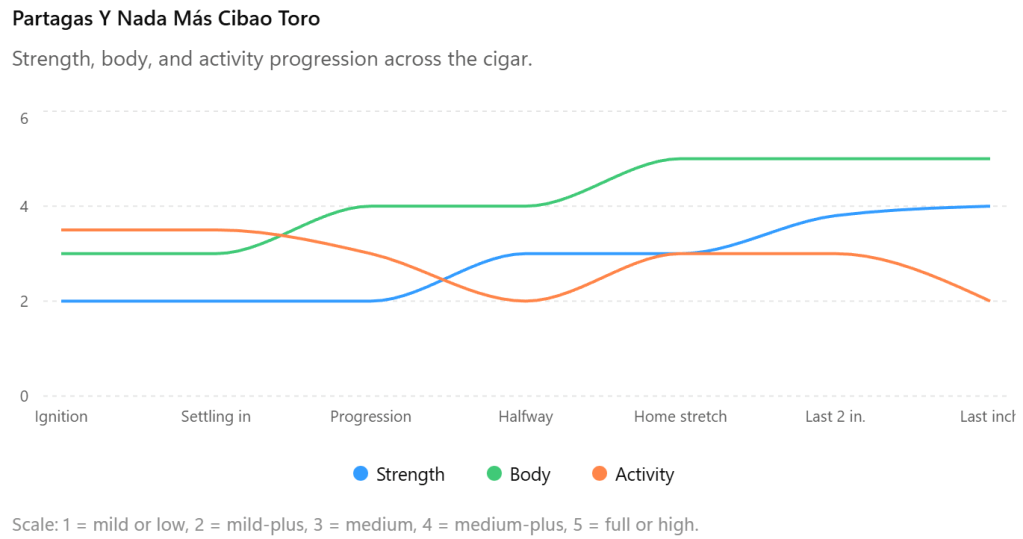
The Partagas Y Nada Más Cibao Toro presents the clearest example of why activity isn’t simply a matter of whether the line rises.
Its body increases from medium to full, while its strength moves from mild-plus to medium-plus. On those two measures alone, the cigar appears to build substantially across the smoke. The activity line tells a less convincing story.
Activity begins at medium-plus, holds briefly, then falls to mild-plus by the halfway point. It recovers through the home stretch before dropping again in the final inch. The cigar isn’t inactive, but its activity is inconsistent and ultimately unsustained.
The graph shows a cigar becoming more physically imposing while its internal life narrows. Body rises. Strength rises. Activity falls, recovers, and falls again.
That helps explain the 88 rating. The cigar never lacked flavor or physical presence, but once its activity dropped, it didn’t go anywhere especially interesting. The increasing strength and body gave it more weight, but the diminishing activity kept that growth from becoming meaningful development.
Cayman Monarch: A Strong Developmental Arc
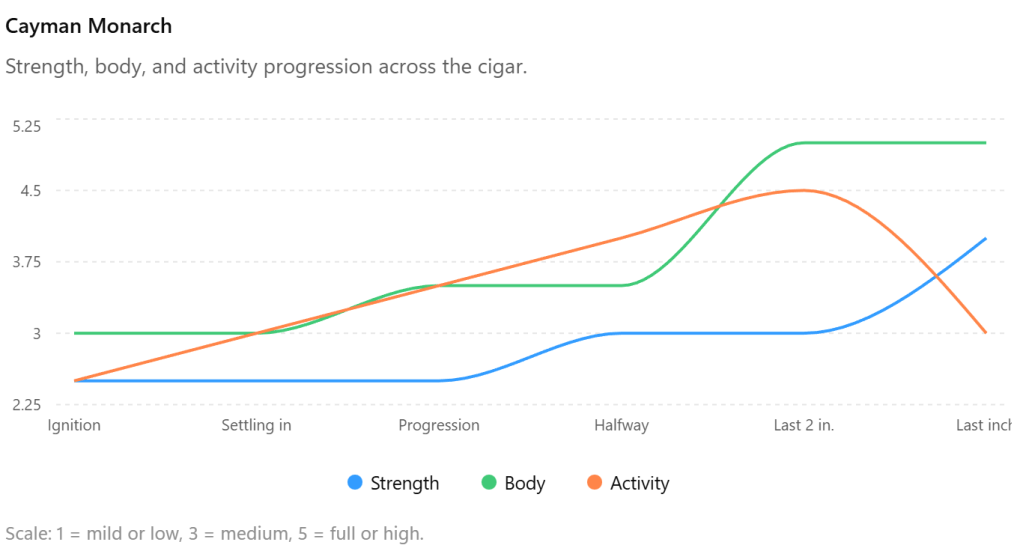
The Cayman Monarch scored 93 because it kept becoming more interesting without losing its center.
Strength begins around mild-plus and rises gradually to medium-plus. Body moves from medium to full. Activity starts slightly below medium, then climbs steadily through the cigar, reaching its peak in the final two inches before dropping at the end.
The activity line captures the Monarch’s developmental arc. Its foundation remains firmly planted, but the details above it continue to move. The core holds while the surrounding elements shift position, flirt with it, and repeatedly change the balance of the profile.
The late decline doesn’t undo what came before it. By then, the cigar has already reached its most active and fully developed expression. The final drop simply reflects the profile narrowing as the cigar approaches its conclusion.
The Monarch earned its 93 because the growing activity produced meaningful development. It continued to work with its established profile rather than merely adding weight or intensity, and it did so without losing the identity it established at the start.
Cayman Sovereign II: Sophistication Without Excess
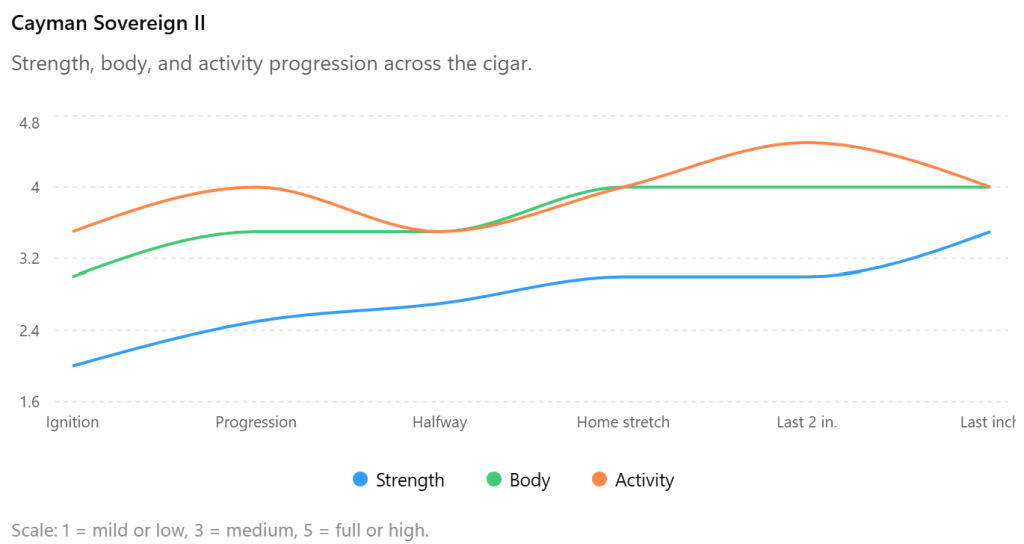
The Cayman Sovereign II scored 96 even though its activity ceiling is slightly lower than the Monarch’s. That’s where the difference between the amount of activity and the sophistication of activity becomes especially useful.
The Sovereign II begins with medium-plus activity, rises, settles slightly at the halfway point, then builds again toward the final two inches before easing at the end. Strength rises gradually from mild-plus toward medium, while body moves from medium to medium-plus and then holds.
The activity line stays elevated for most of the smoke, but it doesn’t rely on dramatic spikes to show development. Its rise, brief settling point, and later return reflect a cigar that continues to evolve without becoming erratic or overcrowded.
Its score didn’t come from presenting the greatest quantity of movement, but from the quality of that movement. The coffee-centered core remained intact while the profile shifted around it. Changes were clear without becoming abrupt. The cigar darkened and deepened without collapsing into harshness, and the late movement felt like a continuation of the established expression rather than a departure from it.
The Sovereign II demonstrates that sophisticated activity doesn’t need to be extreme. Its advantage over the Monarch isn’t simply that more happens. It’s that the movement is smoother, more integrated, and more fully resolved.
Activity Is Descriptive, Not Determinative
Activity doesn’t decide the score. I use the graph to visualize what happens in the cigar. But my score is based on how I interpret that activity.
For example, the Monarch reaches a slightly higher activity peak than the Sovereign II, yet the Sovereign II received the higher rating. The Cibao begins with respectable activity, yet its score is considerably lower because that activity recedes, failing to support the increasing weight and force of the cigar.
The rating depends on what the activity accomplishes.
Does it create development or merely busyness? Does it remain coherent with the cigar’s identity? Are the transitions meaningful? Does the movement become more articulated as the cigar progresses, or does the profile simply widen and narrow without clear purpose?
A high activity number tells us that a great deal is taking place. It doesn’t tell us whether that activity is refined, coherent, or satisfying.
The graph records behavior. The review evaluates what that behavior means.
Seeing the Story
A cigar isn’t defined by how strong it becomes, how heavy the smoke feels, or how many flavors can be named. Those things matter, but they don’t tell us how the experience unfolds.
That’s what the graph is meant to show.
Strength traces the cigar’s physical force. Body traces the weight and texture of the smoke. Activity traces the scale, movement, and sophistication of what happens within the blend. None of those lines assigns value on its own. They simply make the cigar’s behavior visible.
In that sense, the graph reveals part of my scoring process. It shows what I observed and gives the reader a clearer view of the behavior I’m evaluating. But it doesn’t give the score away.
There’s no formula in which a certain level of strength, body, or activity automatically produces a 93 or a 96. The score still depends on interpretation. Was the activity meaningful or merely busy? Did the transitions deepen the cigar’s identity or interrupt it? Did the movement feel refined and purposeful? Did a quiet profile hold itself with composure, or did it simply run out of ideas?
Two cigars can produce similar graphs and still earn very different scores because the quality of the experience can’t be reduced to the shape of the lines.
I haven’t decided whether these graphs will become a regular part of my reviews. They may add clarity, or they may create more visual clutter than they resolve. But as an analytical tool, they’ve already changed the way I work through a cigar. They force me to separate physical growth from meaningful development and make the reasons behind a score more visible to me before I try to explain them to the reader.
Every cigar has something to say.
The graph shows how it speaks.
The score tells you what I made of it.






Leave a comment