
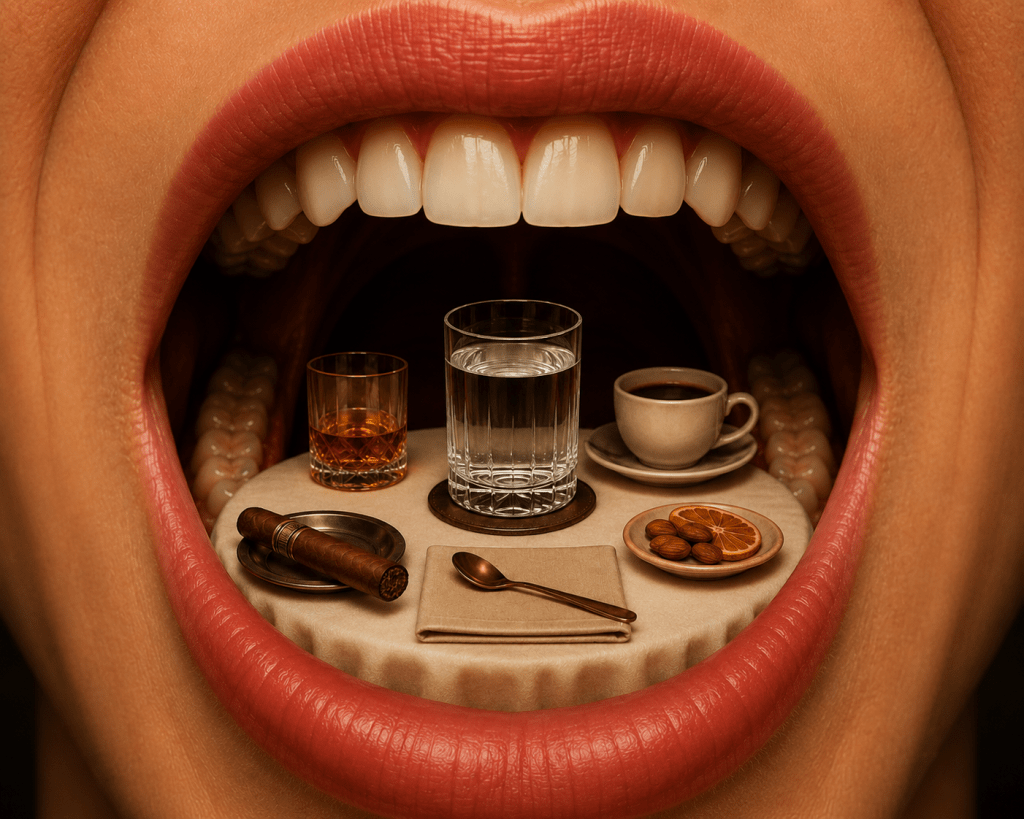
Taste doesn’t begin with the cigar.
It begins with your mouth.
That sounds obvious, but it’s easy to forget. We spend so much time thinking about wrapper, binder, filler, fermentation, aging, construction, humidity, and burn that we sometimes overlook the one environment every cigar has to pass through before we can understand it: our own palate.
And that palate isn’t always neutral.
Your mouth has its own chemistry. Saliva usually lives somewhere near neutral on the pH scale, but food, drink, coffee, alcohol, spice, sugar, citrus, and even dehydration can move things around. When that happens, the cigar doesn’t arrive on a clean stage. It arrives in a room that’s already been painted.
That’s why palate preparation matters.
I’m not talking about turning cigar smoking into a science experiment. You don’t need pH strips, lab notes, or a white coat before cutting the cap. This is simply about giving the cigar a fair shot.
If you just ate jalapeño chips, your palate probably isn’t ready.
If you just drank orange juice, your palate probably isn’t ready.
If your mouth is coated with coffee, sugar, garlic, hot sauce, or artificial flavoring, your palate probably isn’t ready.
That doesn’t mean you can’t enjoy the cigar. Smoke what you want, when you want, with whatever you want. But if you’re trying to really taste the cigar, especially if you’re evaluating it and sharing what you tasted, the starting point matters.
A cigar is already complex. It brings its own acidity, sweetness, bitterness, mineral character, spice, aroma, texture, and finish. If your mouth is already tilted acidic, sweet, spicy, or coated, the cigar has to fight through that before it can present itself.
The simplest reset is water.
Water helps rinse the mouth, stimulate saliva, and bring the palate closer to neutral. Give yourself a few minutes. Let your mouth settle. Let your saliva do its job. Then light the cigar.
That doesn’t mean a cigar should only be smoked with water.
Some of the best cigar experiences happen with a drink in hand. Coffee can deepen darker profiles. Rum can draw out sweetness. Bourbon can add oak, heat, and caramel. Tea can sharpen aromatic detail. Sparkling water can refresh the palate between draws. A pairing can make the cigar more enjoyable, more expressive, and more complete.
But a pairing isn’t neutral.
It becomes part of the experience. That’s part of the pleasure. It’s also why, when I’m reviewing a cigar, I want to know whether I’m tasting the cigar itself or the cigar with the beverage. There’s nothing wrong with either experience. They’re simply not the same.
Water is for calibration.
A good drink is part of the pleasure.
A clean palate tells you what the cigar is doing. A good drink shows you what else the cigar can do.
This becomes especially important halfway through a smoke. The middle of a cigar is often where the blend starts revealing its real structure. If you interrupt that moment with spicy chips, candy, coffee cake, or a heavily flavored drink, you’ve changed the tasting environment. From that point forward, you’re no longer only tasting the cigar. You’re tasting the cigar through whatever you just put in your mouth.
That doesn’t make the experience invalid.
It makes it less useful as evaluation.
There’s a difference between smoking for pleasure and smoking for assessment. When I’m smoking purely for enjoyment, all bets are off. But when I’m trying to understand a cigar, I want the cigar to have the first word.
That means I try to start with a clean mouth, a neutral palate, and plain water nearby. Not because there are rules. There are no rules. But because the cigar deserves a fair reading.
We talk constantly about whether the cigar is ready. We talk about rest, humidity, storage, draw, burn, and construction. But we rarely ask whether the smoker was ready. That matters too. Before we decide a cigar was flat, muted, harsh, or flavorless, it’s worth asking what kind of palate it had to work with.
Sometimes the answer explains everything.




Leave a comment