
Taste is personal. Availability is not.
We talk about cigar preference as if it begins entirely with the smoker. I like this. You like that. He prefers strength. She prefers nuance. Someone else wants sweetness, spice, body, cream, earth, pepper, or whatever. And all of that is true. But before preference can form, something has to be placed in front of us.
We can only taste what’s available to us.
That part of the cigar experience rarely gets discussed. We talk endlessly about flavor, construction, ratings, factories, wrappers, limited editions, and whether a cigar lived up to the hype. But the conversation usually begins after the cigar has already reached the shelf.
Romantics that we are, we focus on the craft, the artistry, and the skill that go into making a cigar. We lean into the stories, the people, the farms, the factories, the hands, the history, and the romance of it all.
But before we even touch a cigar, a whole chain of decisions has already happened. Tobacco has been grown. Blends have been developed. Factories have been chosen. Brands have decided what to release. Distributors have decided what to move. Retailers have decided what to stock. Consumers have decided what to buy.
And all of those decisions feed back into one another.
That feedback loop doesn’t merely determine what reaches the shelf. It helps determine what we come to prefer.
We like to think of taste as pure personal instinct. I like what I like. You like what you like. Every smoker has a palate, and every palate has its own tendencies.
But preference doesn’t form in a vacuum. It forms through exposure.
The more often we encounter certain kinds of cigars, the more fluent we become in their language. We learn their rhythms. We recognize their structure. We know what to expect from them. Over time, familiarity begins to feel like preference.
So the more honest statement may not be, “I like all sorts of cigars.” It may be, “I like certain cigars that are available to me.”
This may be uncomfortable to admit, but it isn’t a radical idea. Preference has been studied extensively, especially in relation to exposure, familiarity, and choice.1 The more often we encounter something, the more familiar it becomes, and familiarity can influence preference.
Food researchers have found similar patterns. Repeated exposure can increase acceptance. Choice researchers have shown that the way options are presented affects what people choose.
Whether we like it or not, cigars don’t sit outside that reality. We may talk about preference as if it begins entirely inside the smoker, but preference is shaped by exposure.
And exposure is shaped by availability.
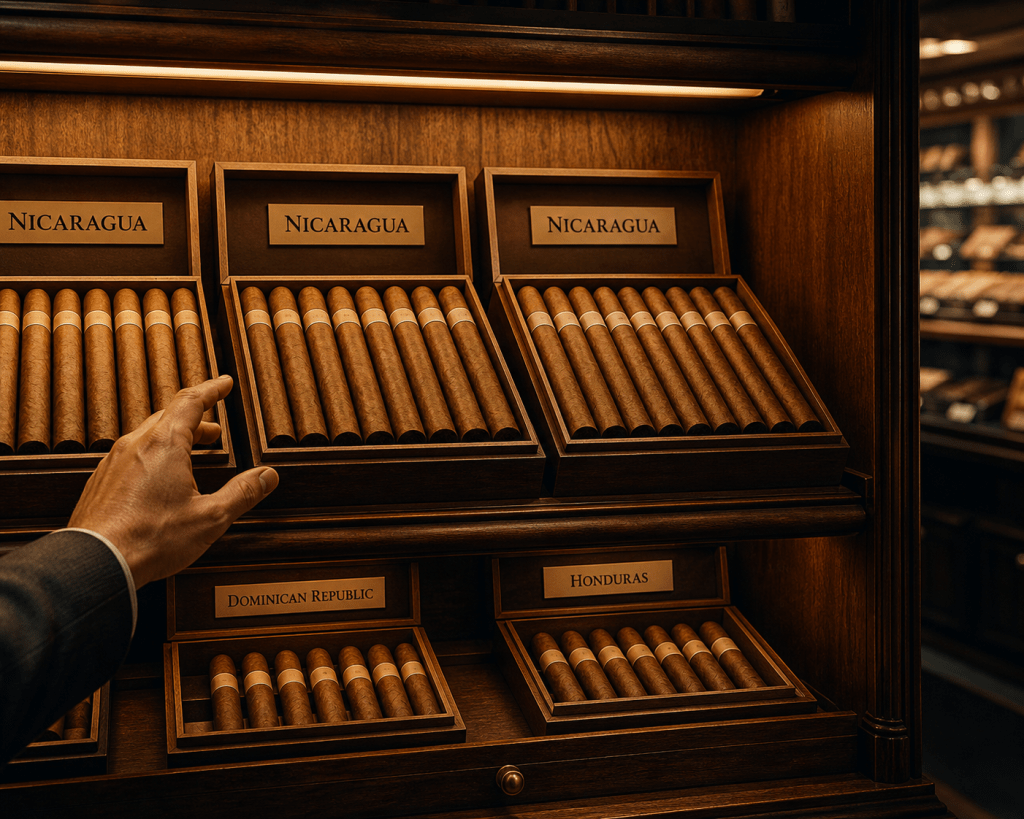
Which brings us to Nicaragua.
While researching another article, I started looking at how different cigar-producing countries show up in the marketplace. What I found was startling. Nicaragua doesn’t simply lead the premium cigar market. In the United States, it dominates it.
Recent import figures show Nicaragua accounts for roughly 60% of all premium cigar imports into the U.S. That means more Nicaraguan premium cigars enter the U.S. market than cigars from every other cigar-producing country combined.
Sit with that for a moment.
One country isn’t merely leading the field. It’s larger than the rest of the field put together.
That is not just an industry statistic. That’s a force.
When one country occupies that much of the field, it inevitably affects what smokers encounter most often. And what smokers encounter most often affects what becomes familiar. What becomes familiar affects what feels normal. And what feels normal eventually affects what we call preference.
This doesn’t mean Nicaraguan cigars all taste the same. They don’t. Nicaragua has earned its place through quality, consistency, production capacity, agricultural strength, and an enormous range of cigars that appeal to modern smokers.
But dominance has consequences.
When a country becomes the primary source of what fills humidors, gets reviewed, gets recommended, gets reordered, and gets smoked, that country becomes part of the palate’s education.
That doesn’t make preference fake. It doesn’t mean smokers are being manipulated. It doesn’t mean Nicaragua has somehow distorted the cigar market by succeeding in it.
It simply means preference has context.
We like what we like, but that is shaped by what we repeatedly encounter. And in today’s market, what we repeatedly encounter is heavily influenced by Nicaragua’s dominance.
This isn’t a criticism of Nicaraguan cigars. I smoke plenty of them. Most of my humidor consists of Nicaraguan cigars. The point isn’t to diminish them. The point is to recognize the force they exert on the field.
When one country accounts for more than half of what reaches the market, it becomes more than a country of origin. It becomes a reference point. It helps teach the palate what strength, structure, body, intensity, and richness are supposed to feel like, and helps define what a modern premium cigar is expected to deliver.
And once that reference point becomes familiar, other cigars are often judged against it.
A softer cigar may read as lacking. A quieter cigar may read as boring. A more restrained cigar may read as mild. A cigar built around aroma rather than force may feel less serious. A cigar that unfolds gently rather than announcing itself immediately may be dismissed before it has a chance to show what it’s doing.
That’s why availability matters. It doesn’t merely determine what we buy. It helps shape what we recognize. It helps shape what we expect. It helps shape what feels familiar enough to become a preference.
Taste is personal. But taste is also trained.
| 1 | Mertens et al. (2021). “The effectiveness of nudging: A meta-analysis of choice architecture interventions across behavioral domains.” National Library of Medicine. https://pmc.ncbi.nlm.nih.gov/articles/PMC8740589/ |




Leave a comment