
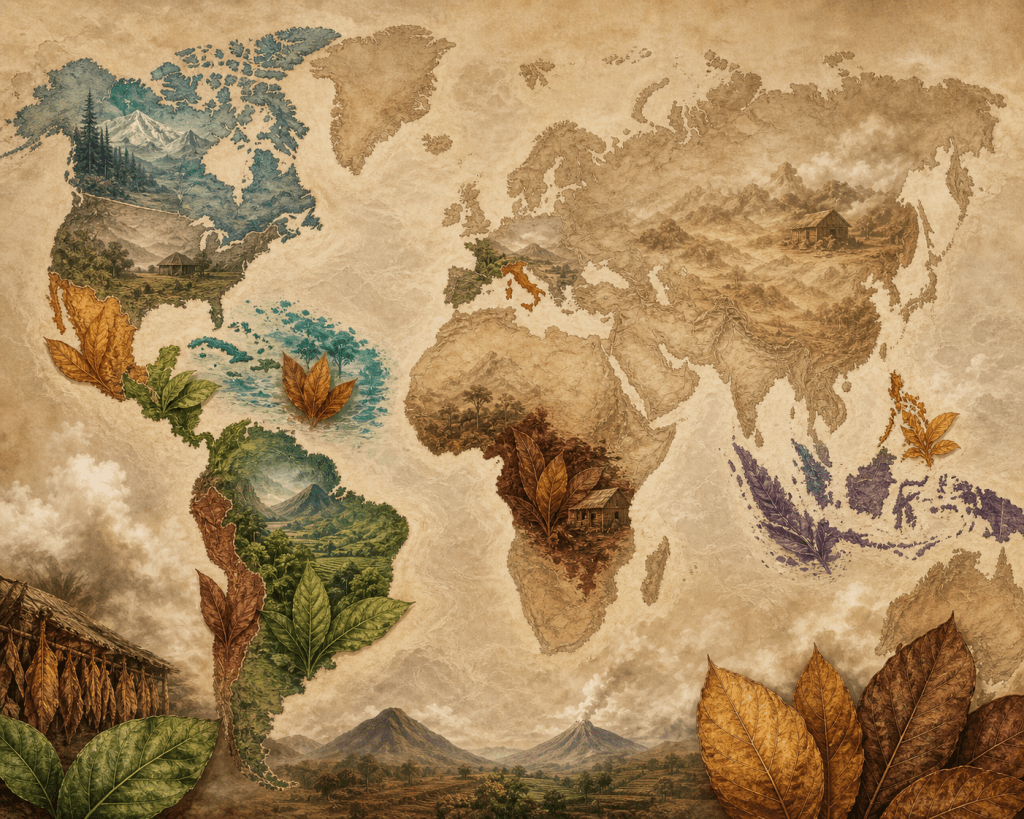
After writing about the roles different leaves play within a cigar, I wanted to take the next step and look at geography. This is something that I have been researching and studying for several months, even before my Certified Consumer Tobacconist coursework.
Most of us are used to seeing countries listed in a blend: Nicaragua, Dominican Republic, Honduras, Brazil, Mexico, Ecuador. But country only gets us part of the way there. A Nicaraguan leaf from Estelí is not the same as one from Jalapa. Brazilian Mata Fina is not the same as Arapiraca. Connecticut Shade is not Pennsylvania Broadleaf.
That’s where terroir comes in.
In cigars, terroir is the idea that where a tobacco is grown affects how it tastes, burns, and behaves. Soil, climate, rainfall, sun exposure, altitude, seed varietal, and farming practices all play a role.
Below is a simplified cheat sheet of major cigar tobacco-growing regions and the general characteristics commonly associated with them. These are presented in order of their influence on global retail sales.
| Country | Region | Regional Terroir Tendencies |
|---|---|---|
| Nicaragua | Estelí | Strong, full-bodied; earthy; pepper; spice-forward |
| Jalapa | Sweeter profile; cedar; lighter spice; aromatic | |
| Condega | Balanced; earth; nuts; moderate spice | |
| Ometepe | Earthy; sweet; mineral; distinctive volcanic character | |
| Dominican Republic | Cibao Valley | Mild to medium; smooth; creamy; subtle spice |
| Santiago | Cedar; earth; balanced; refined delivery | |
| Honduras | Jamastran Valley | Medium-bodied; earth; wood; some sweetness |
| Talanga | Bolder; spice; more strength-forward | |
| Copán | Earth, wood, balanced body | |
| Cuba | Vuelta Abajo | Rich; complex; earth; spice; balanced |
| Semi Vuelta | Lighter; used for binder/filler; less intense | |
| Partido | Historically used for wrapper | |
| Remedios | Lighter; less intense than Vuelta Abajo | |
| Ecuador | (Various wrapper-growing zones) | Clean; neutral-to-sweet; allows filler to show through |
| Brazil | Recôncavo Baiano (Bahia) | Earthy; sweet; rich; aromatic (generality) |
| –Mata Fina | Dark, smooth, earthy, naturally sweet | |
| –Mata Norte | Stronger, fuller, more forceful | |
| –Mata Sul | Less defined; part of Bahia system | |
| Arapiraca | Darker; rich; fermented sweetness | |
| Bragança | Earthy; raw; exotic; jungle-grown; limited production | |
| Indonesia | Sumatra | Sweet; earthy; aromatic; often used for wrapper |
| Java | Mild; woody; neutral-to-sweet | |
| United States | Connecticut River Valley | Mild; creamy; grassy; light sweetness |
| Pennsylvania | Strong; earthy; bold; rustic character | |
| Mexico | San Andrés | Earthy; sweet; cocoa; coffee; mineral qualities |
| Costa Rica | Puriscal (Santiago de Puriscal) | Smooth; earthy; balanced; medium-bodied |
| Cameroon | (Cameroon growing zones) | Thin leaf; sweet; woody; spice; aromatic |
As always, these are generalizations, not hard-and-fast rules. But they give us a useful shorthand for understanding what different growing regions tend to bring to a cigar.
Notes
- Brazil is an interesting case, especially regarding the Bahia region. Brazilian tobacco is most often discussed when it’s used as a wrapper; Mata Fina is the name most associated with that role and ends up representing the entire Bahia region, even though the other sub-regions contribute differently (filler).
- There are several other countries that produce cigar tobacco, such as the Philippines, Peru, Panama, and Jamaica. But their usage in cigars is small or region-specific, so they were not included.
- I ordered the countries by their retail influence on the cigar market, not by geography or perceived prestige. This is important because even though the DR has the highest tobacco export sales, the retail sales of DR cigars are completely eclipsed by Nicaragua, which has a retail influence that is greater than all the rest of the countries combined.
Terroir does not explain everything. A cigar is still shaped by seed varietal, priming, fermentation, aging, blending, and the decisions made by the people working with the tobacco.
But geography gives us another layer of context. When we see a blend listed as Nicaraguan, Dominican, Brazilian, or Mexican, there is usually more beneath the label. The country matters. The region matters too.
As I said in “The Leaves of the Blend,” none of this replaces smoking the cigar. It just gives us a better way to understand what may be contributing to the experience.
And as always, we still cut, light, and enjoy. But the more we understand what went into the cigar, the more we can appreciate what it becomes.
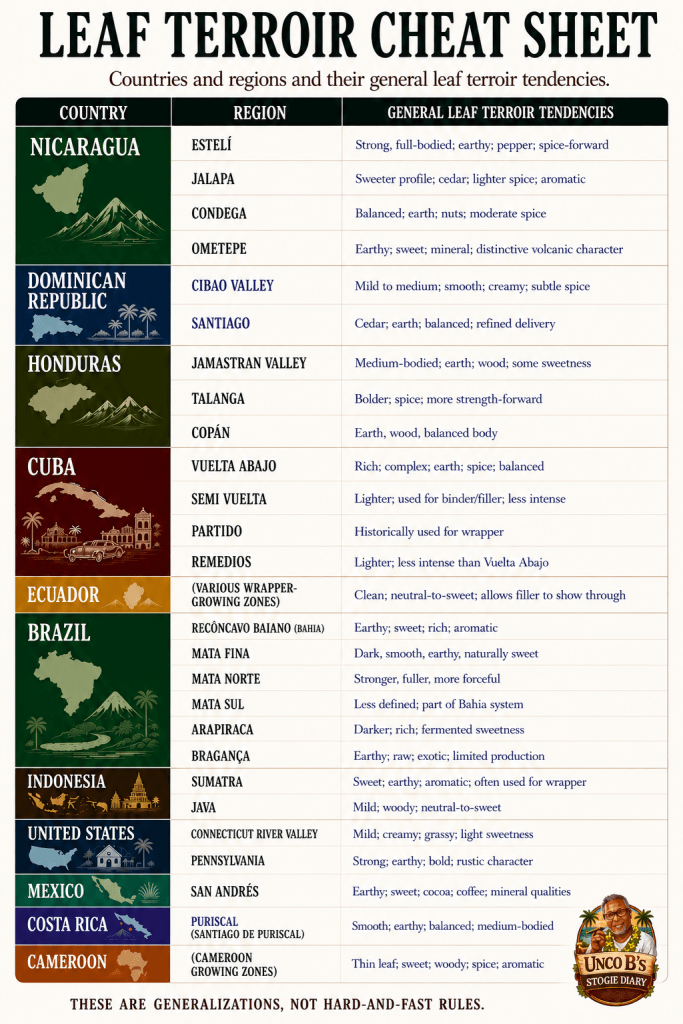
Here’s an infographic of the table above. Feel free to copy it and keep it as a reference.




Leave a comment