
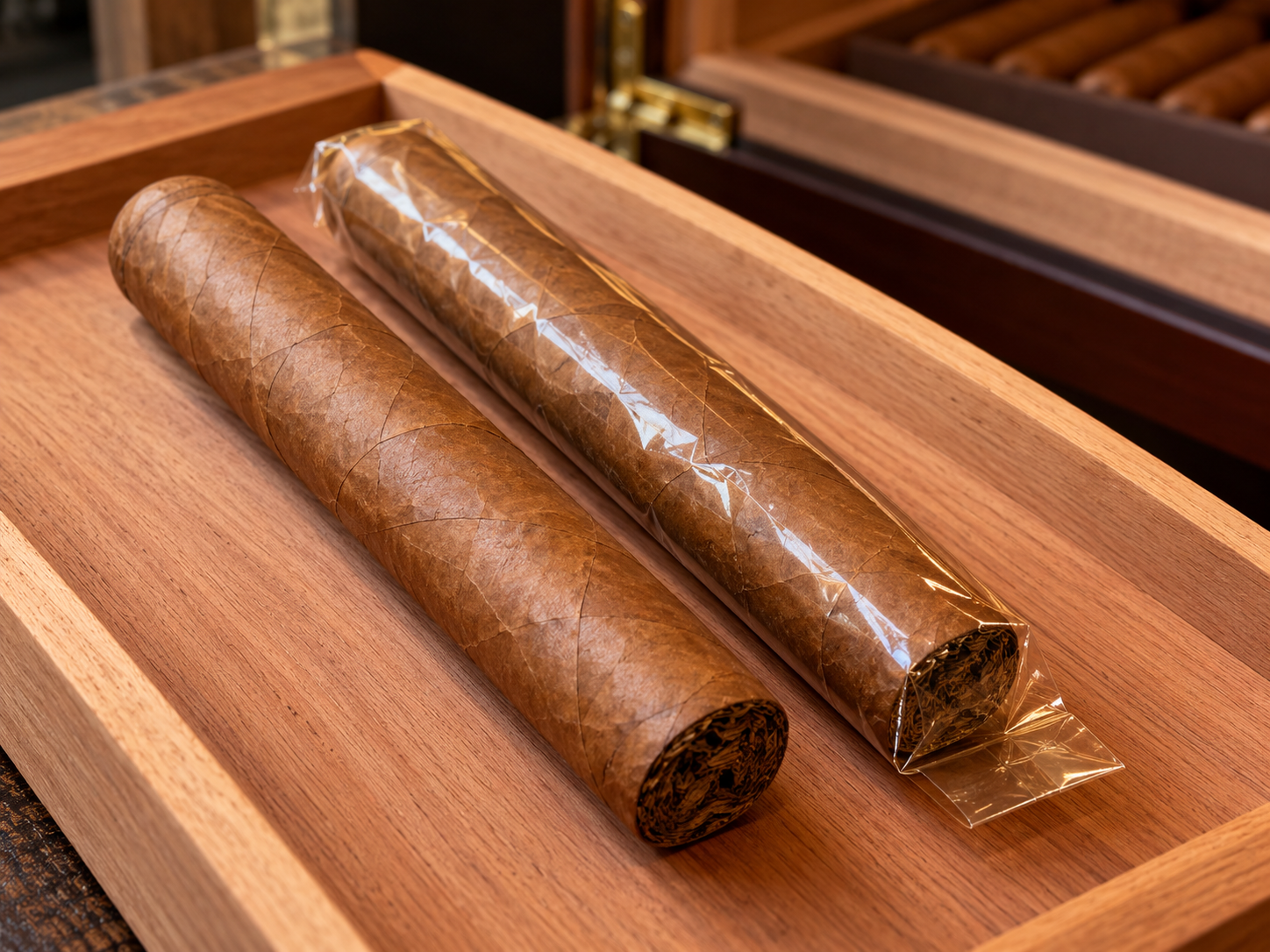
Before we get into this discussion, I’ll simply say this: whether you keep your cigars wrapped in cellophane is entirely a personal preference. There’s no right or wrong answer.
There’s a familiar notion in cigar culture that removing the cellophane allows cigars to age faster. I’ve never been convinced by that explanation. I’ve certainly accepted that cigars can develop differently depending on how they’re stored, but I’ve wondered what supports describing those differences as faster or slower aging.
This discussion has been going on for years. In a 2005 Friends of Habanos forum thread, one participant described slower improvement in cellophane as the apparent consensus among collectors, while also acknowledging that there was no definitive answer. More than twenty years later, retailer articles still present variations of the same advice.
I wanted to understand what supports it.
Does cellophane actually slow the development of the tobacco, or does it change the conditions under which that development takes place? Exploring that question starts with understanding the material and then considering what we mean when we talk about aging.
There are plenty of practical reasons to use cellophane. It protects the wrapper during handling and transport, provides a barrier between the cigar and customers’ fingers, and gives retailers somewhere to put a barcode. Holt’s explains those benefits in its article on storing cigars in cellophane.
The article also describes more uniform aging with the sleeve on and suggests that removing it encourages aging through exchanges of oils and aromas within the humidor. I admit I’ve always had a problem with the uniform aging bit. The first time I read that, I asked out loud, What the hell do you mean by that?
It’s easy to understand the physical protection a sleeve provides. Its influence on development takes a little more explaining. A cigar might retain more of its original aroma, acquire characteristics from its surroundings, or become noticeably milder. Understanding which changes we’re observing would help us make more sense of the advice.
Cellophane is made from cellulose, a material found in plants. Its useful quality for cigars is that it allows moisture to pass through while helping keep aromas inside. Futamura, which manufactures cellophane, describes its plain, uncoated film as highly permeable to water vapor while providing an excellent barrier to gases and aromas.
A 1994 packaging study demonstrated this behavior experimentally. Water vapor passed readily through the tested cellophane, while very little of the aroma compound being tested made it through. That helps explain why a cigar can respond to the humidity in your humidor while retaining more of its own aroma inside the sleeve.
Here’s the salient point: Moisture exchange and aroma retention can happen together.
What about “aging?”
Sometimes we’re talking about changes within the tobacco. Other times, we mean the cigar has gotten milder, lost some aroma, settled into our preferred humidity, or picked up aromas from the humidor or other cigars. We tend to call all of that aging, even though those changes can happen for different reasons.
But does any of that mean an unwrapped cigar is maturing faster? Call me a skeptic.
An interesting practical comparison comes from Thor Nielsen at Cigar Press. He stored original-release La Aurora Cien Años Churchills together in their original box, with and without cellophane, inside a bag maintained at 69% humidity with a Humidipak. His detailed account describes a comparison after thirteen years.
The unsleeved cigar had a quieter prelight aroma, more wood character, and a milder, smooth profile. The sleeved cigar retained a rich, sweet prelight aroma and fuller flavor. Both had changed from their original release, and both remained enjoyable. Nielsen interpreted the greater change in the unsleeved cigar as faster aging.
I found the observations useful, especially because both cigars developed into enjoyable experiences. I read them as evidence of different outcomes under different storage conditions. The fuller retained aroma and greater wood influence tell us how the cigars differed, but I don’t think the difference in flavor in the unwrapped cigar was evidence of faster aging.
What would have been more useful is if Thor let the wrapped cigars age longer to see if they achieved the same profile as the unwrapped cigars.
There are experienced industry voices with different preferences as well. In a Bespoke Unit video, Klaas Kelner explains why Davidoff uses cellophane: humidity can move in and out, the sleeve helps concentrate and preserve the cigar’s aromas, and it reduces aromatic exchange with other cigars. His explanation emphasizes preserving the cigar’s aromatic character over time.
Robert Caldwell strongly prefers cigars without cellophane. In his June 2022 interview with Shane Ireland, he describes storing his personal cigars unsleeved and finding their character different. Ireland also describes more dramatic development without cellophane. Their experience gives us another perspective on the results a smoker might seek.
I appreciate having both perspectives. Each gives us something to consider about how storage influences the experience. They also illustrate why personal preference has such a large role in this discussion.
For me, preserving the identity of the blend is a large part of my preference. Holt’s suggests a smoker might enjoy the interchange between an Ashton VSG and a Padrón 1964 Anniversary stored together. Someone may enjoy that result. Personally, I’d prefer to limit that exchange so I can experience the character of each blend more distinctly.
If one cigar acquires aromatic influence from another, that influence becomes part of what I’m experiencing. Recognizing that contribution helps me understand the result of my storage choices. It also gives me a reason to distinguish changes within the tobacco from changes contributed by its surroundings.
When I review a cigar, I’m interested in what its blender put together: how the tobaccos interact, how the experience unfolds, and what gives the blend its identity. That identity can develop with time. I want to give it room to do so while limiting contributions from unrelated cigars around it. Understanding cellophane’s properties helps me make that choice deliberately.
Keeping more of that character is part of the experience I want. If cellophane helps preserve it, I see that as the cigar aging differently.
It doesn’t tell me the cigar is aging more slowly.




Leave a Reply