I used to write a popular blog called GuitarGear.org. I loved geeking out on guitars, amps, effects, and accessories, documenting my journey to find my authentic sound. I thought I was bad about my level of geekiness then, but it pales in comparison to what cigars have done to me.
With guitar gear, at least the categories made sense. A pickup was a pickup. A tube amp was a tube amp. You could get lost in the weeds, but the weeds had labels.
Cigars are different.
The deeper you go, the more the language starts folding in on itself — half the time, cigar language uses one word to imply three different things.
Take “seed,” for example.
In cigar language, “seed” usually doesn’t mean the little thing you plant in the ground. It usually refers to a seed line: cultivated tobacco that has been selected, grown, adapted, and carried across different countries and traditions over time.
Cuban seed. Habano seed. Sumatra seed. Connecticut seed. Those phrases sound simple until you realize they don’t all operate the same way. Some point to old tobacco families, like Criollo and Corojo. Some point to hybrids, like Habano 2000. Some point to regional adaptations, like Piloto Cubano. Some are shorthand for wrapper traditions that developed over generations, like Sumatra, Cameroon, and San Andrés.
In other words, “seed” is one of those cigar words that looks simple from the outside and immediately becomes a house of mirrors.
The hell of it is that none of the meanings are wrong.
I recently had a conversation with a friend about the different leaves he uses in his cigars. Our discussion triggered something in my mind about the origins of cigar tobacco. I didn’t bring it up at the time, but I filed it away for later research.
And my research had my head spinning.
First, I tried tracing the origins of cigar tobacco. That was a mess because I was immediately caught up in the mish-mash of regions and seed types. Take Habano, for example. Depending on context, Habano can refer to a broad Cuban-seed family, a specific hybrid like Habano 2000, or Habano-seed tobacco grown in places such as Nicaragua, Honduras, Ecuador, or the Dominican Republic. And because those are different terroirs, those leaves won’t present the same way despite sharing the “Habano” name.
Yikes.
Then I tried to spin it a different way and break down the leaves into regions. But I realized I already wrote that article.
I finally realized that the problem was my starting point. I was still focusing on the leaves. So I dropped another level and started looking at cigar tobacco from the perspective of seed lines.
That narrowed the problem considerably, but it was still a bit messy because, as I explained above, “seed” can mean different things depending on the context. So for the purposes of this discussion, I’m going to use “seed” in the context of a cultivar: a plant variety that has been selected, named, and maintained because of its desirable traits.
That cleaned up things nicely.
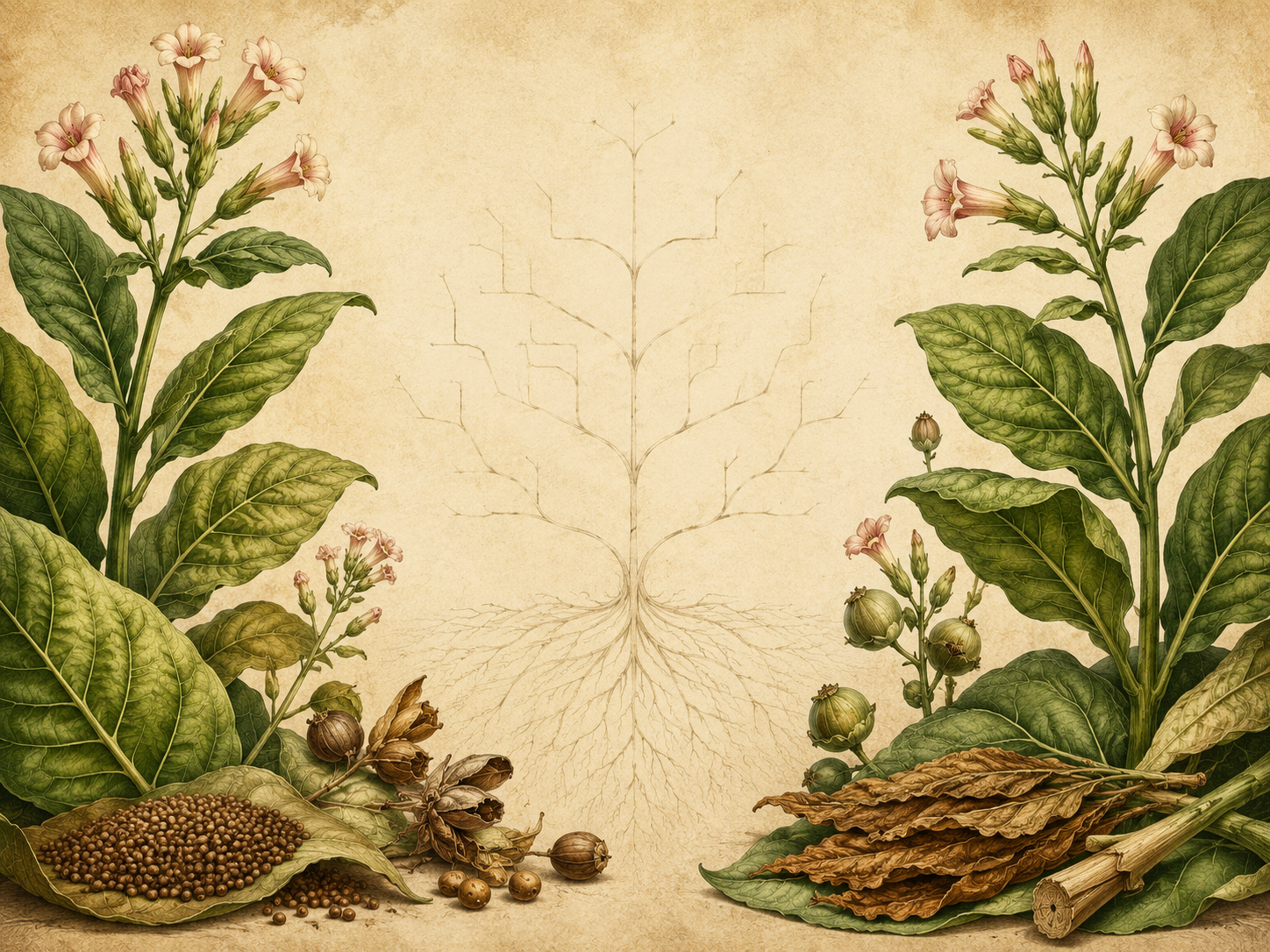
What fascinated me was that, while I expected Cuban seed lines to dominate the landscape, several major cigar tobacco families followed their own paths. The infographic below illustrates the relationships I found.

The big surprise for me was that Nicaragua didn’t have its own lane.
That felt strange at first because Nicaragua dominates so much of the modern premium cigar conversation. Estelí, Jalapa, Condega, and Ometepe all carry enormous weight in smokers’ understanding of modern cigar tobacco. But those are growing regions, not root seed lines.
Nicaragua matters tremendously. Nicaraguan Criollo, Nicaraguan Corojo, and Nicaraguan Habano all matter, but they fall under broader Cuban/Havana seed families rather than forming a separate root category.
A Note on Cuba
There seems to be a mistaken belief, reinforced by the endless Cuban versus non-Cuban debate, that all serious cigar tobacco somehow begins in Cuba.
It doesn’t.
Cuba is enormously important to cigar history. No serious discussion of premium cigars can ignore Cuban tobacco, Cuban seed development, Cuban cigar culture, or Cuba’s role in shaping what the world came to recognize as the classic cigar. But Cuba isn’t the biological origin point of cigar tobacco, and not every major seed line used in cigars descends from Cuba.
Cuban tobacco became one of the great systems of refinement in cigar history. Criollo and Corojo matter because they sit at the center of that Cuban cigar-seed story. But as the infographic illustrates, other cigar seed lines and wrapper traditions developed in different places, climates, and agricultural histories. Sumatra, Connecticut Broadleaf, Cameroon, and Dominican Olor have their own paths.
The cigar world often talks as if everything is orbiting Cuba. Historically, culturally, and commercially, that makes some sense. Agriculturally, it oversimplifies the map.
That’s why seed lines are worth looking at. They don’t replace region, terroir, priming, fermentation, or blending. All of that still matters. But they give us another layer underneath the leaf.
Cigar tobacco isn’t one story radiating out from Cuba. It’s a web of plant families, migrations, adaptations, and refinements, all eventually ending up in the cigars we smoke.






Leave a Reply