

In Where the Hell Is the Coffee?, I wrote about the strange gap between cigar vocabulary and cigar experience. We’re handed a list of familiar flavor words, and then we spend half the smoke trying to find them. Coffee. Cocoa. Leather. Cedar. Cream. Sometimes they’re there. Sometimes they’re close. Sometimes the word points in the general direction of the experience without ever fully capturing it.
Spice deserves its own conversation because it creates a different kind of confusion. Coffee may be hard to locate, but spice is even easier to mislabel. We feel something sharp, hot, prickly, dry, or lifting, and we call it spice. We smell cinnamon or clove and call that spice too. The same word gets used for aroma, sensation, heat, irritation, structure, and finish. That makes spice one of the most useful words in cigar reviewing, and also one of the least precise.
It’s also one of the most overworked.
We use it when a cigar burns the tongue, tickles the nose, sharpens the finish, lifts the profile, dries the palate, or reminds us of cinnamon, clove, nutmeg, black pepper, red pepper, or baking spice.
But it’s more nuanced than most people realize.
The Two Categories of Spice
A lot of what we call spice in cigars isn’t gustatory. It isn’t taste in the strict sense. Taste is sweet, salty, sour, bitter, and umami. Spice usually lives somewhere else. It’s tactile. It’s felt before it’s identified.
Further exacerbating the confusion is the distinction between pepper spices and baking spices. Baking spices such as cinnamon, clove, ginger, allspice, cardamom, mace, anise, star anise, and nutmeg usually live in the aromatic world. They may carry warmth or a faint edge of heat, but they don’t behave like black pepper, red pepper, or jalapeño. They suggest sweetness, pastry, wood, cream, and memory more than they create physical irritation.
Pepper spice is different. Black pepper, red pepper, cayenne, chili pepper, and jalapeño are much more physical. They prick, burn, warm, dry, sharpen, or bloom. They have location and pressure. You can feel them on the tongue, lips, roof of the mouth, back of the throat, and especially through the nose during a retrohale.
That’s why “spice” needs to be separated into two broad categories: aromatic spice and tactile spice. Aromatic spice is interpreted. Tactile spice is felt. One reminds you of the spice cabinet. The other pokes you in the face.
That “poke” is not imaginary. It’s biology.
Understanding the Pepper Spice Sensation
When pepper spice shows up in a cigar, the tongue isn’t simply identifying a flavor. The body is responding to stimulation. That response comes through the trigeminal system, which detects irritation, heat, cooling, pressure, burn, and touch across the face, mouth, nose, and throat.
That’s why pepper feels like it has a physical address.
It can sit on the tip of the tongue. It can prickle the lips. It can grip the roof of the mouth. It can scratch the back of the throat. It can light up the sinuses during a retrohale. It can ride the finish as warmth long after the smoke has left the mouth.
This is why two cigars can both be described as “peppery” and still behave completely differently. One may give a clean black pepper snap on the front of the tongue. Another may bloom with red pepper warmth across the palate. Another may feel like jalapeño heat rising through the nose. Another may simply scrape the throat and call attention to itself for all the wrong reasons.
The word “spice” doesn’t tell us enough.
The better question is: what kind of spice is it, and what is it doing?
Kinds of Pepper Spice
To answer the first part of the question, let’s look at the different kinds of pepper spice. This matters because pepper isn’t one sensation. Black pepper, red pepper, cayenne, jalapeño, and white pepper all stimulate the palate differently. They land in different places, move in different ways, and create different kinds of heat, pressure, dryness, lift, or burn.
The table below isn’t meant to turn cigar smoking into a vocabulary quiz. It’s meant to show how imprecise the word “spice” can be. Once we understand the differences, we can stop asking whether a cigar is spicy and start asking what kind of spice it has.
| Pepper spice | How it’s usually perceived in a cigar |
|---|---|
| Black pepper | Sharp, dry, prickly, and focused. Often felt on the tongue, lips, roof of the mouth, or retrohale. Usually reads as a clean “snap” or peppercorn-like bite. |
| White pepper | Lighter, drier, and more delicate than black pepper. Often perceived as a fine dusting or nasal tingle rather than a heavy bite. Can feel airy or sharp without much warmth. |
| Red pepper | Warmer and broader than black pepper. Often blooms across the palate instead of striking one point. Can create a rising heat that feels more expansive and lingering. |
| Cayenne | Hotter, sharper, and more linear. Usually perceived as direct heat with a drying edge. It can feel like a thin line of fire on the tongue, throat, or finish. |
| Chili pepper | General pepper heat with warmth, body, and sometimes a faint vegetal edge. It tends to feel fuller than cayenne and less precise than black pepper. |
| Jalapeño | Green, vegetal, and bright with a fresh heat. Often perceived as a combination of green pepper flavor, nasal lift, and tongue warmth. Less dry than black pepper. |
| Crushed red pepper | Flaky, warm, and slightly rustic. Often feels like intermittent pulses of heat rather than a steady burn. Can appear on the finish as a lingering warmth. |
| Szechuan peppercorn | Tingling, buzzing, lightly numbing, and electric. Less about heat and more about vibration or prickling across the tongue and lips. Rare as a precise cigar note, but useful when the sensation fits. |
| Mustard seed / horseradish-like heat | Sharp, nasal, and upward-moving. Felt more in the nose and sinuses than on the tongue. Can resemble the way wasabi or horseradish clears the head. |
| Paprika | Mild, warm, slightly sweet, and earthy. Usually more aromatic than aggressive. If smoked paprika is implied, it may carry a smoky, pepper-skin quality rather than true heat. |
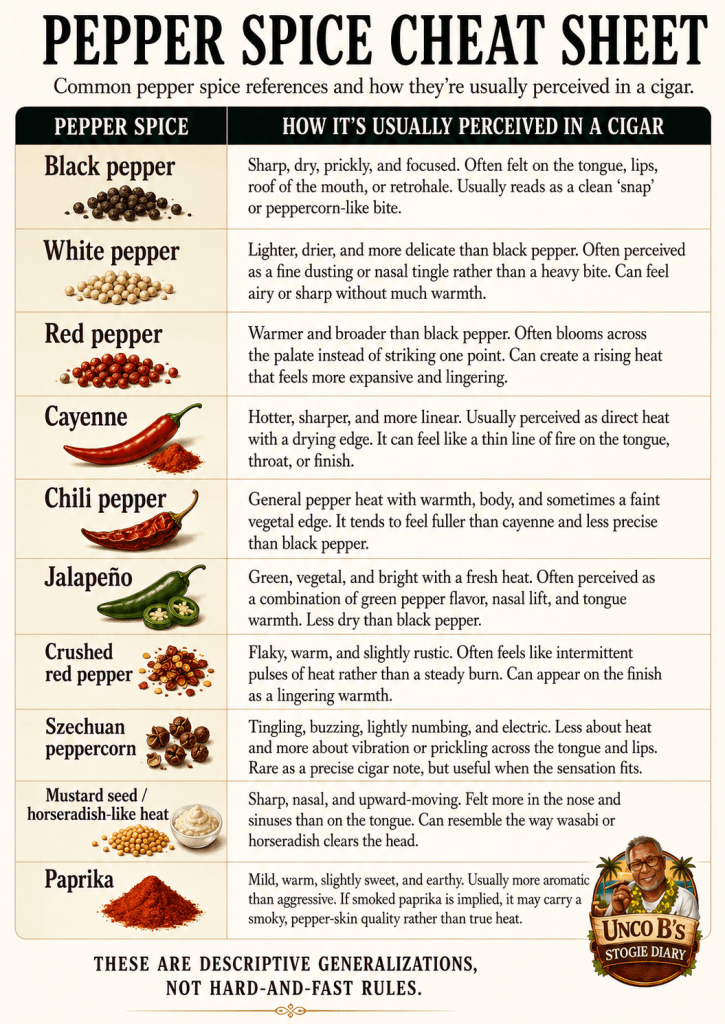
The point isn’t to force every cigar into one of these labels. The point is to recognize that pepper spice has behavior. It doesn’t simply exist as a generic “spicy” note. It lands somewhere. It moves somehow. It has weight, pressure, temperature, sharpness, duration, and direction.
And that’s a perfect segue into answering the second part of the question above: what does it do?
Pepper Spice Behavior
Pepper spice can behave in several different ways in a cigar. Sometimes it creates lift. Sometimes it creates pressure. Sometimes it sharpens the finish. Sometimes it balances sweetness or cream. Sometimes it gives the cigar energy. Sometimes it just scrapes across the palate, exposing roughness.
That distinction matters.
A cigar being spicy doesn’t automatically mean it’s bold, complex, or well-made. Spice can be integrated or disconnected. It can serve the blend or dominate it. It can create tension or simply irritate. Like any other element in a cigar, spice only matters in context.
The first thing to pay attention to is location.
Where do you feel it?
On the tip of the tongue? Across the lips? Along the roof of the mouth? In the back of the throat? Through the nose? On the finish?
Location tells you a lot. Spice on the front of the tongue may feel bright and snappy. Spice in the nose may create lift. Spice in the throat may feel rough, aggressive, or unresolved. Spice on the finish may extend the cigar’s presence after the smoke leaves the mouth.
The second thing is movement.
Does the spice stay in one place, or does it travel? Does it rise through the nose? Does it bloom across the palate? Does it pulse in waves? Does it fade quickly? Does it accumulate as the cigar progresses?
Movement is where spice starts becoming structural. A static pepper note may simply sit on top of the profile. A moving pepper note can create tension, rhythm, and momentum.
The third thing is interaction.
What does the spice interact with?
Cream softens it. Sweetness rounds it. Wood gives it a frame. Citrus sharpens it. Earth grounds it. Cocoa darkens it. Bread or pastry can make it warmer and more aromatic.
This is why spice can’t be judged in isolation. Black pepper against cream behaves differently than black pepper against charred oak. Red pepper against dark chocolate feels different than red pepper against citrus. Jalapeño heat against grass, herbs, or green wood is a completely different experience than jalapeño heat against caramel or roasted nuts.
The fourth thing is purpose.
What is the spice doing for the cigar?
Is it lifting a soft profile? Is it cutting through the sweetness? Is it creating contrast? Is it keeping the finish alive? Is it adding internal energy? Is it giving the cigar shape?
Or is it just there?
That’s the difference between spice as architecture and spice as noise.
Spice as a Flaw
Spice isn’t automatically a virtue.
A cigar can be spicy because the blend has energy, structure, lift, and tension. It can also be spicy because the tobacco is young, the combustion is hot, the cigar is under-acclimated, the ligero is sticking out, or the blend simply isn’t integrated.
Good spice feels intentional. It has a place in the system. It interacts with the rest of the profile. It gives the cigar shape, movement, contrast, or finish. Even when it’s intense, it feels like it belongs.
Bad spice feels disconnected. It scrapes instead of lifts. It burns instead of warms. It dries the palate without adding tension. It dominates the finish without giving it shape. It turns the cigar into a physical endurance test instead of a coherent smoking experience.
That’s why “spicy” should never be treated as praise by itself.
A cigar that bites isn’t necessarily bold. A cigar that burns isn’t necessarily powerful. A cigar that leaves your throat raw isn’t necessarily full-bodied.
Sometimes it’s just a flaw.
Final Thoughts
Spice can be one of the most useful words in cigar reviewing, but only when we stop treating it like a shortcut.
It isn’t enough to say a cigar is spicy. That tells us almost nothing. Is the spice aromatic or tactile? Is it cinnamon warmth or black pepper snap? Is it red pepper bloom, jalapeño lift, cayenne burn, or white pepper dust? Does it sit on the tongue, rise through the nose, sharpen the finish, or dry the palate?
More importantly, does it serve the cigar?
That’s the question that matters most.
Good spice has purpose. It brings energy, contrast, lift, rhythm, tension, and shape. It can wake up a soft profile, cut through sweetness, extend the finish, or give the cigar motion. It can be one of the elements that makes the cigar feel alive.
Bad spice just gets in the way.
The next time you smoke a cigar and reach for the word “spice,” pause for a moment. Don’t just ask whether it’s there. Ask where it is. Ask how it moves. Ask what it touches. Ask whether it belongs.
Because spice isn’t just something a cigar has.
Spice is something a cigar does.







Leave a comment