
Before I wrote about cigars, I wrote about wine and spirits. How I write about cigars was informed by that experience.
Wine and spirits taught me to think beyond flavor notes. They taught me to pay attention to structure, balance, acidity, texture, aroma, finish, and how one sensory element influences another. A wine pairing isn’t successful simply because two things share a flavor. It works because the interaction creates harmony, contrast, lift, tension, or balance.
The same is true with cigars.
When cigar smokers talk about pairing, we usually start with familiar combinations. Bourbon with darker cigars. Rum with Connecticut. Coffee with almost anything. I understand why those pairings come up so often. They’re comfortable, recognizable, and often enjoyable.
But just as cigars have nuance, wine and spirits have nuance of their own. Once those variables start interacting, pairing becomes more complicated than matching broad categories. Conventional pairings often work, but the experience can become much more interesting when we consider the character of both the cigar and the beverage.
That’s where pairing becomes less about rules and more about interaction.
To understand why some pairings work and others fall apart, it helps to look at the mechanics behind the experience.
Pairing Types
There are generally two ways to pair: analogous pairing and contrast pairing.
Analogous pairing works through similarity. The cigar and beverage share a related sensory language. Dark with dark. Creamy with creamy. Earthy with earthy. Bright with bright. These pairings often feel intuitive because both sides of the experience are moving in the same direction. This is the easiest way to pair.
Contrast pairing works through opposition. The beverage brings something the cigar doesn’t. Acidity against richness. Sweetness against bitterness. Effervescence against palate coating. Brightness against density. These pairings can create lift, tension, and separation. They can also be more challenging because they require a better understanding of how the cigar and beverage will interact.
The other challenge with contrast pairing is that what looks good on paper often falls apart in practice. Because of that, I don’t usually chase contrast pairings deliberately. Most of the good ones I’ve found have been happy accidents.
An analogous pairing can deepen the experience and make it feel more immersive. A contrast pairing can wake the cigar up and reveal details that might otherwise stay buried.
Neither approach is better. They simply do different things.
Who Speaks Louder?
This is a nuance no one seems to talk about. Whether you’re pairing analogously or through contrast, one important thing to consider is who you want to speak louder in the pairing. Do you want the cigar to enhance the spirit, or do you want the spirit to support the cigar? Or do you want both to have equal voices?
That choice can affect the cigar you smoke.
For example, last night I poured myself a shot of Planteray OFTD rum. It’s 69% ABV and absolutely delicious. Being an overproof rum, my natural instinct was to reach for something dark and sweet-leaning, like an LCA Super Sea Monkeys. The two would naturally balance each other.
But I wanted to revel in the funk of the OFTD, so I chose a smooth Raymond Pages Hoofty with a Habano wrapper. It allowed the rum to fully express itself without competing with the cigar.
The funny thing is that it also turned out to be a great contrast pairing. Though the rum dominated my palate, the cigar’s smooth dryness and minerality served as a subtle foil to the rum’s funk and power. It didn’t try to match the rum’s intensity. It gave the rum something to push against.
That’s the point of voice in pairing.
Sometimes you want both to speak at the same volume. Other times, you want one louder than the other. There’s no right or wrong answer. It all boils down to preference.
Pairing with High-Proof Spirits
The convention of pairing a high-proof spirit with a cigar seems to be: don’t do it. It’s certainly reasonable, because a high proof also means higher heat that would totally eclipse the cigar.
But I’ve been doing this pairing for years. It all boils down to technique.
First, take what I call a pairing sip. With a high-proof spirit, sips are naturally small, but a pairing sip is even smaller, perhaps just several drops. Let it sit at the front of your mouth until the alcohol heat dissipates. Then move it around your mouth to coat it, allowing any residual heat to fade. Now take a puff from the cigar.
This method engages the entire mouth. Instead of letting the alcohol dominate through heat, you allow the spirit to settle into its flavors. Then, when the cigar smoke enters, it isn’t colliding with raw alcohol. It’s interacting with what the spirit left behind.
That small distinction changes the pairing. The drink becomes part of the palate environment rather than a separate blast of intensity.
Pairings
Now, we’re finally at specific pairings. The tables below reflect my read on possible analogous pairings between beverages and cigars. As mentioned above, analogous pairings are the most intuitive.
I’ve broken down each beverage type into its major expressions and general flavor profile characteristics. I then suggest what type of cigar may work well with it. As with my other foundational pieces, these aren’t meant to be hard-and-fast rules. They’re simply points for further exploration.
The list isn’t comprehensive. That would occupy the space of a book. But it provides a general framework for thinking about what may work with what.
Scotch
| Type | Flavor Profile | Cigar |
|---|---|---|
| Speyside | Honey, orchard fruit, malt, soft oak | Connecticut, lighter Habano, refined Dominican |
| Highland | Balanced malt, oak, fruit, moderate structure | Medium Habano, Cameroon, classic medium-bodied blends |
| Islay | Peat smoke, iodine, maritime, oily, intense | Maduro, Oscuro, Broadleaf, San Andrés |
| Lowland | Light, grassy, floral, delicate | Connecticut Shade, mild Dominican, elegant Ecuador Connecticut |
| Campbeltown | Salty, oily, funky, earthy | Rustic Nicaraguan, San Andrés, earthy Habano |
Bourbon
| Type | Flavor Profile | Cigar |
|---|---|---|
| Wheated bourbon | Soft caramel, vanilla, bread, round sweetness | Connecticut, creamy Habano, classic Dominican |
| High-rye bourbon | Spice, oak, dryness, sharper finish | Habano, Cameroon, structured Nicaraguan |
| Barrel-proof bourbon | Heat, density, char, saturation | Broadleaf, Oscuro, dense Nicaraguan puro |
| Older oak-heavy bourbon | Tannin, leather, dark oak, dryness | San Andrés, mature Maduro, full-bodied structured cigars |
| Finished bourbon | Fruit, wine cask, sweetness, aromatic lift | Cameroon, aromatic Habano, experimental blends |
Rum
| Type | Flavor Profile | Cigar |
|---|---|---|
| Light Spanish-style rum | Clean sweetness, vanilla, light fruit | Connecticut, mild Habano, creamy Dominican |
| Aged Spanish-style rum | Caramel, vanilla, brown sugar, soft oak | Broadleaf, Maduro, medium-full Nicaraguan |
| Barbados rum | Balanced oak, baking spice, fruit, restrained sweetness | Habano, Cameroon, light Broadleaf, balanced Maduro |
| Jamaican rum | Funk, overripe fruit, esters, spice | San Andrés, Cameroon, high-energy Habano |
| Demerara rum | Molasses, burnt sugar, dark fruit, density | Oscuro, Broadleaf, dark Maduro |
| Agricole rhum | Grass, cane, herbs, brightness | Habano, Cameroon, brighter Connecticut |
| Navy / overproof rum | Heat, molasses, funk, saturation | Dark San Andrés, Broadleaf, Oscuro, strong Habano |
Cognac / Brandy
| Type | Flavor Profile | Cigar |
|---|---|---|
| Cognac | Orchard fruit, dried fruit, vanilla, oak, baking spice, polished sweetness | Cameroon, Sumatra, Habano Maduro, refined Dominican Maduro |
| Armagnac | Dark fruit, prune/fig, spice, earth, rustic grip | Corojo, San Andrés, earthy Habano, rustic Nicaraguan |
| Spanish Brandy / Brandy de Jerez | Raisin, caramel, vanilla, sweet oak, sherry-cask richness | Maduro, Broadleaf, softer San Andrés, sweeter Nicaraguan |
| American Brandy | Grape fruit, vanilla, caramel, oak, sometimes softer and sweeter | Connecticut Broadleaf, medium Maduro, Habano, approachable Nicaraguan |
| Calvados / Apple Brandy | Apple, pear, baked fruit, spice, vanilla/oak | Connecticut, Cameroon, lighter Habano, classic Dominican |
| Pisco | Grape floral, citrus, clean fruit, aromatic lift | Connecticut Shade, floral Dominican, brighter Cameroon |
| Grappa / Pomace Brandy | Grape skin, floral heat, herbal bite, dry finish | Habano, Corojo, Sumatra, spice-driven medium cigars |
| Fruit Eau-de-Vie | Fresh fruit, high aromatics, clean alcohol, dry finish | Connecticut, floral Dominican, delicate Cameroon |
Tequila
| Type | Flavor Profile | Cigar |
|---|---|---|
| Blanco | Agave, citrus, pepper, herbs, minerality, clean heat | Connecticut, Cameroon, brighter Habano |
| Reposado | Cooked agave, vanilla, light oak, baking spice, soft sweetness | Habano, Sumatra, medium Dominican, lighter Maduro |
| Añejo | Caramel, oak, dried fruit, vanilla, round spice | Broadleaf, San Andrés, Habano Maduro, refined Maduro |
| Extra Añejo | Deep oak, caramel, baking spice, dried fruit, polished sweetness | Maduro, Oscuro, structured Broadleaf, full-bodied Nicaraguan |
| Mezcal | Smoke, roasted agave, earth, mineral, herbal intensity | San Andrés, Oscuro, earthy Habano, rustic Nicaraguan |
Wine — Sweet → Dry
Wine is tricky to pair, and I almost didn’t include it. Wine has layers upon layers of nuance. Region, climate, grape variety, oak treatment, acidity, tannin, sweetness, and producer style can all change how a wine behaves with a cigar. That’s significantly more variable than any of the other beverages listed here.
Wine also carries the greatest risk of looking great on paper and falling apart in practice.
So I defaulted to broad character traits.
| Type | Flavor Profile | Cigar |
|---|---|---|
| Port | Sweet dark fruit, richness, density | Maduro, Oscuro, heavy Broadleaf |
| Sauternes | Honey, apricot, botrytis richness, acidity, lush texture | Cameroon, lighter Broadleaf, Sumatra, sweeter Connecticut |
| Cabernet Sauvignon — fruit-forward | Ripe fruit, oak sweetness, broader texture | Jalapa-forward Nicaraguan, Mata Fina, sweeter Habano |
| Merlot | Plush fruit, softness, moderate tannin | Maduro, rounded Nicaraguan, medium-full Dominican |
| Chardonnay — oaked | Butter, vanilla, cream, soft oak | Creamy Connecticut, Dominican Maduro, softer Broadleaf |
| Syrah / Shiraz | Pepper, dark fruit, smoke, savory depth | San Andrés, spice-driven Habano, structured Nicaraguan |
| Pinot Noir — earthy/savory | Mushroom, forest floor, savory earth, restrained fruit | Broadleaf, darker San Andrés, earthy Habano |
| Pinot Noir — bright/mineral | Red fruit, acidity, floral lift, tension | Classic Dominican, Cameroon, elegant Habano |
| Cabernet Sauvignon — mountain/mineral | Tannin, dryness, mineral tension, restrained fruit | Habano Maduro, Corojo, Sumatra, San Andrés |
| Chardonnay — unoaked | Crisp fruit, minerality, cleaner structure | Connecticut, mild-medium Habano |
| Champagne / Sparkling Wine | Bright acidity, minerality, effervescence, citrus | Connecticut, Cameroon, brighter Habano |
| Sauvignon Blanc | Herbal, citrus, grassy, high acidity | Connecticut Shade, lighter Dominican, floral cigars |
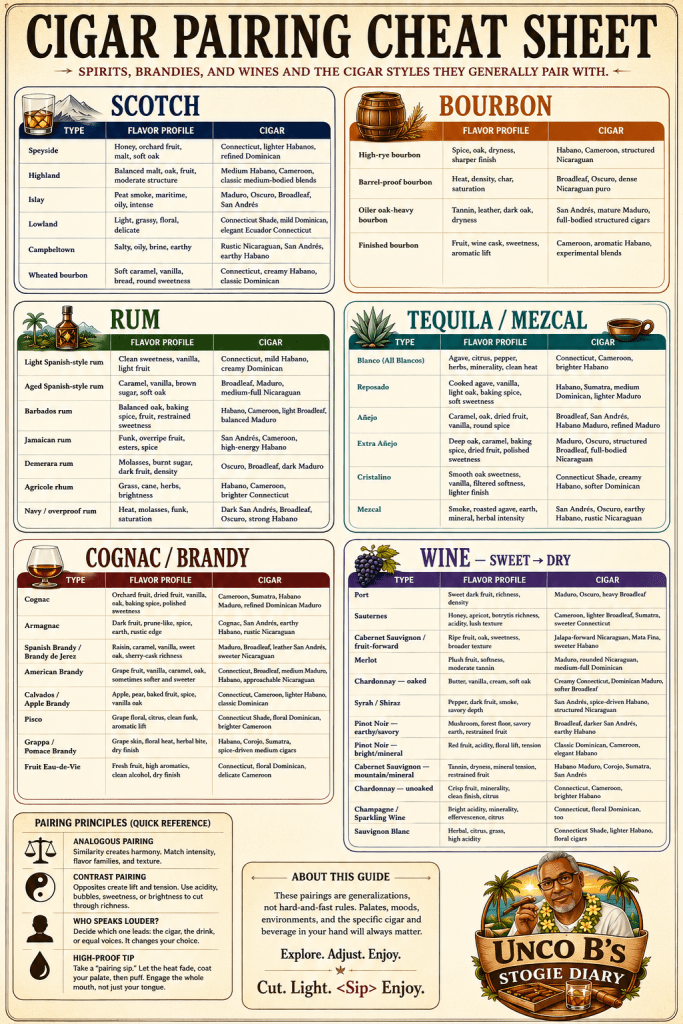
Here’s a convenient infographic that you can copy and save for reference.
Where the Hell Is the Coffee?
You may have noticed that I didn’t have a coffee table. I’m fully aware that coffee has different expressions. In fact, there are so many different expressions that I could dedicate an entire article to coffee.
So that’s probably what I’ll do.
Coffee deserves its own discussion because it behaves differently from wine and spirits. It can be acidic, bitter, roasted, creamy, sweet, dry, sharp, soft, or dense depending on origin, roast level, brew method, and what you put in it. A light roast black coffee and a dark roast latte aren’t merely different flavors. They create completely different pairing environments.
Coffee also occupies a strange place in cigar pairing because it can work both analogously and in contrast. Black coffee can sharpen a cigar, expose sweetness, and add roasted bitterness. Coffee with cream can soften edges, increase texture, and create a more rounded experience. Espresso can be fantastic with the right cigar, but it can also overwhelm the palate quickly.
That’s why I didn’t want to squeeze coffee into a small table. It deserves more room than that.
For now, I’ll simply say this: coffee may be the most versatile non-alcoholic cigar pairing, but it’s not automatic. Like everything else, it depends on what kind of coffee you’re drinking, what kind of cigar you’re smoking, and which one you want to speak louder.
Final Thoughts
At the end of the day, pairing isn’t about finding the “correct” drink for a cigar.
It’s about understanding how one changes the other.
Sometimes the right pairing deepens the cigar. Sometimes it gives the cigar lift. Sometimes it lets the drink speak louder. Sometimes it creates balance. And sometimes it falls apart completely, even when it looked perfect on paper.
That’s part of the fun.
The goal isn’t to memorize rules. The goal is to become more aware of what’s happening in your mouth. Pay attention to sweetness, acidity, texture, heat, bitterness, aroma, and weight. Notice whether the pairing creates harmony, contrast, tension, or interference.
Then adjust.
Try the expected pairings first. Then try something that seems a little sideways. You may find that a pairing you would never have planned becomes the one you remember most.
As always, the point is simple.
Cut. Light. <Sip> Enjoy.




Leave a comment