
Here’s a situation we’ve all encountered a few times.
We buy a pack or a box of cigars. We finish them, and then sometime later we buy more. But when we light up one of the new ones, they seem different. Not bad. Just different.
Fundamentally, the profile tastes the same as our previous sticks. But we feel a variation in the new cigars. Perhaps the texture changed. Or maybe the profile leans a little darker. We look at the leaf stats. It’s the same blend. The smoke is still great, so we chalk it up to our palate’s condition.
But it’s very likely something did change in the blend.
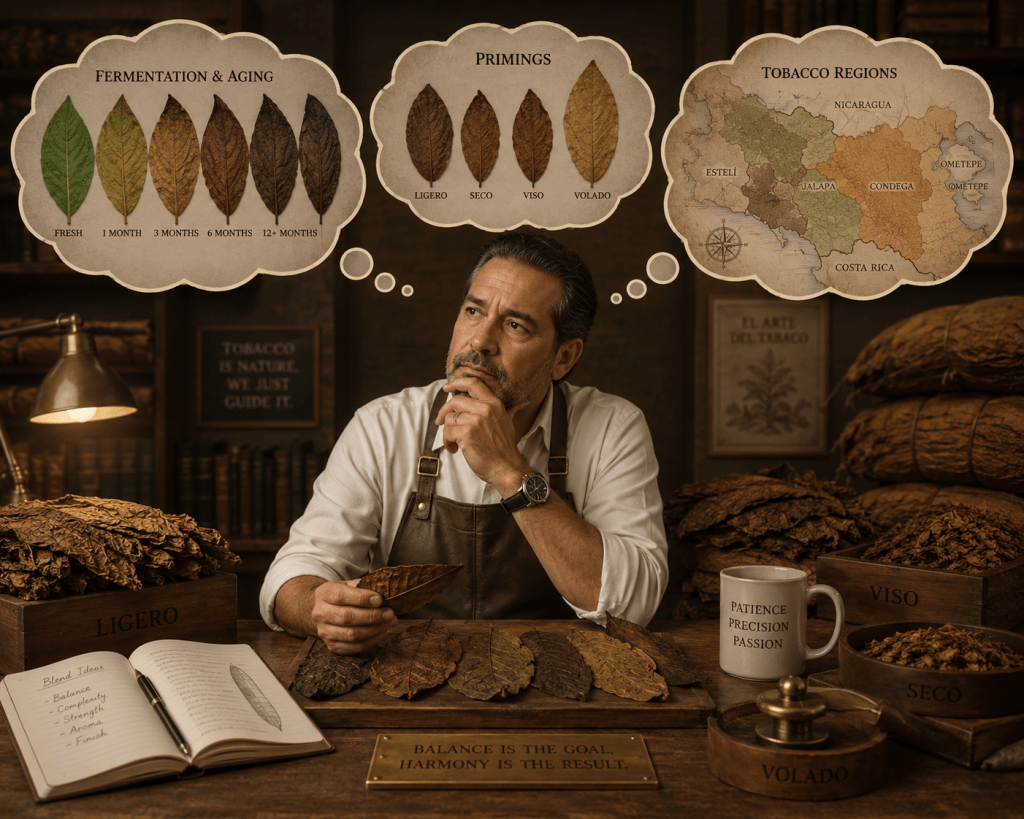
Brands tell you the wrapper is Ecuadorian Habano, the binder is Nicaraguan, and the filler contains tobacco from Estelí, Jalapa, or Condega. They usually won’t tell you the primings, the farms, the crop years, the fermentation history, the aging time, or the exact proportions.
That isn’t secrecy for secrecy’s sake.
It’s because the printed blend is only the public outline. The real blend lives in the decisions underneath it.
The other night, I got into a great conversation with Luis Barragan, founder of Dunamis Cigars, at the shop where he works. It was a slow night, so we had plenty of time to talk about a variety of topics, one of which was consistency.
Even though his brand is still new, he told me it was important to prepare for the future so his blends would remain consistent from run to run. I asked him several questions about how that actually works in practice. What he shared with me became the foundation for what I’ll discuss below.
Leaf Availability
One thing I hadn’t considered as a constraint for a blend is leaf availability. Luis told me the Dominion was originally supposed to use a different wrapper, but Raul Lanuza informed him there simply wasn’t enough leaf left to do a production run. Instead, they chose a deeply fermented San Andrés wrapper.
The result was still spectacular, but it was a clear example of a blender having to adapt based on the tobacco actually available. For a boutique brand, that’s not a small thing. Unless you grow your own tobacco or have access to deep inventories, availability becomes part of the blend.
Leaf Proportions and Priming
Most of us look at a blend’s leaf stats and just assume they’re static. They’re not.
The published blend tells us the broad identity. The working blend is where the adjustments happen.
One run may use slightly different primings. Another may lean on tobacco that spent longer in fermentation. Another may require a different proportion of viso and seco than expected. The regional profile remains the same, but the internal architecture shifts in order to maintain a consistent experience.
That’s the part most smokers never see.
The cigar industry talks about blends as if they’re recipes, but in practice, they behave more like living systems. Tobacco changes constantly because tobacco is agricultural. Climate changes. Soil changes. Crop years change. Fermentation changes. Aging changes. Even after the cigar is rolled, añejamiento (aging) continues shaping the final experience.
The blender’s job is not to freeze nature in place.
The blender’s job is to navigate variation without losing identity.
And because tobacco is an agricultural product, it’s inevitable that some variation will occur from run to run. Raul Lanuza said to Luis that they’ll perfect the blend eventually. What he meant was that they would eventually understand the tobacco well enough to consistently calibrate the experience from run to run.
That doesn’t mean the exact same leaves will always be used in the exact same proportions. In some cases, they can’t be. What matters is whether the cigar still speaks with the same voice.
That’s the real target of consistency.
Not duplication, but continuity of identity.
In the end, consistency in cigars is far more complicated than most smokers realize. Tobacco isn’t a fixed industrial material. It changes with climate, soil, crop year, fermentation, aging, and availability. Even when the published blend stays the same on paper, the working blend underneath may shift from run to run as blenders adapt to the tobacco in front of them.
That doesn’t mean consistency is out of reach. It just means consistency isn’t sameness. A blender may change proportions, primings, or fermentation levels from one run to the next. But if the cigar still feels like itself, if it still carries the same voice, then the blender has succeeded.




Leave a comment