
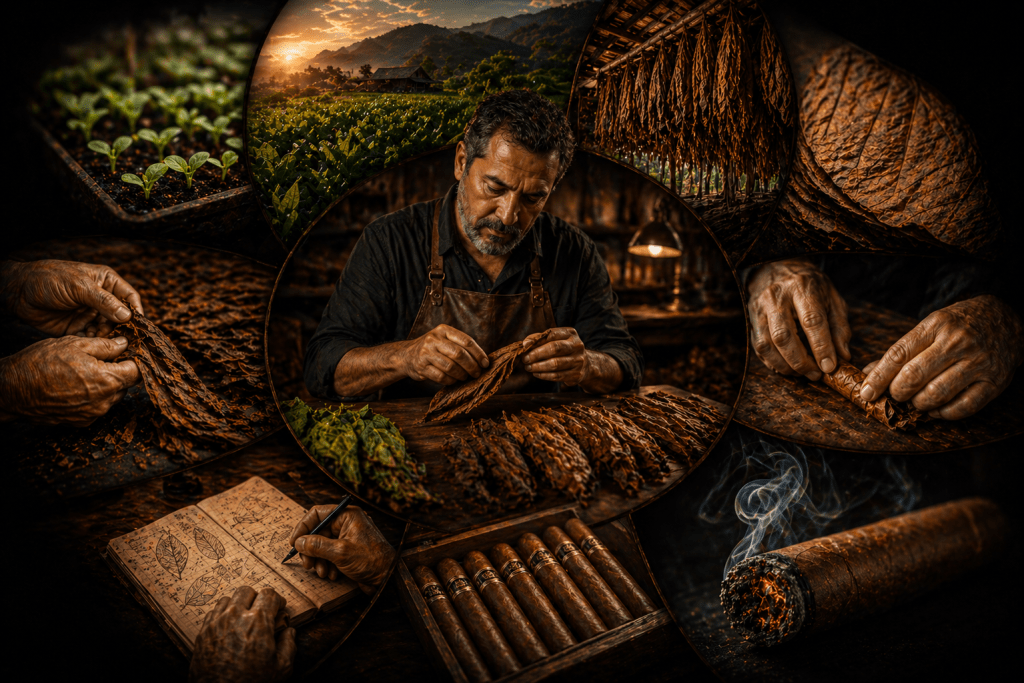
You light up a cigar.
It’s good—exactly the kind of good you expect. The flavors are familiar and right where you want them, the construction is solid, and the burn is even. Even the leaf stats say it should be right in your lane.
And yet, as you keep smoking, it doesn’t do anything. It doesn’t open up, doesn’t shift, doesn’t reveal anything beyond what it already showed you at the start. It just stays there. You let it burn out.
Then you light something else.
From the first draw, it feels different. As it unfolds, each moment leads into the next with a sense of purpose. It feels directed. You’re not waiting for it to become something because it tells you what it is.
Comparing it to the other cigar, you realize the difference between them isn’t quality. It’s intent. One feels put together.
The other feels authored.
Often, what separates a good cigar from a truly great one is the intent behind how it was conceived and produced. That’s where authorship comes in.
Great cigars read like a novel. Others feel more like scrapbooks. They have all the right elements, but they don’t hold together as a single, cohesive whole.
We’re trained to look at cigars through their leaf stats, the regions they come from, and the factories that produced them. It’s useful information, but it’s incomplete.
Factories don’t write the cigars. They execute them.
We can trace a cigar from seed to smoke. But that just tells us how it was made. It’s not what defines it. Somewhere along the line, decisions are made.
Those decisions are what matter.
Leaf selection. Fermentation. Blending. Bunching. Rolling. Curing. Progression. Balance. Resolution.
Authorship comes from the decisions made around these and other critical factors. It’s the difference between an assembled cigar and a directed one.
When we smoke an authored cigar, we feel the result of those decisions. Everything works together. It carries a sense of direction. It builds. It resolves. All we have to do is follow it.
The blender probably doesn’t care if you know who they are. That’s not the point. Their name isn’t what you’re experiencing. What you’re experiencing is their thinking—how they chose, what they left out, how they shaped the cigar into what it becomes. The authorship is in the decisions, not the name behind it.
Not every cigar has authorship. But it’s obvious when it does.
In my reviews, I often use metaphors to describe a cigar’s behavior. That only works when there’s something to follow—something consistent enough to translate into an idea. Without that, there’s nothing to hold onto beyond isolated impressions. Simply put, it doesn’t just happen.
It was made to happen.
Authorship appears in the signatures we’ve become familiar with. You start to recognize it in the way certain cigars carry themselves from start to finish. The most obvious example is when you smoke an AJ Fernandez cigar. His authorship is so identifiable that cigars he didn’t even make are sometimes attributed to him.
Saka and Melillo are other great examples whose cigars are meticulously authored.
And there are exciting new boutique outfits teaming up with blenders to create fantastic cigars, such as Daniel Lance and Esteban Disla of Domain Cigars, and Don Emmanuel and Eladio Diaz with Don Emmanuel Cigars.
What ties them all together isn’t the factory they use or the components they select. It’s someone making decisions about how the cigar should behave and following those decisions all the way through.
That’s what shows up when you smoke it.
And that’s what separates a cigar that’s just assembled from one that’s built with intent.




Leave a comment