
Though there are thousands of decisions that go into producing a cigar, one area that rarely gets attention is the leaves themselves and what they contribute.
I’m currently studying to become a Certified Consumer Tobacconist (CCT), and part of that curriculum focuses on the tobacco plant, how it grows, how it’s harvested, and how different leaves are used for different purposes within a cigar.
I find the subject fascinating.
It’s one thing to know a cigar is made of different leaves. It’s another to start recognizing that those differences matter.
Most of us understand a cigar’s construction in terms of geography. We know where the wrapper comes from. We know the countries listed in the filler. But beyond that, it usually stops there.
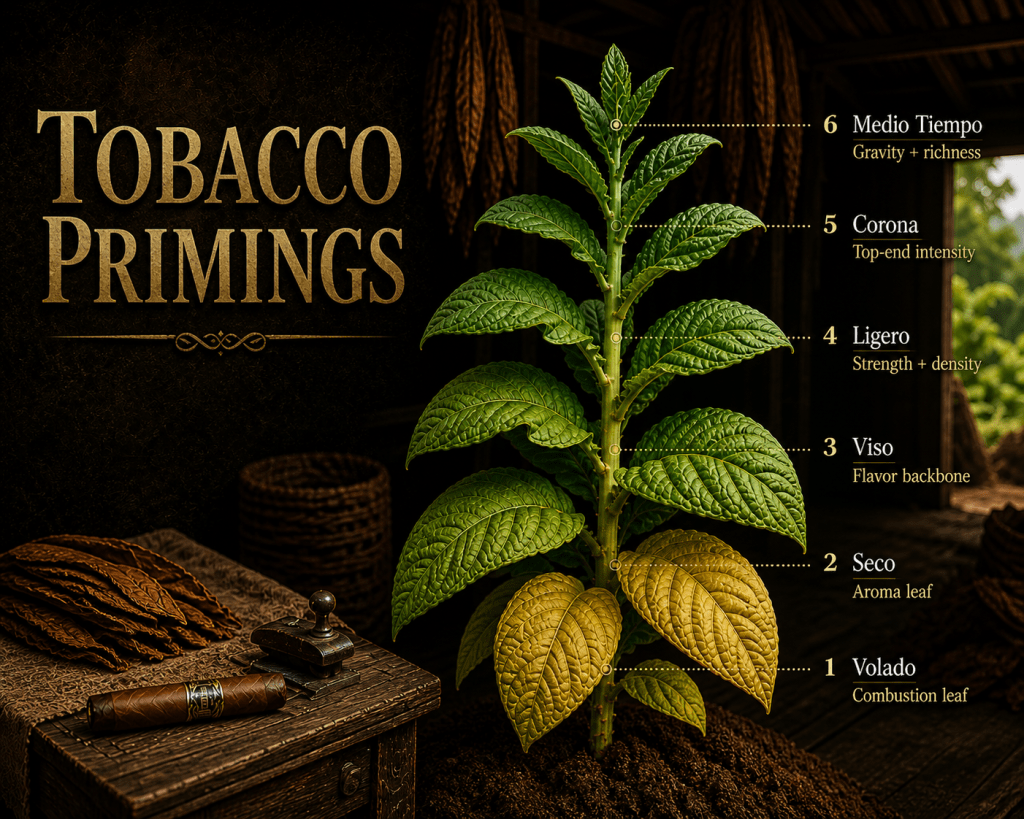
What we don’t see is where those leaves came from on the plant itself. Which part was chosen. Why it was chosen. What role it was meant to play once everything was brought together.
That said, none of this matters to enjoy a cigar. But it is interesting to understand what’s driving the way it tastes and behaves.
Below is a simplified view of how the leaves are positioned on the plant and what they generally bring to a blend. This is based on the CCT curriculum along with additional research.
It’s not meant to be a technical manual or a set of rules. It’s a way to understand the roles these leaves play within the context of a cigar.
Once you see that, it becomes easier to understand why cigars do what they do.
| Priming | Position on Plant | Leaf Traits | Flavor | Burn Behavior | Fermentation Needs | General Usage in a Cigar |
|---|---|---|---|---|---|---|
| Volado | Bottom | Thinnest, lowest oil, lowest nicotine | Mild, neutral, light earth | Fastest burn, coolest temperature | Light, low‑heat fermentation | Combustion leaf — added to ensure the cigar lights easily and stays lit; stabilizes blends with heavy ligero |
| Seco | Mid‑lower | Thin‑medium, aromatic, moderate oils | Floral, herbal, aromatic lift | Moderate burn, stable | Moderate fermentation; heat‑sensitive | Aroma leaf — provides fragrance, nuance, and retrohale character; balances stronger fillers |
| Viso | Mid‑upper | Medium thickness, higher oils, more density | Core flavor: earth, wood, spice | Slower burn, more smoke density | Deeper fermentation; tolerates heat | Flavor backbone — the structural center of most blends; provides body, complexity, and balance |
| Ligero | Upper | Thick, oily, high nicotine | Strength, pepper, dark earth, deep sweetness | Slow burn, hot internal temperature | Long, hot fermentation; ammonia‑heavy | Strength + density — adds power, chew, and smoke thickness; used sparingly to avoid burn issues |
| Corona | Very top | Highest sun exposure, thickest, strongest | Concentrated strength, sharp spice | Slow burn, can burn unevenly if not blended well | Long fermentation; requires careful management | Top‑end intensity — used when a blender wants sharpness, edge, or a high‑tone strength spike |
| Medio Tiempo | Rare top leaves (not always present) | Ultra‑thick, ultra‑oily, extremely dense | Concentrated sweetness, mineral depth, heavy earth | Glacial burn, massive smoke density | Very long, volatile fermentation; difficult to manage | Gravity + richness — adds syrupy sweetness, weight, and slow‑motion burn; used in small quantities |
I want to stress that these aren’t hard-and-fast rules. They’re generalizations. As with most things, there are exceptions, but this provides a basic idea of the roles the leaves play.
A Note on Harvesting
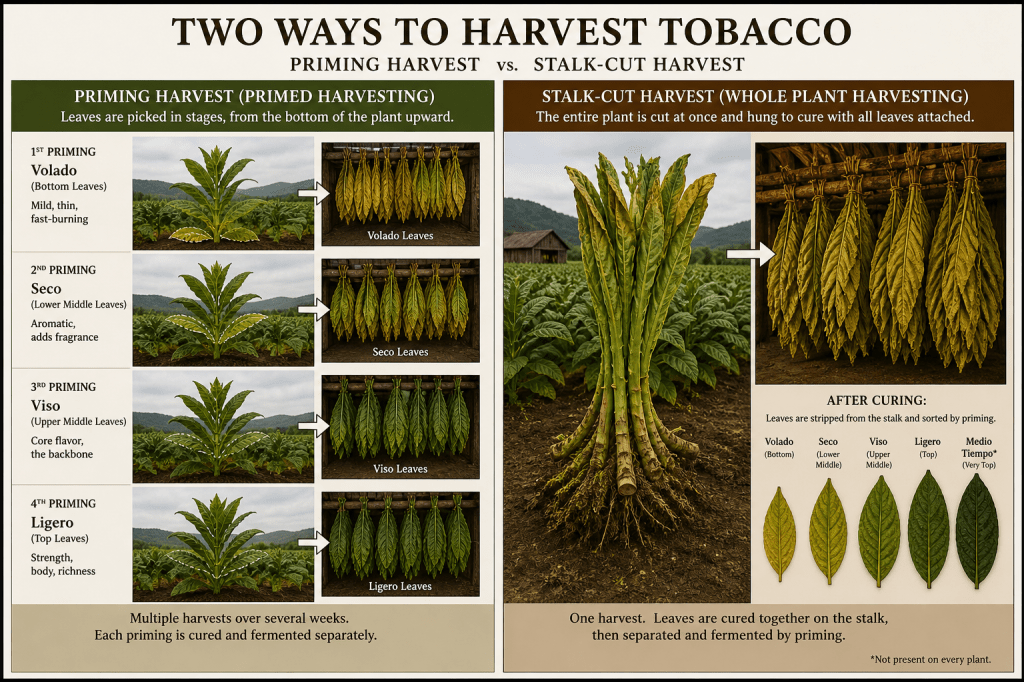
Another thing I learned is how tobacco is harvested. The most common method is called primed harvesting, where leaves are removed from the plant over time, starting at the bottom and working upward as each level matures.
The other method is stalk harvesting, where the entire plant is cut at once and cured as a whole.
In both cases, the leaves are still sorted and selected afterward based on position, color, and quality before they’re used in a blend.
The graphic below lays out both approaches side by side, showing how the leaves are taken from the plant and handled in each method.
At the end of the day, none of this changes how or why we smoke cigars. We simply cut, light, and enjoy. But it helps to have a little context.
I’m learning this because I enjoy it. It’s part of the hobby. The more I understand, the more I appreciate what I’m smoking.
For me, it all starts with the leaves.






Leave a comment