
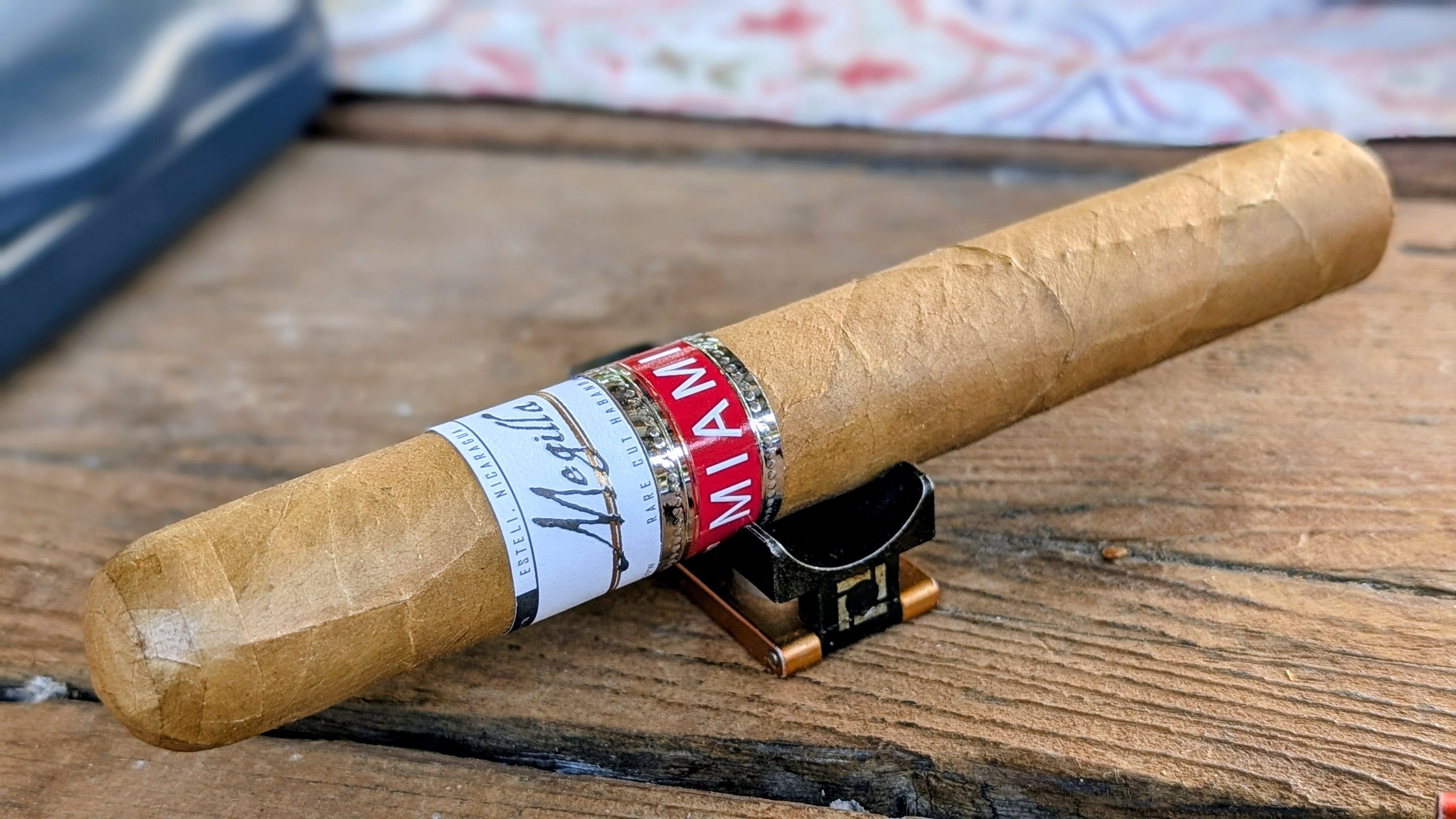
Wrapper: Connecticut Shade (USA/Ecuador)
Binder: Mexico
Filler: Dominican Republic, Nicaragua
Size: Toro (6 x 52)
Strength: Medium (builds slightly above medium)
Body: Medium → Full (late)
Price: ~$7.50 → $8.00
Factory: El Titan de Bronze
Blender: Raymond Pages
Release: 2025
Experience Rating: 94

I don’t like Connies.
That’s what I thought when I saw the fiver included with the samples Cigar Page sent me for review.
But it’s not that I don’t like Connecticut wrapper cigars. I do. It’s just that, in my experience, they tend to get harsh in the final third. More often than not, I end up letting them burn out.
And when I do that, it feels like I only got two-thirds of the experience.
It’s one of the reasons I only occasionally have a Monte White. It’s great through most of the cigar, but in the last couple of inches, it collapses into a harsh mess. Up to that point, it’s fantastic.
So, when I lit up the Megilla Miami, I was expecting the same experience I’ve had with so many Connies. I was prepared to enjoy two-thirds of the cigar and move on.
I couldn’t have been more wrong.
I’ll just say this up front: this is going into my regular rotation.
Not only was it refined and composed from foot to head, it stayed flavorful all the way to the nub. It didn’t turn harsh in the final third. It gathered itself and gained depth without collapsing into muddiness.
This is yet another cigar that shattered my expectations.
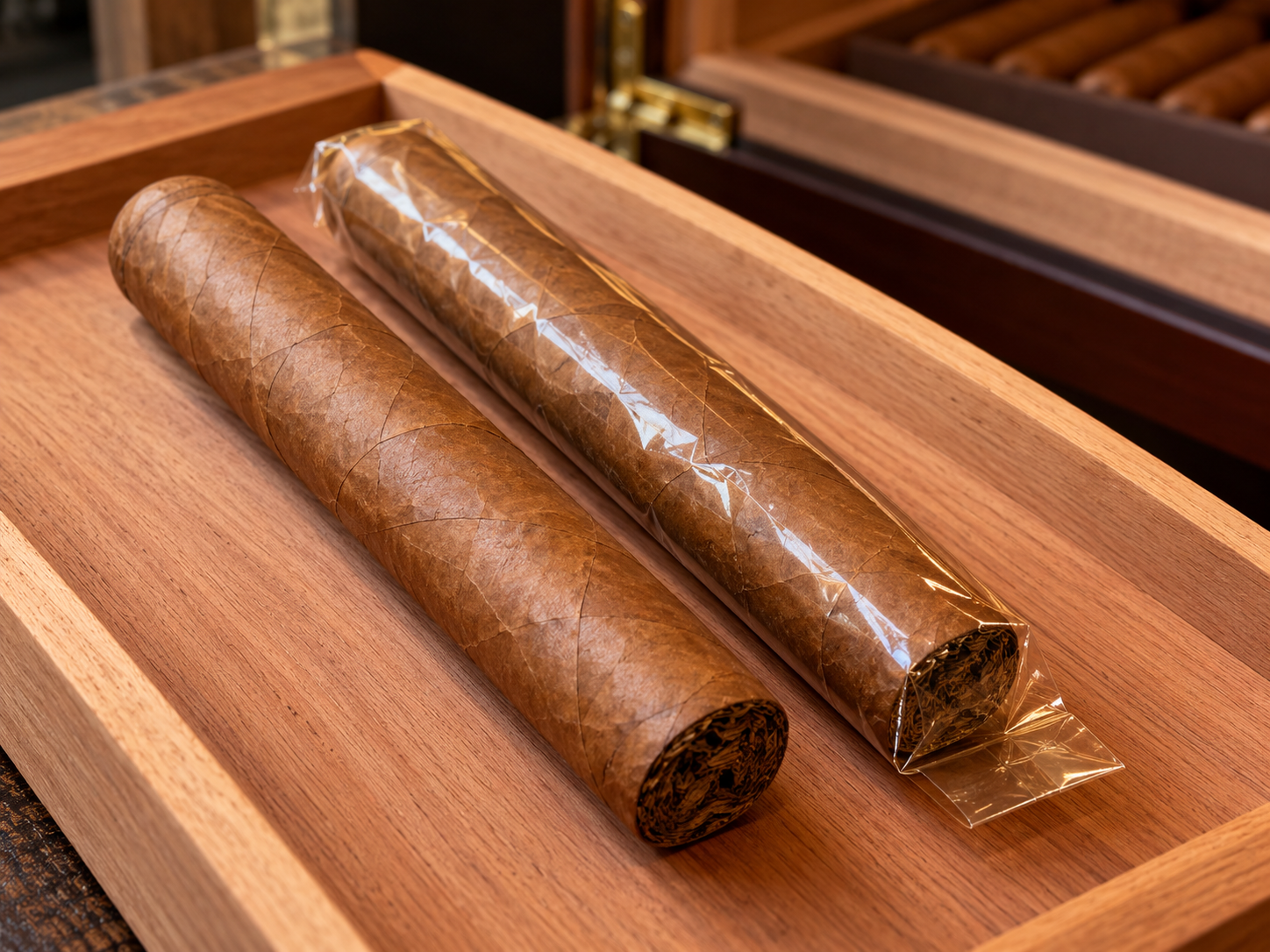
Though blended by Raymond Pages, this is an El Titan de Bronze stick—and it shows. The first thing I noticed when I removed it from the cellophane was how cleanly it was rolled. Barely visible seams, some veins, but the wrapper was tight and smooth. It had some heft, solid in the hand with no soft spots or unevenness. It was clear ETdB used high-level torcedores on this one.
Notes of barnyard, fresh-cut grass, hay, and fruit roll-up come off the wrapper, while the foot gives off dried fruit. The cold draw is excellent—sweet cream, caramel, vanilla, and more hay. Very Connie-like.
Lighting it up, I get a hit of cedar, white pepper, and leather. The smoke is immediately creamy and mild, and I’m encouraged by the start.
As it settles in, the cigar plants a flag and jumps to medium strength. The cream intensifies, laying down a foundation for what’s to come. Flavors begin to accumulate: citrus, cedar, floral notes, vanilla crème, earth, leather, nougat, malt, cashew, and sourdough toast.
There’s no discernible core at this point, but the cigar feels structured and composed. Everything is well-behaved, with nothing overwhelming the others. It doesn’t shift so much as it builds—collecting flavors and stacking them on top of one another. This creates a sense of constant motion.
Further in, a gentle red-pepper spice appears and lingers through the finish, fading until the next puff, when it resets. It’s rhythmic—like a heartbeat. Nicotine arrives in a flourish. It’s not strong, but the way it enters feels like it barged through a doorway. Meanwhile, the cigar glides smoothly.
Then a core forms with the arrival of coffee.
It’s like a sergeant assembling his troops—pulling in leather, cedar, and cream. The spice becomes the unit’s banner, hovering above it all, lifting and driving the formation forward.

Meanwhile, the transitions continue. No new flavors arrive, but they roll in slow-shifting combinations—not rapid-fire like the Manzanita—staying in line with the smooth glide and easy tempo that’s been established.
They remind me of the Foucault Pendulum at the San Francisco Academy of Sciences—always swinging, perpetually driven by gravity and the Coriolis effect.
That was just the first half of the cigar.
By the second half—about forty-five minutes in—the action hasn’t changed. The core is confirmed and solid, while the shifting palette of transitions continues to drive the experience forward.
Just past the halfway point, the nicotine settles. The way it backs off reminds me of that flamboyant character barging into the room, waiting to be acknowledged—then realizing no one is paying attention, pulling up a chair in the corner to sulk and brood.
In the home stretch, strength notches up just past medium. It occurs to me that once the core formed, the experience has been one long sweet spot. The action never changed. It just rolled along—driving forward, asking nothing of me but to enjoy the ride.
And through all this, there has been no harshness. None.
The core becomes a little darker, giving the profile more depth, while the transitions continue their slow, pendulum-like motion.
In the last couple of inches, cream is crowned king. Its presence completely overshadows the spice, which becomes muted and subdued—like a gag has been tied around its mouth.
Strength increases to just shy of medium+, but as the profile deepens, the body jumps to full.
In the last inch, the core deepens further but doesn’t collapse. It gathers and tightens. Coffee becomes espresso. Cedar chars. Leather takes on a darker tone.
The spice manages to slip its gag and push through the cream. Its voice is weak—as if from screaming—but it still acts as a punctuation mark on the finish. I smoke it down to the nub.
Talk about an expectation-breaker.
I’m usually not a fan of Connies, but this was so good I can’t just look at it as a Connie-wrapped cigar. It stands on its own as a great cigar. And dare I say it? I like it even more than the excellent Jaime Garcia Reserva Especial Connecticut—a cigar I thought was the only exceptional Connie I’d had. But even with that one, I couldn’t nub it. I got further than most, but still abandoned it in the last inch and a half.
This is a perfect example of a blend working in concert. I’ve got that giddy feeling like I just discovered a hidden treasure.
And Connie wrapper or not, it’s going into my regular rotation.
Some people may balk at the $7–$8 price for a house blend. But don’t think of it that way. This is an El Titan de Bronze cigar—one that Cigar Page and Raymond Pages had produced there. From that perspective, you’re getting all the quality, consistency, and expertise that comes with that factory.
You can buy these at Cigar Page. I think you’ll be just as surprised as I was! Use the discount code CPMEGM10 to get 10% off the cigars.





Leave a Reply