
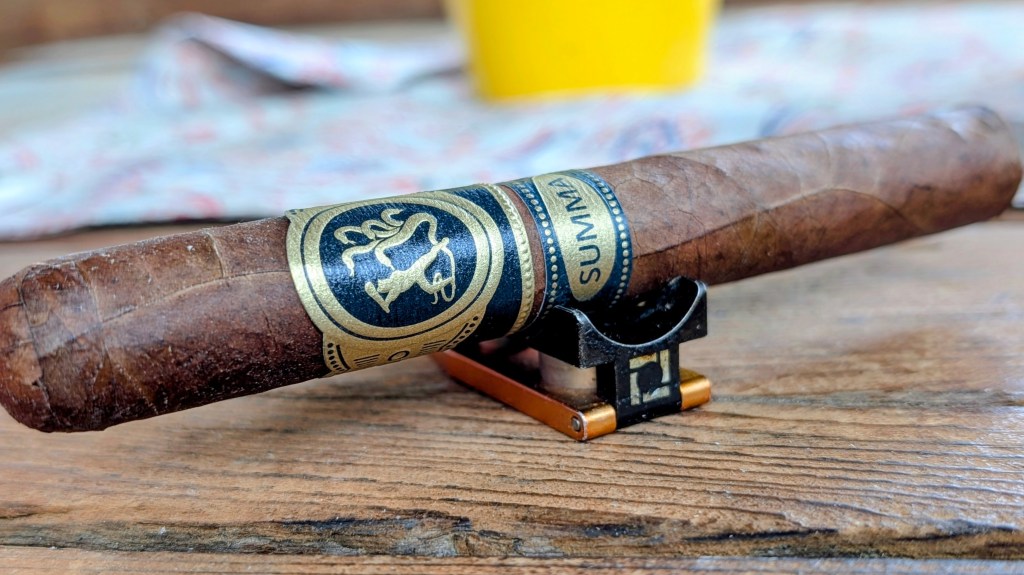
Wrapper: Ecuadorian Corojo
Binder: Ecuadorian Sumatra
Filler: Nicaragua & Dominican Republic
Size: Toro (6 x 52)
Strength: Medium → Medium+
Price: ~$20.00 (varies by retailer)
Date Released: 2023
Factory: Tabacos de Exportación (MATASA), Dominican Republic
Blender: Michael Herklots
Experience Rating: 98
When I look at a cigar’s leaf stats, I can’t help but form an idea of how it’s going to taste and behave. Sometimes I’m right. More often, I’m not.
With the Summa, I was only half right. I expected spice from the Corojo wrapper, and it was there. I expected some muscle from the Nicaraguan filler, but while the cigar was solid, it never leaned in that direction. And I thought the combination of tobaccos would make this a flavor-forward cigar with obvious complexity. It is complex—but not in the way I expected.
In an interview, Michael Herklots described the enjoyment of a cigar as binary in nature—you either enjoy it or you don’t. Everything else is just an attempt to explain why.
That stayed with me while smoking the Summa, because it clarified something I was already feeling but hadn’t fully articulated. This wasn’t a cigar that asked to be analyzed in pieces. It didn’t rely on transitions or surprises to justify itself. It either worked or it didn’t.
And for me, it did.
The first thing I noticed before lighting it up was how unassuming it was. The simple gold on black dual bands adorn a smooth wrapper with a subdued, oily sheen. The aromas of the wrapper and foot were simple—a little barnyard, stone fruit, and vanilla wafer. It felt composed.
That same composure carried through the moment I lit it.
It didn’t take long to realize this wasn’t a cigar that would announce itself with bold transitions or a steady build of intensity. It formed its core early and settled in just as quickly—espresso, charred wood, chestnuts—held together by a creaminess that gave it weight without pushing it forward, while a red pepper spice provided a subtle lift, keeping everything in place. I’ve always appreciated cigars that don’t waste time getting down to business, and the Summa makes its intentions clear almost immediately.
Within the first half-inch, it confirmed its structure—something many cigars take much longer to do. It hadn’t fully revealed its identity yet, but there was an elegance in how it held itself, a restraint that signaled something more considered and deliberate.
And in that moment, I knew I was smoking something special.
As the cigar settled in, the smoke took on a creamy texture that quickly established itself as the foundation of the core, with dark coffee and charred wood anchoring the profile. The wood shifted subtly between cedar and oak, while the chestnut resolved into hazelnut.
There was a warmth to it as well, something reminiscent of hot chocolate with marshmallows, alongside a yeasty, bread-like note that gave the profile a grounded, almost familiar quality. And wrapping around it all was a red pepper spice, not aggressive, but precise—punctuating the core and giving it just enough lift to keep it from settling too deeply into itself.
At this point, it was clear this wasn’t going to be a flavor bomb. It was too balanced, too composed. And yet there was something beneath the surface, an underlying complexity that kept drawing my attention deeper into the cigar. That balance wasn’t neutral or static. There was a coherence to it—everything working together in a way that powered it.
It shifted my attention away from the flavor notes and into the experience itself.
As the cigar progressed, I began to notice something else happening. Flavor notes would appear above the core—sweet bread, pineapple, teak wood, sourdough, a cheese-like umami, citrus, roasted almonds, shortbread cookies—but instead of fading, they seemed to gather, then coalesce into different combinations from puff to puff. They never settled. They just kept shifting.
It felt like energy—something internal and persistent, sustaining it, like a generator.
The core hadn’t moved—it didn’t need to. Everything that mattered was happening around it. Those notes would gather, coalesce, then break apart again, never fully settling, never fully leaving. They weren’t leading the cigar anywhere. They were keeping it alive.
That’s what made it so compelling. The experience wasn’t built on progression or change. It was built on this constant, circulating energy—quiet, controlled, but always present. The cigar stayed centered, but it never felt still.
As the cigar moved past the halfway point, the core’s intensity built, but the strength didn’t follow. Instead, its flavors clarified—dark coffee, charred wood, nuts, hot chocolate, yeasty bread—coming into tighter focus without adding weight. The spice began to move forward and take the lead. Even then, the smoke retained a luxurious texture, the creaminess still present beneath the surface, keeping everything grounded.
With that increase in intensity, you’d expect some sharp edges to emerge. But they never did. The cigar maintained its refinement and composure, carrying itself with the same restraint it showed from the beginning.
And all the while, that layer above the core remained. Those notes—sweet bread, citrus, something faintly savory—would appear and recede, never fully leaving. They felt contained, almost suspended, like those old psychedelic mood lamps where globules gather and break apart in slow motion. You’d notice one, then another, then something new formed from what was already there—never quite settling, always in motion.
As it moved into the final stretch, there was very little change from the midpoint. The cigar didn’t need to evolve. It had already established what it was going to be, and it stayed there with a quiet confidence.
In the last couple of inches, the core shifted slightly. The spice eased back, allowing the coffee to take the lead, now joined by a toffee-like sweetness that added a gentle richness to the front of the profile. The cream thinned just a touch, but it never left. It remained the foundation, holding everything together as it had from the beginning. The hazelnut, which had been part of the core, moved forward, becoming more pronounced.
And through it all, that motion above the core never stopped. Those notes continued to gather, separate, and reform, never settling, always in quiet motion—like those oil globules in a mood lamp. It stayed with me, not as a comparison, but as the clearest way to describe what was happening in front of me.
Looking back, the cigar revealed itself in three parts. The opening established the structure. The middle clarified and strengthened it. And the end didn’t change it—it simply allowed it to resolve.
As I neared the finish, the spice returned to the front—not stronger, but more present, moving forward on the palate and giving the profile a slightly sharper edge.
And that’s when the question of its identity became clear. Not through some metaphorical parallel, but through its name.
Summa.
A fully realized expression of its intent—nothing added, nothing exaggerated, nothing beyond what it already is.
It doesn’t take you on a journey because it doesn’t need to go anywhere. Everything is already in place. All it asks is that you sit with it for a while, let everything else fall away, and enjoy what it has to offer.
Total smoking time: 1:50





Leave a comment