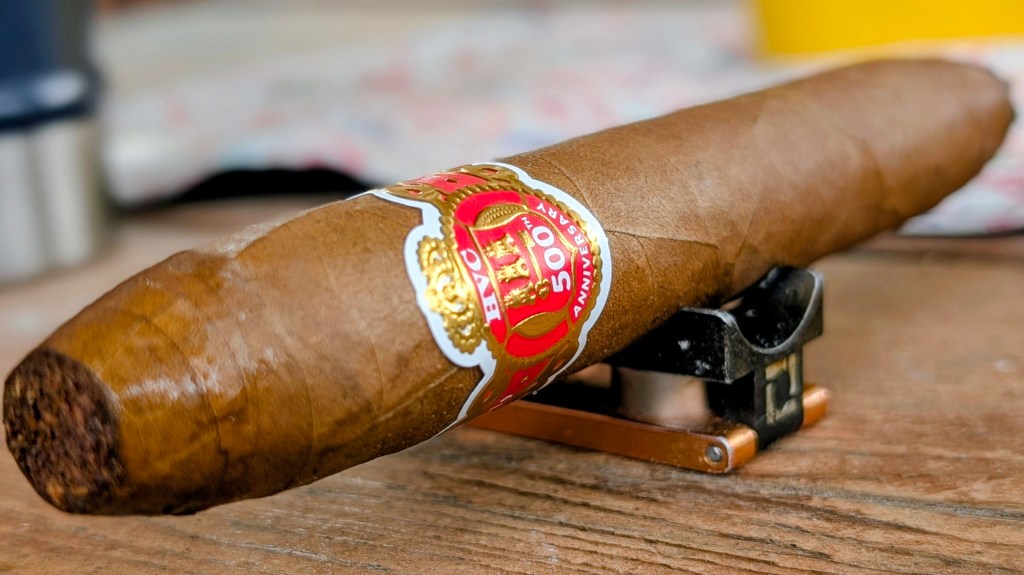
Wrapper: Corojo ’99 (Jalapa, Nicaragua)
Binder: Nicaragua (Jalapa)
Filler: Nicaragua (Jalapa, Estelí — Criollo ’98, Corojo ’99)
Size: Salomón (7 1/4 x 54-58 taper)
Strength: Medium
Price: ~$16.00–$18.00 (varies by retailer)
Date Released: 2019 (500th Anniversary of Havana)
Factory/Blender: TABSA (Aganorsa) / Reinier Lorenzo
Experience Rating: 96
For some reason, I’ve rarely connected with cigars produced by TABSA/Aganorsa. The cigars they produce are good. But except for the Aganorsa Leaf Supreme Leaf—when I can get it—the Signature, JFR, and Guardian of the Farm sticks have always felt a little unresolved to me.
That lack of resolution isn’t about construction or quality. It shows up in how those cigars carry themselves. They hold together. They behave correctly. But they stop short of saying something definitive. I finish them understanding what they are, without ever feeling like I’ve arrived anywhere.
The HVC 500th Anniversary breaks that pattern entirely.
It tells you who it is from the start. It doesn’t build toward identity. It begins with it.
It’s like sitting across from someone who’s been through it all—years of experience, mistakes, successes—and asking for advice because you recognize they’ve already lived through the questions you’re only beginning to ask. What you get in return is measured. Deliberate. Given in pieces. Each response lands with purpose. Each one gives you something to carry forward, and leaves enough unsaid to keep you engaged.
That’s how this cigar behaves.
It carries itself with that same sense of experience. It doesn’t rush. It doesn’t overextend. It speaks when it needs to and leaves space when it doesn’t.
It’s composed.
Even before it’s lit, that composure is already present. The wrapper gives off dry earth with a faint sweetness sitting just beneath it. The foot opens slightly—cinnamon roll, earth, hay—each note grounded and in place. There’s a softness to the aroma. No elbows out. Nothing pronounced.
On the cold draw, cedar, earth, and a sugary sweetness come through with clarity. It feels like the conversation has already begun before a word has been spoken.
On ignition, the cigar immediately stands up to greet me with coffee, cedar, toasted nuts, and the sweetness I found on the cold draw resolves into a classic Corojo sweetness, slightly citrusy and with a light spice. Within the first few puffs, coffee, earth, toasted nuts, white, and red pepper come together to form the core. Buttered popcorn appears to add some texture. Floral notes and cedar move into the foreground, but seem tethered to the foundation.
There is structure from the start. The cigar settles into itself and begins to move.
The composure isn’t incidental. It’s the identity.
And in a cigar marking the founding of Havana, that feels intentional.
As it moves through the first inch, the foundation becomes unmistakable. Earth holds the center. Coffee deepens. The toasted nuts detach and circle the core. Corojo sweetness begins to assert itself as a signal. It appears, recedes, and returns again—like a flag in the wind, visible and intentional, pointing toward something larger than itself.
It’s controlled. Composed. Nothing is rushed. Nothing is forced. It’s as if the cigar is already teaching me how to listen.
As it settles further, the profile fills in around that core. Floral notes, cedar, and citrus move through the foreground. The buttered popcorn softens into cream. The spice develops, gaining presence while remaining fully integrated. The movement is constant, yet contained.
The cigar behaves like that mentor because it never wastes energy. It doesn’t overwhelm you with everything it knows. It gives you exactly what you need at the moment you’re ready to receive it. Each part of the experience feels intentional. Each step builds on the last without ever needing to announce itself.
I lean in because I want to hear more.
And then it becomes clear. This is a Nicaraguan cigar that carries itself like a Cuban. The connection isn’t in flavor replication. It’s in behavior—composure, refinement, control. The cigar remains grounded while citrus moves through the profile, providing lift and creating that familiar brightness without altering the core.
It stays centered the entire time.
Around two inches in, the cigar shifts. Corojo sweetness becomes more visible, moving across the profile like a banner. Roasted nuts join it. An artichoke-like quality circles the core, adding a savory, vegetal dimension that reinforces the foundation.
The spice deepens and begins to move more clearly through the mid-palate. The cream holds. The cigar releases its stored energy in small, controlled doses.
That energy draws me in.
You want to follow it.
At the halfway point, the cigar reaches a sweet spot. Strength increases slightly, showing up as richness rather than weight. The core deepens. Spice carries the structure forward. Corojo sweetness remains present, joined by roasted walnuts and a bread-like quality—fresh, slightly yeasty, still warm.
The cigar is constantly moving. The changes are steady, controlled, and fully integrated into the whole. Everything arrives in place, does its job, and clears the way for what comes next.
It carries itself like someone who has spent a lifetime mastering their craft. The kind of person who makes something difficult look routine.
That composure and refinement create the effect. They hold everything so tightly together that the work disappears into the execution. You could sit with this cigar and think not much is happening because nothing is being pushed forward or separated for display.
You’d be wrong.
A lot is happening. It’s delivered with such control that it never needs to break the surface. The longer you stay with it, the more the depth behind that restraint begins to reveal itself.
Then the tone shifts again. The core takes on more density. Leather works its way in, adding structure without changing direction. The cigar shows what it’s capable of, then returns to its baseline with the same composure it has carried from the start.
That quiet confidence defines the experience.
In the final third, the profile tightens. Spice moves forward and takes the lead. Sweetness steps back and supports from the background. The earthy core remains intact, now joined by a more pronounced vegetal note that continues to ground the cigar.
Charred cedar appears and settles into place as if it had always been there, simply waiting to be noticed. A flinty bitterness joins the core, adding dimension while remaining fully integrated. A citrus element flickers in and out, reinforcing the lift.
Texture becomes creamier as the spice builds.
Strength rises to just shy of medium-plus and holds there. It stays exactly where it needs to be to support the profile without weighing it down.
Even at the end, the cigar maintains its composure.
At the nub, sweetness fades into the background and becomes ambient. The core intensifies without losing clarity. Coffee, steady throughout, deepens into espresso. Nothing breaks. Nothing muddies. The cigar holds its line all the way through.
It finishes the way it began—controlled, measured, intact.
And when it’s over, what stays with you isn’t any single component.
It’s the way it carried itself.
This is a cigar built on composure. It moves with discipline. It speaks with clarity. It delivers exactly what’s needed, when it’s needed, and leaves the rest alone.
Considering this marks the 500th anniversary of Havana, that makes perfect sense.
It doesn’t imitate Cuba.
It understands it.
This is one of the finest expressions of TABSA/Aganorsa production I’ve ever smoked. Unlike many of the cigars I’ve had from that factory, this one resolves into a complete identity. It doesn’t leave anything open-ended. It doesn’t rely on you to finish the thought. It carries itself all the way through and arrives exactly where it intends to.
That’s what separates it. Like the others, it carries composure and restraint. Here, they lead somewhere. They organize the experience instead of keeping it contained. The cigar doesn’t just behave correctly—it completes the idea. In doing so, it shows what TABSA is capable of when everything aligns.





Leave a comment