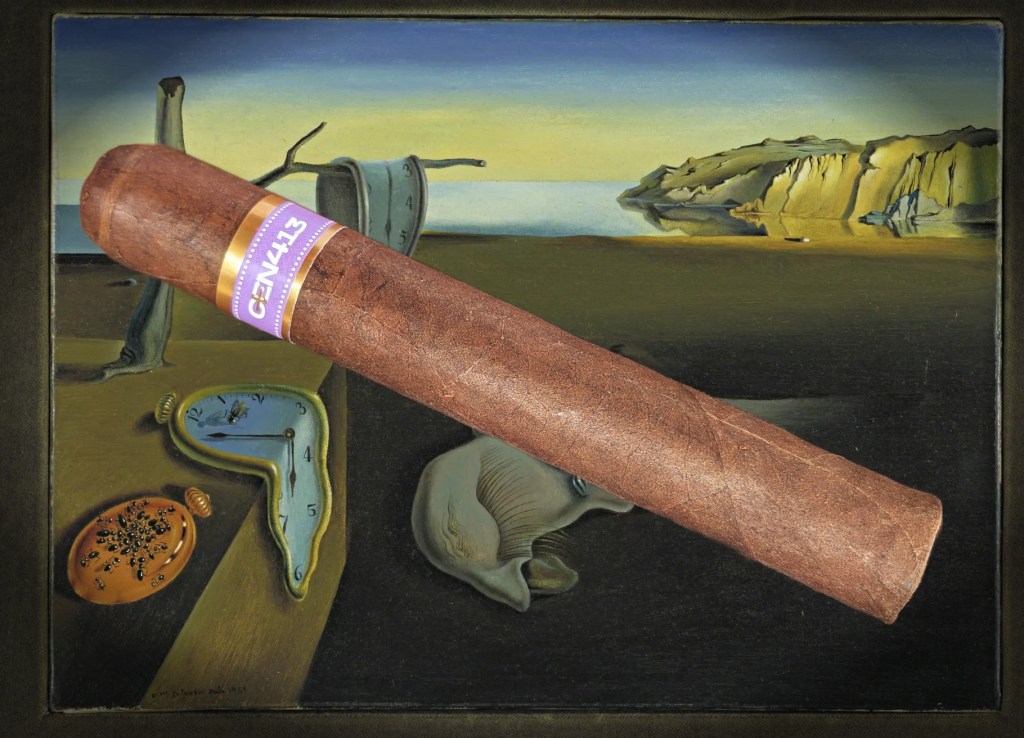
Where Flavor Ends and Interpretation Begins
This is a companion piece to the review I wrote for Katman. You can read it here. In that review, I kept the focus on the cigar and its dynamics, leaving out much of the broader commentary. This piece is meant to explore that side—what the cigar is doing, and how it was constructed to do it.
When I first sat down with the GEN 413, I didn’t understand it.
That wasn’t unusual—I’ve had cigars that took time to open up, cigars that needed a second pass. But this felt different. Even after several cigars, it still resisted definition.
There were flavors, sure. Earth, umami, a restrained sweetness, flashes of spice. But nothing arranged itself into something I could point to and say, that’s what this is. It felt incomplete. Unresolved.
And yet, I kept coming back to it.
Part of me wondered if I was falling into Einstein’s definition of insanity—returning to the same thing, expecting a different result. But it didn’t feel like that. This cigar sat so far outside the rest of the Definition portfolio that it kept pulling me back. I felt like I was missing something.
It wasn’t until I revisited it with a different frame of mind that things started to clarify—not because the cigar had changed, but because I had.
That realization is the entire experience.
The GEN 413 was described as being designed to prompt smokers to question the root of their identity, their beliefs, and how they define what they encounter. That’s easy to read as marketing language. But in this case, it isn’t. That idea is embedded in the cigar itself.
Most cigars present an identity early. They introduce themselves clearly—this is what I am, this is how I’ll develop, this is where I’m going. Even when they evolve, that identity tends to remain intact. The GEN 413 chose a different path. Its identity isn’t contained in its flavor profile.
It’s in its movement.
It refuses to resolve into something immediately recognizable. It offers information, but not a conclusion. It asks you to stay with it longer than you might normally, and in doing so, shifts the experience from identification to interpretation.
This is where Luciano Meirelles’s approach to blending becomes important.
Luciano doesn’t seem to build cigars around loud, declarative flavor profiles. Instead, his focus appears to be on structure—how the cigar holds together, how it transitions, how it carries itself over time. He’s spoken about how his synesthesia informs that process, shaping the way he perceives and constructs those relationships.
With the GEN 413, that seems to translate into a kind of restraint. Nothing stands out on its own. Every component feels like it exists in relation to something else. That kind of blending doesn’t reward quick reads.
It rewards attention.
Here, that restraint is pushed even further. The cigar doesn’t express itself immediately. It controls when and how that expression becomes clear.
And that’s a very different objective than simply delivering a linear sequence of flavors.
If you look at the cigar from a construction standpoint, the experience starts to make more sense. The combination of tobaccos isn’t arranged to create contrast—it’s arranged to maintain equilibrium.
The Nicaraguan fillers, including the use of Chincagre, contribute to that core of earth, umami, and minerality. They provide depth, but not dominance. Nothing jumps out ahead of the rest. The San Andrés binder reinforces that grounding, adding weight to the core without pushing the profile in a new direction. And the Ecuadorian Broadleaf hybrid wrapper introduces sweetness and structure, but in a restrained way. It doesn’t sit on top of the profile. It integrates into it.
The result is a cigar where everything is present, but nothing defines the experience early on. That’s why the cigar feels the way it does.
It isn’t building toward complexity in the traditional sense. It isn’t layering new flavors on top of each other as it progresses. Instead, it refines what’s already there. As the cigar moves forward, the edges sharpen. The relationships between components become more defined. What initially felt indistinct becomes clearer—not because anything new has been introduced, but because the structure allows it to come into focus.
It’s a shift from accumulation to clarity—and that shift changes how you experience it.
At a certain point, it becomes obvious that the cigar hasn’t changed. It was built this way from the beginning. What changed was my ability to perceive it.
That’s what makes the GEN 413 different. It doesn’t hand you an identity. It asks you to reconsider how you arrive at one. And in doing so, it becomes less about what the cigar is and more about how you engage with it. Once I realized that, it changed everything. It compelled me to write this companion piece.
We’re used to looking at cigars through a single lens—flavor, how it presents, how it develops, how it declares itself—with the implicit assumption that a cigar will offer up a bevy of flavors. That’s how we’ve been trained to understand them.
With the GEN 413, that lens doesn’t work. That feels intentional, aligning with Definition’s goal of prompting smokers to question how they define what they encounter.
And the proof is in the profile itself. It’s sparse. As I mentioned in the review, taken on flavor alone, it would be easy to dismiss the cigar—but that would miss the point. By limiting the number of flavors, it forces you to look elsewhere to understand its identity.
That’s where the challenge lies—and, frankly, what I find most compelling about the experience. The cigar makes it clear that your usual frame of reference doesn’t apply. But it doesn’t offer a replacement. You have to arrive at that on your own.
For me, the GEN 413’s identity revealed itself through its movement. But that may not be the case for every smoker. It reminds me of that scene in Coming to America where Eddie Murphy asks his betrothed, “What do you like?” and she replies, “Whatever you like.”
The answer is there—but it only reflects what you bring to it.
That’s a risky proposition from a product standpoint. It asks the smoker to stay engaged, to pay attention throughout, rather than relying on the cigar to declare itself. I’m not sure how many smokers are willing to make that kind of investment.
But if they are, it resolves—what that ultimately becomes depends on how they engage with it. For me, it was clarity that revealed itself through its progression. For someone else, it may be something entirely different.
And that’s the beauty of the GEN 413.






Leave a comment