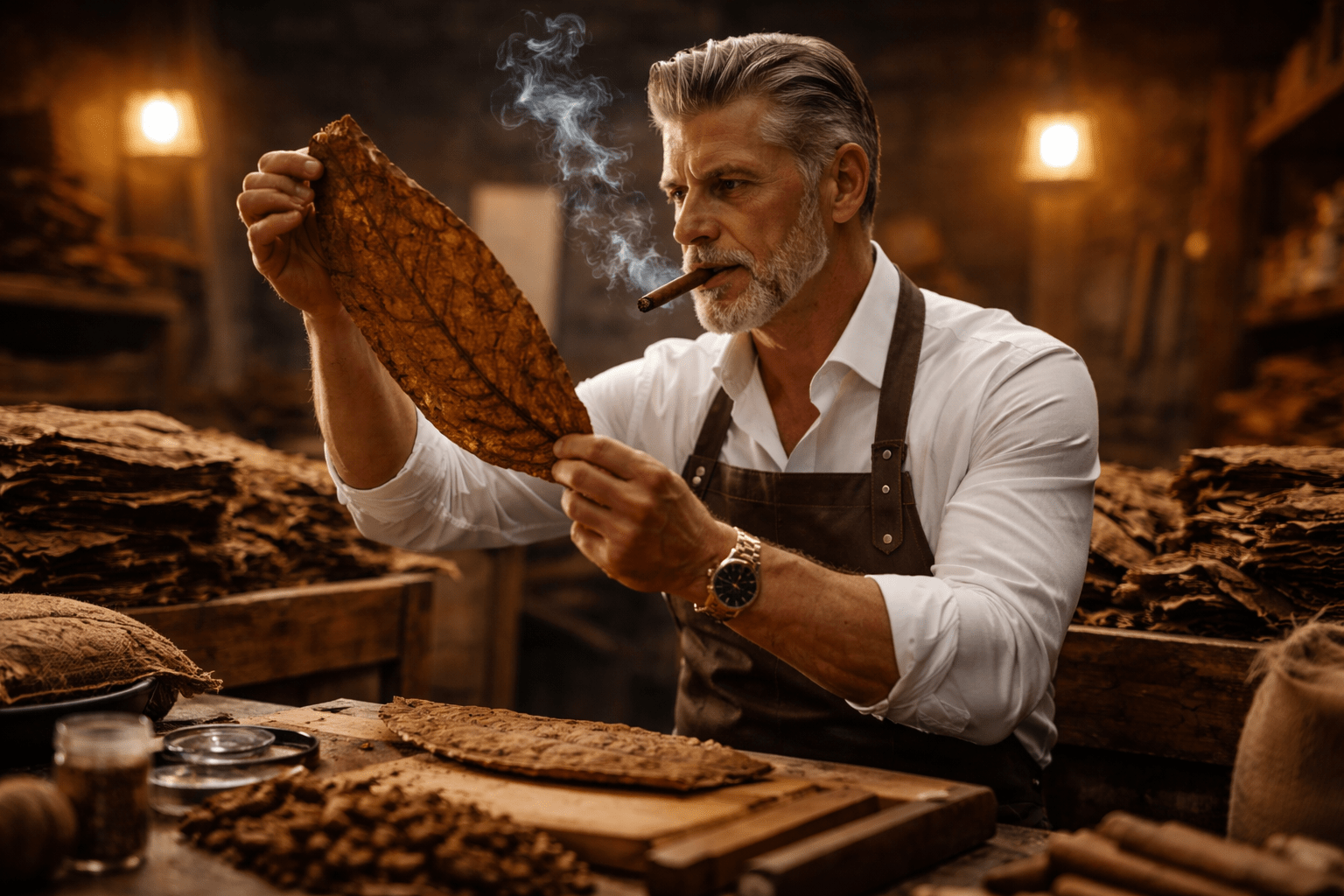
In addition to cigars and a handful of other obsessions, I’ve always loved to cook—and, obviously, to eat. I’m not formally trained, but gourmet cooking and technique have been a quiet through‑line in my life for as long as I can remember. I’ve always been fascinated by chefs from around the world and the way they use technique, ingredients, and point of view to create something unmistakably theirs.
That lens—watching how chefs build identity through craft—ended up shaping how I see cigars. Because somewhere along the way, the cigar world started to look a lot like the food world did in the 90s and early 2000s, when chefs stopped being anonymous technicians and became cultural figures with recognizable styles and fingerprints. Cigars weren’t always built for that kind of authorship, but here we are: the blender has become the center of gravity.
Today’s smoker can read intention. They can sense authorship. They can tell when a cigar has a point of view behind it. And that shift didn’t happen loudly, but it changed everything.
If you’ve smoked long enough, you’ve felt this shift even if you never named it.
When the Factory Was the Star
For most of cigar history, the factory was the brand. A single factory might produce for twenty different companies, and nobody blinked. Consumers didn’t ask who blended the cigar because the question didn’t exist. The factory was the identity. The goal was consistency, volume, and lineage. The maker stayed invisible.
It was industrial baking, not cuisine—reliable, structured, and anonymous.
When Smokers Started Spotting Fingerprints
The turning point came when smokers got curious—and connected. Early forums, review sites, and blogs created a more informed audience. People compared notes. They started noticing patterns:
- “This tastes like Pepín.”
- “This feels like Kelner.”
- “This has Saka’s structure.”
- “This is definitely AJ.”
- “This has that Fuente sweetness.”
Once you can identify a blender by taste alone, the blender stops being a background technician and becomes an author. Cigars shifted from products to authored objects. The industry didn’t announce the change, but it was already underway.
The Old Guard: The First Recognizable Authors
By the late 90s and early 2000s, a group of blenders emerged whose names carried weight on their own. They weren’t “celebrity blenders” in the modern sense, but they were the first generation whose signatures were recognizable. Their work had structure, discipline, and lineage. They built the grammar—the classical canon—that the next generation would eventually bend, stretch, and remix.
The Old Guard
Here’s the Old Guard mapped to their culinary equivalents—chefs who defined classical mastery before the rise of modernist cuisine:
| Blender (Brand) | Chef (Restaurant) | Unifying Creative Style |
|---|---|---|
| Don Pepín García (My Father / DPG) | Joël Robuchon (L’Atelier de Joël Robuchon) | Classical discipline; technical mastery; precision-first craft |
| AJ Fernandez (AJF) | Paul Bocuse (Auberge du Pont de Collonges) | Modernized classicism; reproducible excellence; disciplined evolution |
| Eladio Díaz (Davidoff) | Auguste Escoffier (Ritz Paris) | Refined balance; aromatic clarity; codified elegance |
| Carlito Fuente (Arturo Fuente / OpusX) | Alain Ducasse (Plaza Athénée) | Heritage-driven refinement; ceremonial classicism; legacy stewardship |
| Ernesto Pérez-Carrillo (EPC) | Jacques Pépin (Howard-Johnson, culinary author) | Clean fundamentals; honest craft; classical technique without ornament |
| Litto Gomez (LFD) | Thomas Keller (The French Laundry) | Controlled intensity; immaculate execution; disciplined power |
| Hendrik Kelner Sr. (Davidoff / Kelner family) | André Soltner (Lutèce) | Restraint; aromatic precision; quiet, meticulous refinement |
| Jochy Blanco (Tabacalera Palma) | Michel Guérard (Les Prés d’Eugénie) | Understated elegance; fermentation clarity; soft-spoken mastery |
| Jorge Padrón (Padrón) | Daniel Boulud (Restaurant Daniel) | Stoic consistency; structural purity; unwavering identity |
This is the Bocuse/Robuchon/Escoffier era of cigars: mastery first, personality second.
The New School: The Modern Creative Class
Then came the generation that treated cigars like cuisine—personal, expressive, and unmistakably authored. They didn’t inherit the old rules; they built new ones. They brought subculture, design, narrative, and personal philosophy into the craft. They treated factories like kitchens and tobacco like ingredients. They made cigars legible as creative work.
The New School
Here’s the New School mapped to the chefs who reshaped modern cuisine—identity‑driven, culturally expressive, and unmistakably personal:
| Blender (Brand) | Chef (Restaurant) | Unifying Creative Style |
|---|---|---|
| Nick Melillo (Foundation) | José Andrés (Jaleo / WCK) | Cultural ambassador; land-rooted humanism; farmer-first generosity |
| Pete Johnson (Tatuaje / L’Atelier) | Anthony Bourdain (Les Halles) | Subculture identity; noir classicism; anti-prestige cultural voice |
| Steve Saka (DTT) | Ferran Adrià (elBulli) | Technical disruption; engineered creativity; rule-rewriting systems thinker |
| Matt Booth (Room101) | René Redzepi (Noma) | Hyper‑conceptual modernism; emotional surrealism; experimental identity; constant reinvention. |
| Dion Giolito (Illusione) | Masa Takayama (Masa) | Purist minimalism; quiet mastery; ingredient-forward restraint |
| Kyle Gellis (Warped) | Massimo Bottura (Osteria Francescana) | Aesthetic modernism; conceptual reinterpretation; youthful refinement |
| Robert Caldwell (Caldwell) | Andoni Luis Aduriz (Mugaritz) | Bohemian experimentation; conceptual provocation; intentional imperfection |
| Noel Rojas (Rojas Cigars) | Enrique Olvera (Pujol) | Cultural preservation; micro-craft heritage; regional storytelling |
| Esteban Disla (Nica Sueño) | Alex Atala (D.O.M.) | Industrial modernism; muscular precision; material-driven craft |
| Skip Martin (RoMa Craft) | David Chang (Momofuku) | Punk-rock anti-prestige; fermentation-theory brain; working-class disruption |
| Néstor Andrés Plasencia (Plasencia Cigars) | Sean Brock (Audrey) | Tradition‑rooted craft; ingredient obsession; subtle modernization within the canon |
This group turned blending into authorship—and authorship into culture.
And adding Néstor Andrés Plasencia → Sean Brock matters. Plasencia isn’t just the head of a factory empire; he’s a modern, authored voice with a recognizable creative identity. He respects the lineage, honors the raw materials, and adds a subtle personal twist that modernizes the work without turning it into a gimmick. Like Sean Brock, that’s exactly how Plasencia blends: grounded in heritage, disciplined in execution, and unmistakably his. Leaving Plasencia out would be like ordering a pizza without cheese or sauce — technically possible, but it misses the entire point of the thing.
What the Celebrity Blender Era Actually Means
The blender is now the brand. Factories are kitchens. Blenders are chefs. Smokers follow people, not companies. Identity is the new organizing principle.
The cigar world now mirrors the culinary world’s shift from classical houses to celebrity chefs. The Old Guard built the foundation. The New School built the culture. And for the first time, the maker—not the factory, not the label—is the story.
This is the celebrity blender era.
The Future Belongs to the People Who Sign Their Work
The industry has crossed a line it won’t walk back. The Old Guard established the grammar. The New School carries the torch. And the blender’s worldview—once invisible—is now the center of gravity.
Cigars have finally matured into a creative medium. Intention matters. Authorship matters. And the people who sign their work are the ones shaping where the industry goes next.
Discover more from Unco B's Stogie Diary
Subscribe to get the latest posts sent to your email.
