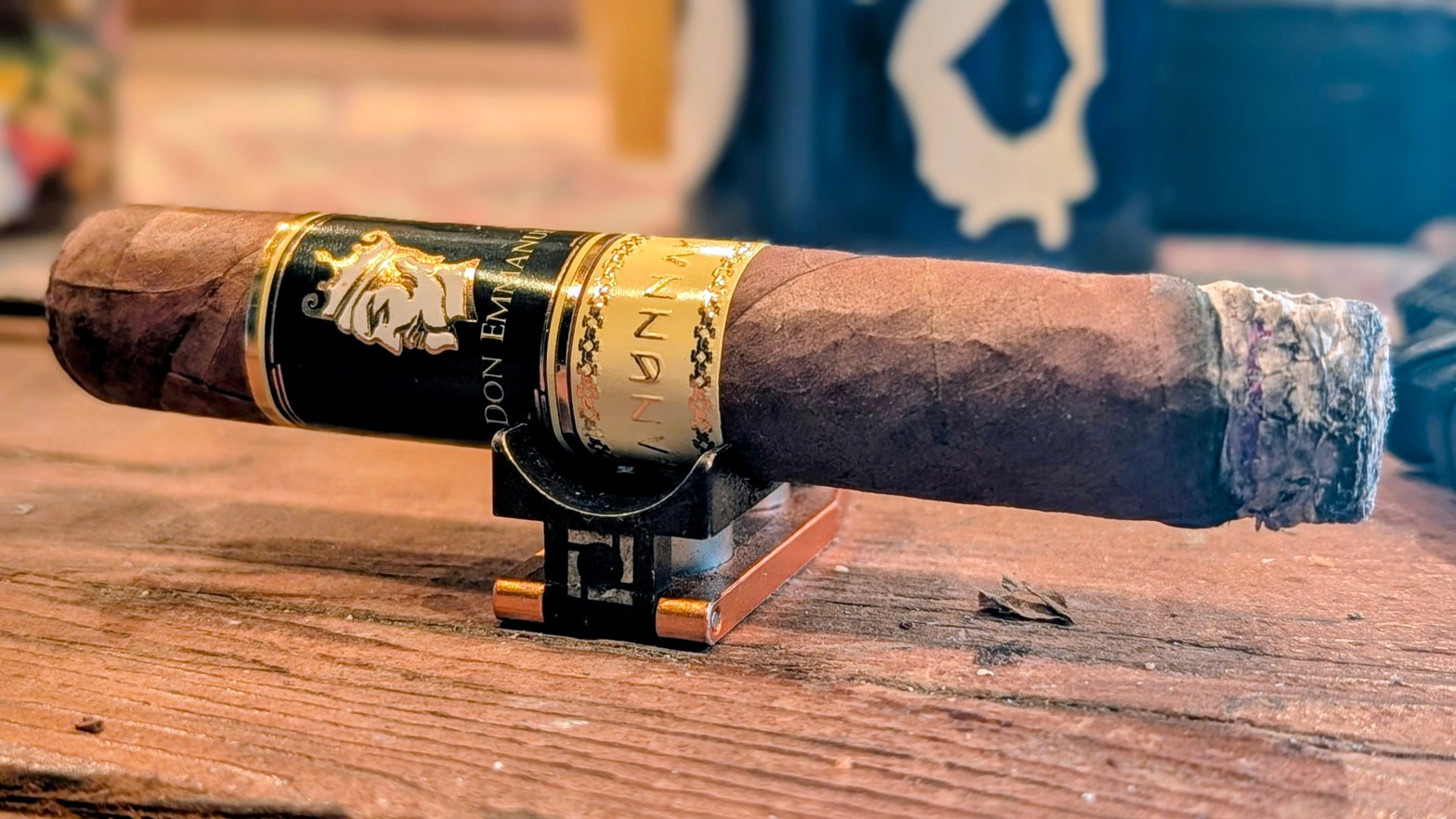
Wrapper: Dominican Republic
Binder: Mexican San Andrés
Filler: Undisclosed Mix of Five Different Dominican Tobacco
Size 5 X 50 (Robusto)
Strength: Medium/Medium+
Price: $10-$15
Date Released: Spring 2024
Factory/Blender: Tabacalera Díaz Cabrera/Eladio Díaz
Experience Rating: 98*
Some cigars are worth revisiting because they’re special. Others are worth revisiting because they change. The Don Emmanuel Anunnaki Ki falls into a third, much rarer category: a cigar that doesn’t just evolve with time, but redefines itself.
When I first reviewed the cigar at two months of age, I was blown away by its complexity. It performed at the level of the finest Dominican cigars I’ve ever had from Fuente or Davidoff — refined, aromatic, and built on the expressive flavor profile expected from top‑tier Dominican cigars. It was a box of surprises, shifting from puff to puff with the kind of controlled volatility you only get from elite Dominican leaf. And that wasn’t an accident. The Ki was blended by Eladio Díaz at his Tabacalera Díaz Cabrera factory, a small‑batch workshop where every cigar is built with boutique precision and Davidoff‑grade fermentation discipline, and every step of production is personally overseen by Eladio himself.
With a year of age on it, imagine my surprise when I smoked one yesterday (and again today to confirm) and found that the volatility was gone. The cigar that once moved like a live wire now behaved like a calibrated instrument. The entire profile had tightened into something sequential and engineered — almost mechanical in its progression. The Ki didn’t mellow; it focused. It didn’t soften; it organized. It aged into a cigar with a clear identity and a defined structure, and that shift alone made it worth reviewing again.

Imagine a vehicle assembly line: it starts with a chassis, then, station by station, more parts are added until the build is complete. That’s what the Ki smoked like — each section locking into place with a kind of engineered sequence. A year ago, the cigar was a funhouse full of unexpected turns; now it moved with the steady, deliberate feel of assembling a luxury sedan.
And that shift sets the stage for the flavor progression, because the Ki no longer reveals itself all at once. It builds. It advances. It moves through defined phases, each one adding structure to the last.
A year later, the Ki feels like it has been rebuilt from the inside out. The prelight is surprisingly quiet—saltine crackers, hay, a grassy dryness that almost suggests the cigar has lost something. But that impression disappears the moment I light the cigar. The ignition is clean and confident: medium strength, black coffee rising immediately, a touch of cedar, and a quick flash of red pepper. The cigar starts building itself with purpose.
The first half behaves like an assembly line. Instead of drifting sweetness, the cigar establishes a chassis: light black coffee, a gentle but mouth‑coating cayenne, a flinty mineral edge with a light, sugary sweetness, toasted hazelnut, and a touch of unsweet vanilla extract. These aren’t decorative flavors—they’re structural components. The burn line is razor‑straight, the nicotine is essentially absent, and the motion is linear. The cigar is assembling its frame, installing its engine, bolting down its drivetrain. It’s all business.
At the halfway point, the cigar rolls to the next station. The base reorganizes itself. The black coffee moves to the back and joins the hazelnut and flint. The cayenne, which had been a steady presence, suddenly steps aside, and the sugary sweetness detaches from the core and becomes a background hum. This clearing of space allows the cigar to introduce a new layer of complexity—fruity sweetness, cream, roasted nuts, shortbread, graham cracker, and an orange-citrus twang. These flavors don’t drift in; they’re added deliberately, like trim pieces being installed on a car that finally has its body panels in place.
The final third feels like the paint booth. The structure is complete, and the cigar focuses on finishing touches. Cream returns, but now it sits on top of a more assertive base. Malt reappears, but without the softness it had in the young version. Black pepper sharpens. Leather and charred oak step forward. The intensity rises, and the red pepper that had quieted earlier comes back with purpose. The cigar stops evolving and starts finalizing. By the nub, the strength has climbed to medium‑plus, and the motion has settled into a steady, confident hum. The machine is finished.
A cigar that behaves this way isn’t an accident. It’s the product of real intention—of a blender who understands how to build structure, how to control motion, and how to let a cigar age into its own identity. The Ki’s transformation from a volatile, high‑energy funhouse to a disciplined, sequential machine speaks to Eladio Díaz’s approach: not chasing fireworks, but engineering a profile that reveals its design over time. Most cigars drift as they age, but this one tightened and found definition instead. The Ki didn’t just hold up after a year—it proved that its blueprint was intentional from the start.
Total smoke time: 1:40
The cigar keeps its original rating of 98. I must admit that I had my doubts it would hold this score when I lit it up. But as I got deeper into the progression, I realized that the cigar had completely transformed from what it was originally, and that got me excited enough to give it a new review.
Discover more from Unco B's Stogie Diary
Subscribe to get the latest posts sent to your email.
