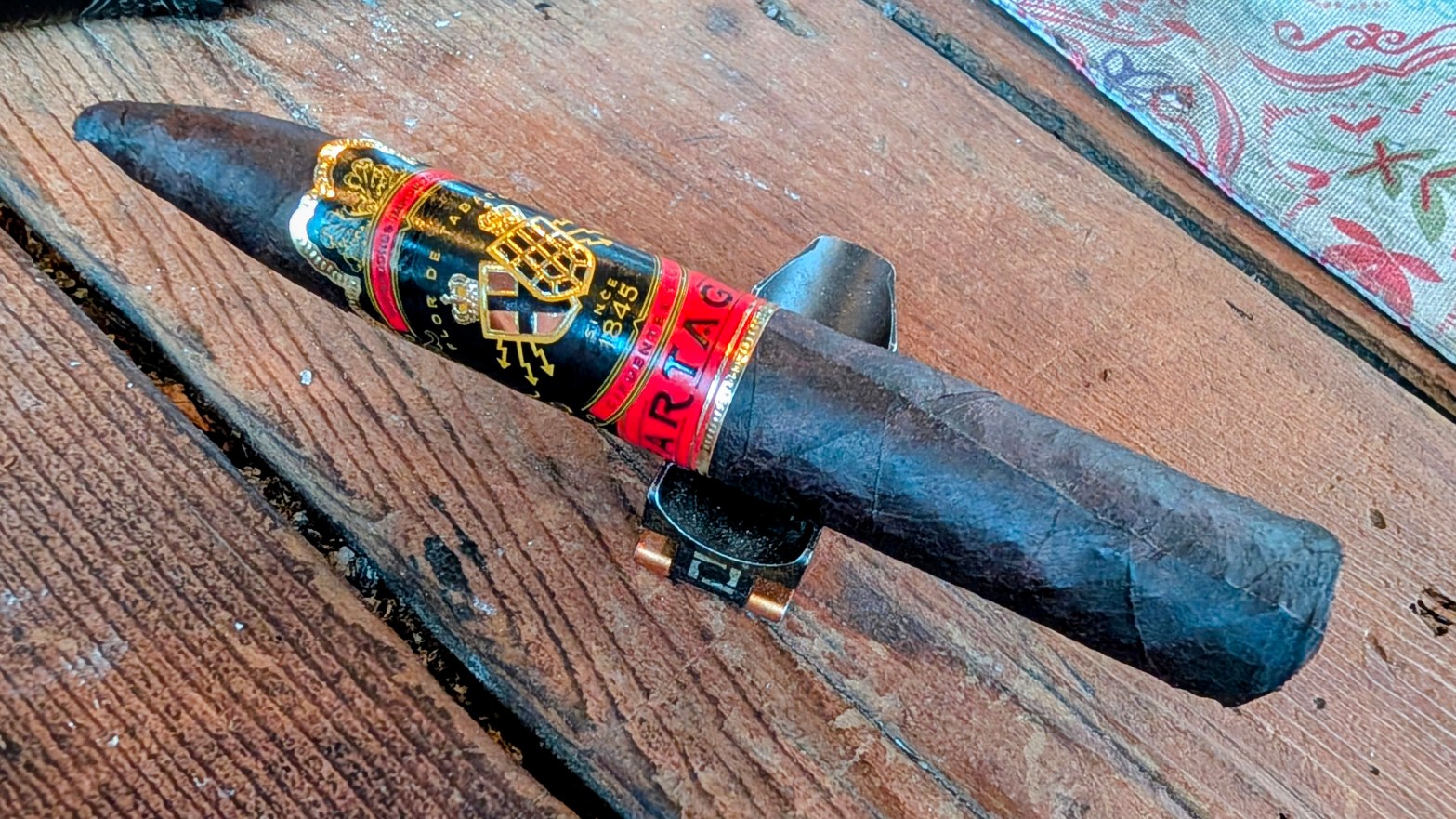
Purchased: 2 Singles Piramides (6 X 60)
Price: $14.95 each
Store: Cigar Palace, Santa Cruz, CA
Buy Again: Yes
Box Worthy: Yes
Experience Rating: 97
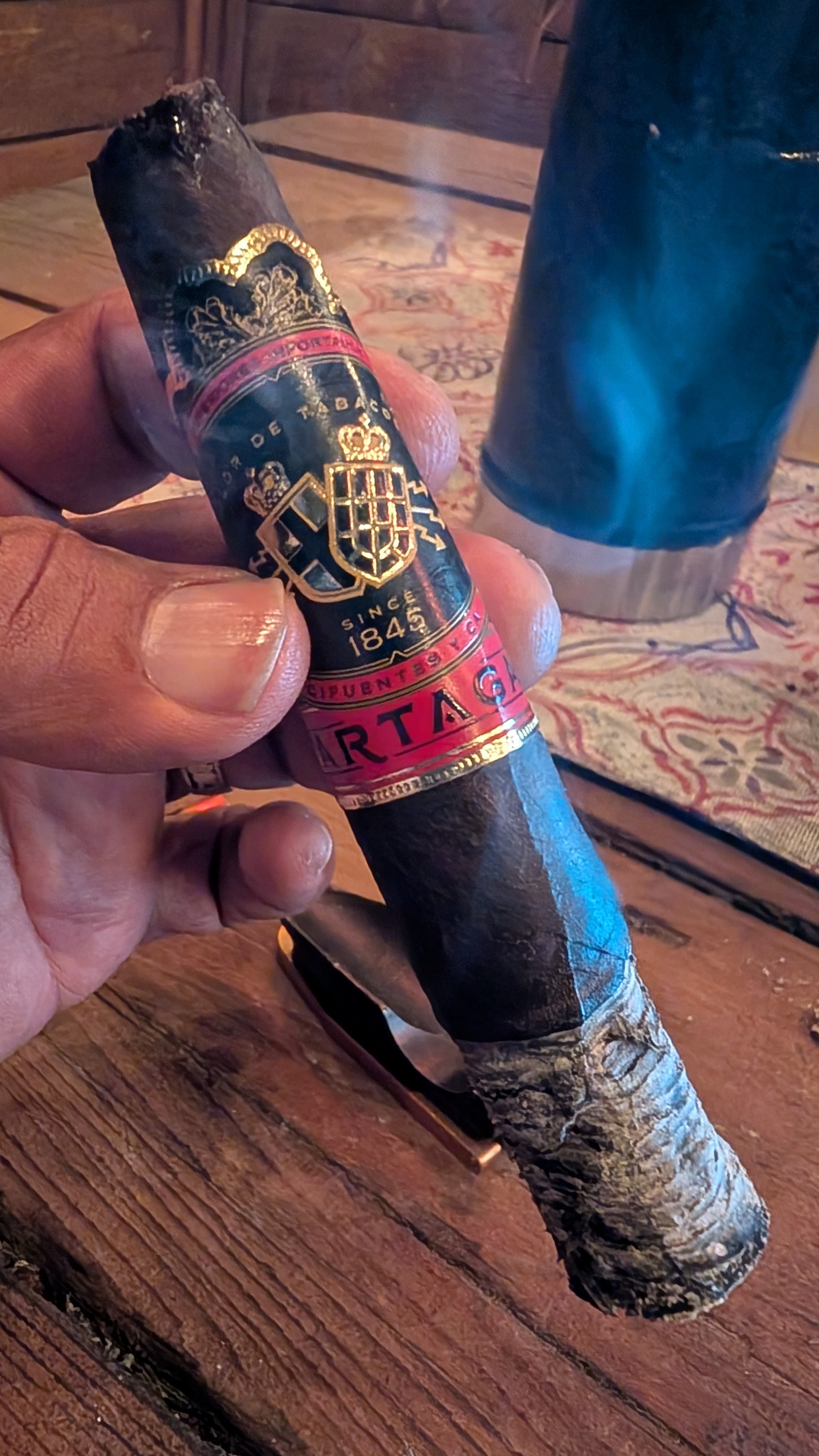
I’ve never been a big jazz guy — I’ve always lived in the ’60s, ’70s, and ’80s classic rock world — but one of my all‑time favorite albums, regardless of genre, is Kind of Blue by Miles Davis. It’s the rare jazz record that cuts across everything I normally listen to, and it’s no surprise so many people consider it one of the greatest albums ever recorded. It’s also the album that finally let me hear modal theory — not just understand it, but recognize its sound.
My favorite track on the album is Blue in Green. It’s a ballad with a slow tempo, but if you listen closely, it carries a quiet, continuous motion and energy — a depth and complexity that can slip past you if you’re not paying attention. And it’s exactly how I feel about the Partagas Black Label.
I love wandering into cigar stores in different towns and stumbling onto cigars I’ve never smoked, sometimes ones I didn’t even know existed. That’s exactly how I found the Black Label. I was in a small shop called Cigar Palace in Santa Cruz, perusing their humidor, when my eyes landed on a box of Black Labels. I did a double-take when I saw them. The wrappers were almost ink‑dark, and the shape pulled me in. I picked one up, turned it in my hand, and knew immediately I was walking out with a couple.
Before I smoked one, I glanced through a few reviews to get a sense of how people were framing it. I wasn’t concerned about being influenced; most cigar reviews tend to operate on a narrow axis of flavor‑note bookkeeping and simple strength declarations. They’re useful to me as a kind of ambient context, nothing more. And across nearly all of them, the same point surfaced: the Black Label is strong.
In fact, most of the reviews — and even retail descriptions — led with this trait. But once I got a few puffs into it, it became immediately clear to me that the Black Label has far more to offer than sheer strength. It is a strong cigar, to be sure, but it’s also remarkably complex in both structure and flavor architecture. And the kicker is its smooth delivery, and that’s what brought Blue in Green to mind about halfway through my first cigar.
And that song is the perfect frame for understanding this cigar because, like modal jazz, it establishes a central theme and then riffs on it through a series of variations. The Black Label follows the same pattern: a clear, deliberate core, and then a sequence of beautifully shaped riffs that expand, deepen, and re‑color that theme. In this case, those variations are extraordinary.
Like Miles Davis assembling his ensemble (say that three times fast), let’s look at the leaf stats:
Wrapper: USA CT Broadleaf (Medio Tiempo priming)
Binder: Dominican La Vega Especial
Filler: Dominican Piloto Cubano, Nicaraguan Ligero
When I saw that the wrapper used the medio tiempo priming, I immediately paid attention. I’ve only encountered this priming once before, in the La Gloria Cubana Medio Tiempo, which uses that priming on its Ecuadorian Sumatra wrapper. Medio tiempo appears only when two additional leaves sprout above the highest priming, allowing them to absorb the most sunlight and nutrients, which is why their flavor becomes so unusually concentrated. Only a small fraction of plants ever produce them, and that scarcity alone makes the leaf compelling.
So when I realized the Black Label was using Connecticut Broadleaf taken from the same priming, my interest sharpened. Broadleaf already carries density, sweetness, and a naturally high oil content; medio tiempo intensifies all of that. It told me immediately that I was in for something far more compelling than strength alone — something with depth, structure, and that quiet internal motion I associate with Blue in Green.
Just as in Miles’ ensemble, the other leaves play essential roles. The La Vega Especial keeps the architecture intact, functioning like the rhythm section of Paul Chambers and Jimmy Cobb — steady, disciplined, and foundational. The Piloto Cubano and ligero bring the depth, color, and upward motion, the blend’s equivalent of Coltrane’s and Evans’ solos.
The Black Label, like Blue in Green, begins in a measured, almost understated way, laying down a dark, subtle foundation of cocoa, black pepper, and espresso, like the same quiet groundwork Bill Evans sets with his opening chords, supported by Paul Chambers’ sparse bass line and Jimmy Cobb’s feather-light brush work. Then, like Miles setting the emotional core of the song, a pronounced but never overpowering layer of fruity sweetness, light cayenne, and roasted nuts rises through the profile with clarity and intention, forming the spine around which the rest of the cigar will develop.
After that, brighter, sharper notes begin to appear — green‑apple candy brightness, a flicker of black pepper, sharp mineral streaks, even a thin thread of black licorice — all of them adding tension and forward movement, the way Coltrane leans into the harmony without disturbing the calm surface.
Around this, the softer tones drift in: cedar, oak, vanilla cream, cocoa powder, dark chocolate — the Bill Evans colors that deepen the space and give the cigar its impressionistic shading. Eventually, the profile circles back to the core trio of roasted nuts, fruity sweetness, and cayenne spice, the cigar’s equivalent of Miles returning to the motif.
And beneath it all, almost invisible but essential, are the leather undertones, the baking‑spice flickers, and the steady warmth of the nutty base — the cigar’s version of Paul Chambers’ sparse bass line and Jimmy Cobb’s brushwork, the subtle pulse that keeps everything moving forward even when the surface feels perfectly still.
Over the course of its progression, the cigar doesn’t intensify into a single, flattened mass. Instead, much like Blue in Green, it deepens into clarity, the profile remaining intact even as the internal motion grows more pronounced.
As it moves into the final stretch, the Black Label doesn’t collapse under its own weight or become muddy. Instead, the core motif becomes more defined. The fruity sweetness moves into a darker register, almost like molasses. The cayenne threads itself more tightly through the profile, and the roasted-nut holds everything in place. And much like Blue in Green, the cigar resolves not by changing direction, but by revealing the full shape of the theme.
Strong? Yes. But the cigar’s true character lies in everything that follows — the depth, the motion, and the clarity that strength simply sets in motion.
Total smoke time: 1:35
Discover more from Unco B's Stogie Diary
Subscribe to get the latest posts sent to your email.
